Banner
    How Planes Fly Or How Polarized Debates Are Wrong Versus Wrong
    By Sascha Vongehr | December 27th 2010 06:07 AM | 33 comments | Print | E-mail | Track Comments
    About Sascha

    Dr. Sascha Vongehr [风洒沙] studied phil/math/chem/phys in Germany, obtained a BSc in theoretical physics (electro-mag) & MSc (stringtheory)...

    View Sascha's Profile

    The old discussion about how an airplane, that is many tons of steel, can keep staying supported in mere air, is a perfect example for how discussions way too often polarize into two camps with both sides being wrong. Little headway is possible once any attempt at resolution is portrayed as either a dangerous accommodating that leads onto a slippery slope toward defeat, or worse belonging to the other, the evil side. There are too many such issues, not only in politics or largely yet to be explored scientific fields like climatology. Even in known physics, for instance in special relativity, there are these polarized debates where both sides are wrong. The theories are well known and their domains of applicability are well delimited by both mathematics and experiment. It is the “human condition” which obstructs progress.


    The issue with the airplane is according to one side of the debate fully explained by the fact that the airplane’s wings have a certain, asymmetric shape: The top, called the “upper camber”, is thicker than the bottom or “lower camber”. The magic of Bernoulli’s principle and related equations of fluid flow make it so that the shape is getting some force directed towards the top side when slicing through a medium like air. This explanation has two problems:
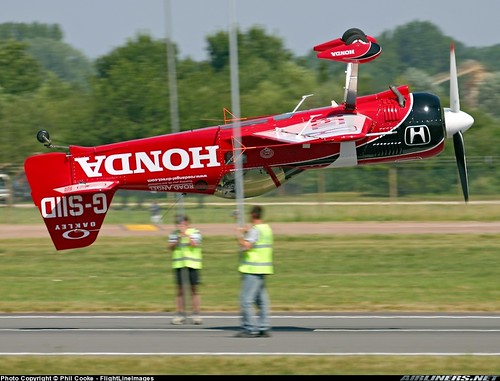


    One (1) is that aerobatic planes can fly upside down, and I do not mean a quick loop, but flying along a straight horizontal path while being upside down. This is already proof enough for that the traditional ‘Bernoulli-Magic Position’ cannot be the full story.


    The second problem (2) is the usual ‘explanation’ that will be provided if the student is not satisfied with magic. It is said that because the shape of the wing is curved towards the top, the air has to move faster along the top than it needs to flow along the bottom, namely in order to get all the way around the top or respectively the bottom. Therefore a kind of vacuum results which pulls the wing to the top.
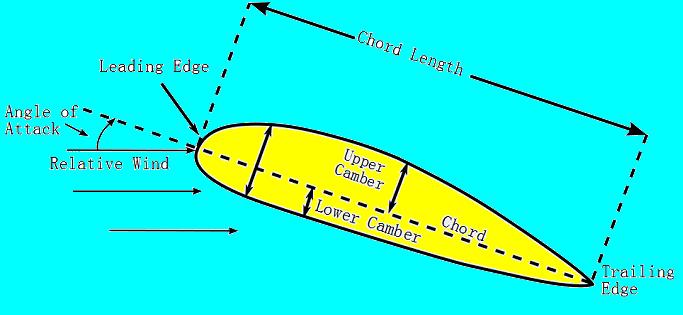

    This “explanation” is not satisfying for at least three reasons: (2a) Vacuum does not “suck”. Fundamentally it is always the gas particles that interact, and they can only collide; they always push, never pull. If they are faster, they collide even more violently and push yet more. The only act they can perform on the top of the wing is pushing down on it!


    Next caveat (2b): The higher top presents a larger cross section to the oncoming air and should be expected to force more air around the top than the relatively flat bottom of the wing forces around the bottom. The bottom gives the air much less of a head-on collision. What about this force pushing more air going over the top than under the bottom in the first place? If you want to have more air going up, you need to somehow push all the air particles up, which needs an upwards force, say exerted by the leading edge of the wing. The wing is in turn pushed down.


    Moreover (2c): What makes the top air go faster? Who accelerates the molecules? To make the top air go faster, a lay person will likely only see one way, namely you have to squeeze it between the wing and the air in the atmosphere yet higher above it, since there is no ceiling. It shoots out through the middle like toothpaste out of a squeezed tube. By the way – this is kind of what happens in the Venturi effect which is without fail mentioned by the ‘Bernoulli Magicians’. In other words, there is yet another force that pushes the wing down.

    So there is no upwards force that most undergraduate students even in physics could easily spot, but three forces that all ensure the plane never leaves the tarmac plus airplanes flying upside down anyways. The traditional ‘Bernoulli-Magic Position’ is obviously untenable.


    The next time I will deconstruct the opposing team, the “Angle of Attack Party”.

    Comments

    rholley
    If you can banish the ju-ju from this domain, it will be much appreciated.  I’m looking forward to the second part.

    Mentioning the Venturi effect also reminds me of the Coandă effect.  And now to the following:
    Fundamentally it is always the gas particles that interact, and they can only collide; they always push, never pull. If they are faster, they collide even more violently and push yet more.
    I’m not sure that applies in this case.  If they are all moving together, this should not increase the pressure: according to my limited understanding, it’s the variance of their velocity that relates to the pressure, not their mean velocity, which in static air would be zero..


    Robert H. Olley Quondam Physics Department University of Reading England
    vongehr
    it’s the variance of their velocity that relates to the pressure, not their mean velocity, which in static air would be zero.
    You mean there is no air pressure if the wind stops blowing? My head explodes (literally). ;-)
    Sure you did not mean that, but anyways, pressure is always particles colliding. Fundamentally, there is no pressure but particles bumping about. The Coanda effect, Venturi, Bernoulli, ... all fail on the same grounds: The critical student looks at all the air and not just a certain part that happens to give a convenient solution. 'More air goes faster and thus you have a certain gain' is not far off from arguing for perpetual motion machines: "Look this part goes faster and so we gain energy". Yes, but how did it go faster in the first place? A critical student who encountered discussions about energy conservation (which mostly precede the air plane discussions) is acutely aware of the danger of partial descriptions and wants to look at all the parts involved. To give the magic an Italian sounding name ain't making the Perpetual Motion go round either.
    Hank
    Debates where both sides can be partially correct are a great analogy for politics and culture.   On plane wings themselves, I just tell people Bernoulli rules the upper surface and Newton's dynamic momentum transfer the lower.
    Want more no-nonsense, independent science? Buy Science Left Behind
    Johannes Koelman
    Count me in with the Circulation Party.
    vongehr
    The didactically worst of all alternatives: Circulation Magic. Your students will make planes with rotating cylinders for wings.
    Johannes Koelman
    Yes, that would be awesome. These backspin wings would also help them understand baseball.
    vongehr
    You mean 'misunderstand baseball'. All these magic solutions seem to work even with ideally smooth surfaces, with which the air cannot even know what direction the surface moves relative to it, let alone the velocity. All these magic solutions (Bernoulli, Coanda, circulation, ...) presuppose the effect that they purportedly explain. Thus they truly all belong to the 'circulation party', namely via circular argumentation.
    Hank
    As long as they are lightfoils/solar wings he may be okay.
    Want more no-nonsense, independent science? Buy Science Left Behind
    Johannes Koelman
    This 'backspin wing' plane did fly back in 1930:


    Ok, it did so only once, and crash landed. But it is the principle that counts. Any object that is capable of creating circulation (a regular airfoil, a flat piece of wood, a rotating cylinder, ...) can fly.

    Funny how Sascha invariably adds the word 'magic' to any explanation he doesn't like...
    Hank
    Wha...?  An opinionated person in science on the Internet?  

    While in principle you're right, I can't fly my barn door to Paris all that easily.   But I was mostly serious about a solar wing in space; the pressure in the K-J theorem being refraction pressure due to the difference in the refracted and reflected rays of light.
    Want more no-nonsense, independent science? Buy Science Left Behind
    vongehr
    1) I doubt the effect as little as I doubt curve balls in base ball - in fact I use those myself even more effectively in table tennis all the time.
    2) I do not add 'magic' to all explanations I do not like. Many 'explanations' are wrong without being magic. What makes Bernoulli/circulation etc magic is that they basically just say XYZ is so because XYC is the Exotic Name - effect. That does not explain anything. It is like my school teacher explaining how mitochondria can move in the cell: "They are the fundamental components of life."
    rholley


    And here’s the Coandă-1910, which was the first aircraft built with a turbine powerplant which compressed and heated air, and expelled it rearward for thrust. It was constructed by Romanian inventor Henri Coandă and exhibited by him at the Second International Aeronautical Exhibition in Paris in October 1910. In the 1950s, Coandă began to claim that this aircraft was the first jet, and that it flew once and crashed at the French Army airfield Issy-les-Moulineaux on the outskirts of Paris. Some aviation historians agreed, and some disputed his claim.

    (from ro.wikipedia.org)
    Robert H. Olley Quondam Physics Department University of Reading England
    SynapticNulship
    NASA's What is Lift site has some neat little interactive Java simulations:
    various objects with lift
    FoilSim III (more variables and test on both Earth and Mars)
    spinning ball (with RPM control)
    The online book "See How It Flies" by John Denker already debunked most, if not all, wrong explanations about flying. Enter www.av8n.com/how/ and take a look.
    Cheers,

    Its true, that most discussions way too often polarize into two camps with both sides being wrong and that It is the “human condition” which obstructs progress. We need more shades of grey and less black and white in all of these debates.

    Another silly polarized debate where both sides are wrong: people who think that using a person's name as shorthand for a physically real effect means exactly the same as saying it's magic vs. people who think that there is never more than one useful physical model for a single effect.

    Just because there is no "vacuum" near an airplane wing does not mean there is not negative pressure!

    vongehr
    means exactly the same as saying it's magic
    You are welcome to ask about what you did not understand.
    planes are not made of much steel, but they may have tons of it-- we all know that aluminum alloys are dominant with bits of magnesium and titanium---

    but overall, the discussionl sounds like religion and politics-- also how does one pronounce the boss's name when it is "Mr. Dumass?"

    vongehr
    Thanks - I must admit that having written "steel" is silly.
    the discussion sounds like religion and politics
    Well - it is, you are one of the few who got that. Does bad didactic diminish students' overall ability for critical thinking? Should we use 'explanations' that at most satisfy the masses (here the engineering mindset) but are obviously suspicious to critical investigation (the physicist mindset) as long as we can get away with it and the majority turns functional? We do not accept such 'explanations' for perpetual motion of the whatever kind; why do we accept them anywhere? Because the plane flies and it does not matter why as long as the common man believes that the right people know why? Because we believe in our religion and political systems and we need to stick to our rationalizations about them so they keep flying for whoever they fly?
    Yea U R Rite, amen, and hallelujah---- the purpose is to learn how to think, that is so often forgotten in education with all of the controversy on the facts and not the process of learning, in good political debates and in good religious debates-- it would be refreshing if people did their own thinking and did not repeat viewpoints or beliefs assigned to them. If people would do their own thinking, these institutions would change drastically and many would have no use... (I keep forgetting, should lie and steal?? or not? what were the rules last week?? Maybe I gotta go to church, pay $20 and ask what to do and be relieved of guilt.

    MikeCrow
    Okay, let see if I have a grasp on this one.

    If you consider a square column of air, as the wing divides this column, because of the shape of the upper side (curved) vs lower side (flat) the upper side has a larger surface area than the bottom, ie on top your 1 sq in column will now be larger than the same bottom sq in, since they both had 14.7( or there abouts) pounds pressure to start with, the larger area on top has less pressure than the bottom, this difference is lift.

    For this to work, the wing would have to cut the air fast enough so air on top doesn't just fill in the extra area, this would explain why wings stall at lower speeds.

    Fighter Jet wings which have thinner wings, and therefore less of a difference top and bottom, require either more area or higher speeds to get the same lift, which I think also hold true.

    Flying upsides down would seem to me to be solved by changing the angle of attack, I'm waiting to see your next blog on the subject.
    Never is a long time.
    I think that the key is actually the difference in surface area...
    which though is minimal, yet when
    a certain velocity of the wing moved through the air,
    at that certain point, the top part of the wing becomes
    more "sticky" than the bottom of the wing which has less surface area;
    and all of sudden the slight difference of surface area between the top and bottom
    becomes very contrasted, so
    you see a "stickiness" of the wing to the air around the wing,
    and this is why a plan can fly upside down consistently.

    So it is a principle of adhesion at work, rather than anything having to do with various pressures.

    This is considered in view that air should be thought of an easily movable
    and constantly shifting solid, rather than a vaporous substance.

    logicman
    ...it is always the gas particles that interact, and they can only collide; they always push, never pull.

    Try this experiment.  Find a suitably sized ice floe and throw a rope over it.  Pull the rope.  Even as the rope slides towards you, the drag will cause the floe to move towards you.

    Now try the experiment again, but this time try pushing the rope.

    That is how the wind moves masses of ice many thousands of kilometers across.

    It is commonly observed - perhaps too commonly - that the wind blowing over the roof of a sealed structure creates a force sufficient to remove the roof entirely.  Either there is a pressure reduction sufficient to cause the under-roof ordinary atmospheric pressure to 'raise the roof', or the drag of the passing wind 'grabs' the roof, or the passing wind causes the gravity in the roof to evaporate.

    Aerodynamics can be such a drag.  ;-)
    vongehr
    This pseudo intellectual teasing with oh so clever hidden cunning, language plays, and historical reference, but without saying anything definitive, especially by older folk who think they appear wise or whatever the special feeling is they are after, is soooo damn boring with the time (there are at least like three geezers here that irk me that way). I today though have an insight triggered by this perfectly misleading rope example, which is I think not actually designed to mislead the lay man but simply reflects the confusion of the commenter: The reason for the pseudo-cunning is that they are afraid to speak clearly because it would then be much easier for everybody to see that they maybe have no clue what they are talking about. With little confidence in one's own knowledge and the overriding constraint that face must be saved, communication stays at the level of veiled hints of wildly interpretable suggestive nothings.
    Science - useful to feel elevated over the upper class Victorian housewife writing poems on the beautiful with respect to the morally good. Science is awesome, isn't it?
    MikeCrow
    On one hand, I qualify as a geezer.

    On the other hand, you do seem to engage those that really irk you, so maybe that means I'm not one of the three.

    In general I do really like to know when I'm wrong, but that doesn't mean I will always accept that assertion.
    Never is a long time.
    logicman
    Sascha: you have not responded to my criticism.

    You state:
    Fundamentally it is always the gas particles that interact, and they can only collide; they always push, never pull.
    Fundamentally, atoms and molecules in a gas can interact due to inter-molecular attractive forces.
    vongehr
    Oh - so your poem was about VdW forces between molecules rather than a misunderstanding about vacuum "sucking" or whatever else could have been interpreted? See, maybe you should have just said that. So now, as there is actually something being stated, and so briefly too, we can answer. ;-)
    Planes would fly just as well in ideal gasses, they do not for example become impossible in a nobel gas like Helium. An ideal gas has no VdW attraction, and the non-ideal terms due to air molecules are negligible in this discussion. So the discussion about Bernoulli versus whatever is one about ideal gases, and they never pull.
    logicman
    Can we please leave aside the sarcasm?

    Planes don't fly in ideal fluids except in the arcane world of mathematics.

    In real fluids, molecules can be attracted to surfaces and to each other in streamlines.
    Molecules can diffuse across streamlines due to random motions.
    Diffusion of gases across streamlines happens in spite of, not because of inter-molecular collisions.

    "Students, and teachers too, are apt to derive their ideas of the content of a subject from the topics treated in the textbooks they can lay their hands on, and it is undesirable that so many of the books on fluid dynamics for applied mathematicians should be about problems which are mathematically solvable but not necessarily related to what happens in real fluids."
    G.K. Batchelor
    vongehr
    In real fluids, molecules can be attracted to surfaces and to each other in streamlines.
    In ideal fluids they are "attracted" (in the Bernoulli sense) too. Except if you mean to focus on the VdW contribution, in which it would not be the part that keeps the plane in the air. You do not agree with this or is the point just to insist on that there is VdW attraction? Sure there is, but I think VdW attraction mentioned in a post about planes being kept in air is very misleading.
    logicman
    Sascha:  I don't say that VdW forces keep a plane in the air.  I was merely pointing out that particles don't just push each other.  Am I pedantic, or what? ;-)

    For the record: I do agree that the 'faster/slower' explanation of flight leaves much to be desired and that the fact that planes can fly upside-down negates many 'explanations' of how planes fly.
    rholley
    or the passing wind causes the gravity in the roof to evaporate.
    That, of course, is what they would teach in

    Dr Dyer's Academy

    so it must be right!
    Robert H. Olley Quondam Physics Department University of Reading England
    I apologize about the misspellings...
    but beyond this...
    I believe that the semi-chaotic vortexes make the top of the wing more sticky than the bottom...
    this is actually how this adhesion process works... (sort of like velcro)
    When the velocity decreases to a certain extent, then both top and bottom of the wing
    become more equally slippery... and then the wing descends...
    because there is no intermediary medium of adhesion by the chaotic vortexs,
    between the top surface of the wing and the air.
    and the surrounding air.

    This won't hurt a bit...But before we go ahead, you'll need to have a pencil, letter paper and your natural imaginary skills. I'm going to describe to you what I refer to as Polarized Air Pressure., which is of little relation to Atmospheric pressure. On your letter-size paper, draw a 6 inch diameter circle by hand. This will represent a vortex circulation system. Visualize hour-clock positioning as follows. At the 11pm position, draw an arrow indicator which shows a clockwise vortex circulation. At 9pm, create a pivot-point along the vortex string track. From this point, draw a one inch vertical line which will represent a plane edge. You will observe that you have created a V. The right section of the V consists of high-speed air molecules moving away at a constant vector from the left side of the V. Because the left side of the V acts as a barrier to the surrounding air environment, the air molecules are pulled along the X axis, while the air molecules along the Y axis stretch downwards to fill the gaps. (Law of molecular attraction getting pushed around). The end result is that the ambient pressure remains the same inside the V as well as outside the V. However! the polarized air pressure(vacuum) along the X axis will be pulling the left side of the V, vigorously toward the right side(vortex circulation perimeter). Conventional air-pressure devices cannot be used to measure Polarized air pressure. Which is half the reason for all the confusion! The other half is ultimately due to our collective ignorance.
    Anybody get it?
    M.
    crowwind@hotmail.com