




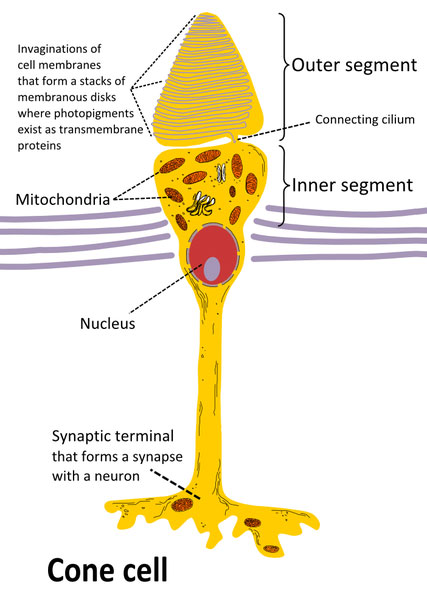
Purple (magenta) is elicited if our L-cones and also the S-cones, which are especially responsive to short (S), “blue” wavelengths, are both excited, while however the receptors for medium (M) wavelengths in between L and S (M-cones responsive to green) are much less excited. In this sense, we can represent “red” by the LMS values 100 (only L excited), while “purple” = 101. Yes, this is similar to RGB colors, however, L-cones are most responsive to green-yellow wavelengths rather than red light.
The point is that there is no single wavelength light that elicits purple, because a wavelength between L and S will trigger mostly M-cones, and thus be “green” = 010 rather than purple. Purple must be a mixture, and not just one like orange (110), but it must be a "mixture with a hole" in the more physical description via wavelengths, a zero between several 1s. Even to those who claim that pure red or blue “are out there” and all else is out there as mixtures, purple is rather the hole, the zero(s) between 1s!
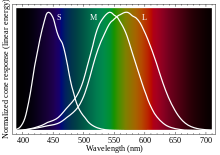
L-cones are most responsive to green-yellow light, not red.
Does the above imply that color is "only in my mind" and not “really out there”? Yes and no:
Our color space is two dimensional (2D). It is spanned by a 2D surface in the 3D intensity space of three different kinds of wavelength receptors, namely L, M,and S types. This simple dimensional color space has been put into question by “Novel colours” [1] like reddish-green [2,3]. But let us nevertheless stick with the dimensional color space, because then we can get to “novel colors” in a systematic manner via my “generalized purples”.
The system of four “pure” hues (yellow, red, green, blue) in spite of three different types of receptors is a mostly cultural phenomenon. We have three dimensions, L, M, and S, which leaves a 2D color surface after taking intensity out as a mere distance to the origin at 000. You can traverse a color circle around the white point on that 2D surface, and therefore, there is a “purple”, i.e. the circle closes and starts again after having gone through the spectrum of wavelengths.
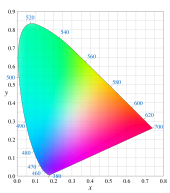
Follow the spectrum from red over orange and yellow all the way to blue, then close the circle around the white point in order to hit purple along the lower edge, then thank the magic of qualia for "purple".
Most birds and even perhaps 3% of female humans have four different types of color receptors, namely one more for ultra-violet (UV), a condition called Tetrachromacy. Their color space is a patch on a 3D hyper-sphere hyper-surface in 4D space: L, M, S, UV. They have different and more “purples”: While we have only LMS=101, they have a probably similar 1010, but also 0101,1001, 1101, and 1011.

Those visual systems do see those “hyper-purples”; they are “in their minds”, but they are not, have never been, in my mind. Thus, they are in other minds in the same (= indistinguishable) way as I would see it, too*, if I could, so these purples are “out there”! With more types of photoreceptors, there are ever more of my hyper-purples waiting to be discovered – how many are there with Pentachromacy?

Just like red could possibly be described in a book titled “How red looks like, finally satisfactorily explained and thus taken from the ineffable” (likely to be an audio book popular with those blind from birth), so also the UV-purples are a distinct and potentially describable to the extend of widespread inter-subjective consent, and in that sense, they are “out there”, to be discovered somehow, just like the red is out there relative to red-green color-blind people, reachable with technologically modified eyes plus training of our visual systems, out there “existing” outside of my mind although not directly physical.
Would they be different for different wavelengths (IR instead of UV), for different emotions (green blood), for different cultures?
-------------------------------
* Except you think that everybody has a personal red.
** My argument is similar to that of Nagel [4] about Bats and Frank Jackson’s [5]. Jackson imagined a vision researcher called Mary [6] who gets to know everything there is to know about color while being in a black-and-white-only room. When she steps out for the first time, there is something still to be discovered: color. Some “Physicalism” is false because the complete physical account does not tell us everything there is to know.
--------------------------------
[1] Evan Thompson: “Novel colours.” Philosophical Studies 68(3), pp 321-349 (1992)
[2] Hewitt D. Crane and Thomas P. Piantanida: “On Seeing Reddish Green and Yellowish Blue.” Science 221 no. 4615 pp.1078-1080
[3] Billock, Vincent A.; Gerald A. Gleason, Brian H. Tsou (2001):"Perception of forbidden colors in retinally stabilized equiluminant images: an indication of softwired corticalcolor opponency?". Journal of the Optical Society of America A18 (10): 2398–2403. Direct Link
[4] Thomas Nagel: "What is it Like to Be a Bat?" Philosophical Review 83: 435-450 (1974); reprinted in his Mortal Questions (Cambridge: Cambridge University Press, 1979), pp. 165-180, p. 175: "If mental processes are physical processes, then there is something it is like, intrinsically, to undergo certain physical processes. What it is for such a thing to be the case remains a mystery."
[5] Frank Jackson: "Epiphenomenal Qualia." Philosophical Quarterly 32: 127-136 (1982)
[6] Frank Jackson: "What Mary Didn't Know." Journal of Philosophy 83: 291-295 (1986)





Comments