




A research team at John Hopkins Medical Institutions has introduced synthetic chromosomes into yeast (Saccharomyces cerevisiae, see figure 1), in an effort to better understand how genomes work, and potentially allow some ‘control’ at genome level. As part of the synthetic yeast genome project, or Sc2.0, the researchers have introduced a synthetic right arm of the ninth chromosome, synIXR, and a partially synthetic left arm of the sixth, semisyn-VIL.
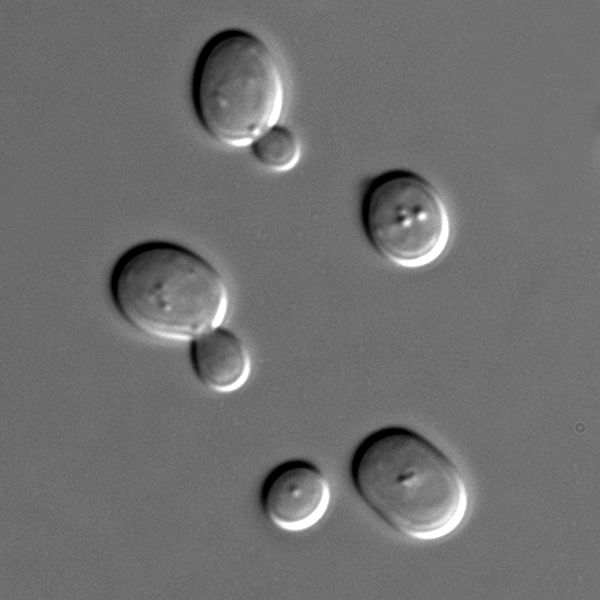
Figure 1: S. cerevisiae.
(Source: Wikimedia Commons, user: Masur)
This was done while adhering to three design priniciples:
- Firstly, the introduction of these synthetic genome parts should result in a near wild-type phenotype and fitness.
- Second, destabilizing elements, such as tRNA genes and transposons should be lacking.
- Finally, genetic flexibility should be included to facilitate future studies.
By stringing together DNA bases, and assembling them in longer segments, the chromosomes were build, with respect for the design principles. After the segments were about 10,000 base pairs long, they were introduced into the yeast cells, and ‘swapped’for their natural counterparts.
The yeast cells containing (partially) synthetic chromosomes were subsequently grown on different nutrients and in different conditions, testing their ability to grow. Their performance was undistinguishable from natural yeast.
But perhaps the most remarkable element of this study, is the inclusion of a ‘mutation switch’, called SCRaMbLE, or Synthetic Chromosome Rearrangement and Modification by Lox-P mediated Evolution. In the words of the authors, it is summarized as:
…a novel method of combinatorial mutagenesis, capable of generating complex genotypes and a broad variety of phenotypes.
Basically, markers called loxPsym were added to all the non-essential genes. These markers are ‘attacked’ by an enzyme called Cre, which swaps genes between marker sites. (For a more complete explanation, check this page at Sc2.0) After ‘flipping the mutation switch’, the yeast was tested again. Some grew fast, some slow, some very slow, suggesting that random variation was indeed introduced. This was backed by analysis of the molecular structure of the artificial chromosomes, which showed deletions, rearrangements and other alterations at varying locations.
And this is just the beginning of a greater project, synthesizing the entire yeast genome. In the words of the authors:
When complete, the fully synthetic genome will allow massive restructuring of the yeast genome, and may open the door to a new type of combinatorial genetics based entirely on variations in gene content and copy number.
Will certainly be continued…
Reference
Dymond, J.S.; Richardson, S.M.; Coombes, C.E.; Babatz, T.; Muller, H.; Annalura, N.; Blake,W.J.; Schwerzmann, J.W.; Dai, J.; Lindstrom, D.L.; Boeke, A.C.; Gottschling, D.E.; Chandrasegaran, S.; Bader, J.S. and Boeke, J.D. (2011). Synthetic chromosome arms function in yeast and generate phenotypic diversity by design. Nature. Advance online publication, 14 September 2011. doi:10.1038/nature10403.





Comments