




So-- about four decades before the publically known Project Ozma search-- the Navy stepped up to find out.
Well before SETI (the Search for Extraterrestrial Intelligence), Project Ozma, Area 51, or even the 1938 radio hoax 'War of the Worlds', the Navy was looking for Martians.
The DC Examiner reports that the Navy,Chief of Naval Operations Edward W. Eberle requested, via telegraph, a 3-day listening period to seek out Martians.
The telegraph message to the Naval radio posts and astronomers read: “NAVY DESIRES COOPERATE ASTRONOMERS WHO BELIEVE POSSIBLE THAT MARS MAY ATTEMPT COMMUNICATION BY RADIO WAVES WITH THIS PLANET WHILE THEY ARE NEAR TOGETHER THIS END ALL SHORE RADIO STATIONS WILL ESPECIALLY NOTE AND REPORT ANY ELECTRICAL PHENOMENON UNUSUAL CHARACTER AND WILL COVER AS WIDE BAND FREQUENCIES AS POSSIBLE FROM 2400 AUGUST TWENTY FIRST TO 2400 AUGUST TWENTY FOURTH WITHOUT INTERFERRING WITH TRAFFIC”
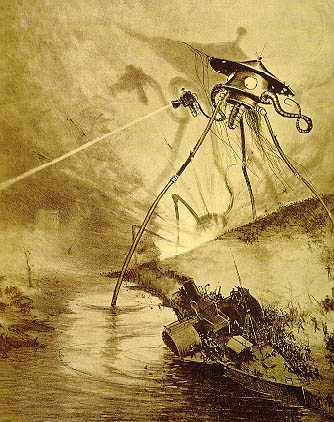
There's a few interesting points this historical story raises. First, the Navy has always been active in astronomy. Historically, Navies did astronomy because astronomy was the basis of navigation, and of time. Your not-so-humble writer here spent four years at the Naval Research Laboratory (in DC) doing solar physics observing and modeling.
While the joke in the military today is "the US Navy owns up to the ionosphere, the Air Force owns everything above that", for applied observational work, the Navy is still very strong in astrophysics.
And in 1924, the idea of life on Mars wasn't unreasonable. We thought there might be water, there had been earlier images of canal-like structures that weren't fully debunked. Noted astronomer Percival Lowell was a proponent of the 'intelligent life on Mars' camp, while Alfred Russell Wallace (in 1907) published one of the skeptic retorts. Wallace's science was more sound, as he suggested a low atmospheric pressure and low temperatures meant no liquid water on the surface in his 1907 book 'Is Mars Habitable?'.
Neverless, it was still a debatable issue, and would remain so until our first flyby visit-and-shoot the surface of Mars with Mariner 4 in 1965.
The Examiner notes "During the three day period, during which Mars was in opposition to
Earth, nothing but static was detected by Navy radio stations." And now that the Mars rovers Spirit and Opportunity have trundled around several regions on Mars, we may have to discard our wish of meeting Martians face to face.
At least, until we can land there and be the Martians ourselves.
Alex, the Daytime Astronomer
Tues&Fri here, via RSS feed, and twitter @skyday
Read about my own private space venture in The Satellite Diaries





Comments