

Fake Banner
    The Return Of Karl Popper: Is Social Science Really Different Than Natural Science?
    By Nicholas Horton | March 8th 2010 10:48 AM | 35 comments | Print | E-mail | Track Comments
    About Nicholas

    I'm a graduate student in mathematics at Portland State University. My areas of study are Quantum Game theory and Mathematical Biology with a focus...

    View Nicholas's Profile
    Social Scientist have contended for much of the last century that we cannot approach the study of human behavior with the same tools that we would use to study the natural world.  This is hogwash.  And I think Karl Popper, the great 20th century philosopher, would agree with me. Humans are animals, they are made up of chemicals and cells, their behavior is determined by a complex interaction of chemical processes and their lives are a network of cause and effect relations with other animals (some of which we’d call human).   If we are ever going to get a solid grasp on our own behavior, we’ll need to use the items from the large and well developed toolbox of natural science.

    Falsifiability and Objective Reality
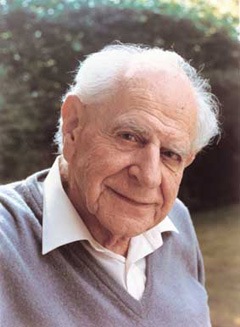
    Karl Popper believed that a theory is scientific if and only if it is falsifiable.  Most scientists would agree with this statement, and in fact would be shocked by anyone who didn’t.  (This may be why natural scientists and social scientists don’t tend to hang out together!)  But, falsifiability presupposes a belief in an Enlightenment-style “objective” reality beyond that of our own minds.  In much of social science, especially in sociology and psychology, there is a powerful belief in a post-modern relativism that rejects an objective reality. That is to say, they don’t believe that there is a truth that is inherent to the objects of study themselves.

    Without a belief in an objective truth outside the mind of the observer, it is impossible to even discuss what it would mean to falsify a statement.  Therefore, you cannot use Poppers falsifiability axiom as a demarcation line for what is and isn’t science.  And now we allow in all sorts of unfalsifiable statements and theories simply because who is to say what is and is not objectively true?  This is not good science.  But, it defines much of what passes for science in the world of social inquiry.

    Now, it must be said, that the truth is likely somewhere in the middle. But, most relativists are basing their relativism on what I’d consider a false understanding of some basic ideas.  Among the more common things I hear when encountering someone who is a hardcore relativist, who wants to impress me (knowing that I’m a mathematician) is with the idea of quantum physics.  It usually goes something like this, “hey, man, you know that every time we observe a particle we
    change it’s state.  So, everything is relative.  Our presence changes what we observe.  There is a reflexivity between us and the object.  There is no way to know what’s what if every time observe something that something changes.  Reality can be and is manipulated.”

    OK, true.  But, it’s missing the point.  When we say we change a particles state, we aren’t saying the particle didn’t have a state to begin with.  It was simply a state we can’t directly observe.  That isn’t relativism in the strictest sense.  Sure if I observe it and you observe it, we’ll see different things, but that doesn’t mean the particle didn’t have an objective state before we each changed it. True relativism would be that the particle has no state until someone
    observes it. But, that isn’t quite how it works.


    Octavian-coin
    Think of a particle as a coin.  Suppose I spin that coin on a table.  While it is spinning is it heads or tails?  You might say neither, or more accurately, you could say both.  It’s 50% heads and 50% tails.  That’s its "objective" state.  We'd think of it as a probability of heads vs tails, but that is in fact the definition of quantum state.

    In mathy terms, we'd call it a convex linear combination of basis states.  So if we wrote Heads as H and Tails as T, and picked the number "p" to be a number between 0 and 1, we could write the state of the coin as pH + (1 - p)T.  It's a probability.  But, it's still a state defined by the equation above. 

    This can get worse: what if we lived in a world where we weren't able to see a coin while it was spinning.  What if we could only see coins when they are heads or tails with 100% probability – that is, when they are flat on the table.  Then if I wanted to observe the coin, I'd have to slam my hand down on top of it to stop it from spinning (assuming I knew where to slam my hand down!).   And what if, for example, that it landed heads up.

    Now suppose it always pops back up and begins spinning again after a minute.  Then you come by and slam your hand down on it.  If you caused it to land on tails, then we’d each have seen the same coin in different states.  I'd claim the coin is heads, you'd claim the coin is tails, but neither of us would realize that it was a combination of both before we slammed our hands down on it.

    Many things in the natural world are of this form (or we're forced to deal with them in a form like this).  That doesn’t mean we can’t study them objectively, and infer what we can, correct for our own “observation” errors, etc.  Physics is going along just fine with far crazier objects than humans could ever hope to be.  There is no reason we have to pretend that studying human behavior is somehow so much harder than studying particle physics.

    Popper’s 3 Worlds

    There is no doubt that the reality outside our minds is not always in line with the perceived reality we hold within our minds.  Many natural scientists, in light of this, are Cartesian dualists without even knowing it.  That is, they accept that there are two worlds: the world of material things that we study; and the world of the human mind. They accept that these don’t always jive, and that each one has an influence on the other.  But, keeping them separate, at least heuristically, is seen as useful.

    In social science there is a stronger emphasis on the effects culture on the mind.  And this is seen as a feedback loop from the mind to itself. Karl Popper goes one step further with his heuristic and suggests that the universe is really made up of three worlds.  The objective world of objects.  The world of the Mind.  And the world of human-created ideas as manifested in books, paintings, blogs, etc.  

    The third world includes culture and so brings it out of the second world, thus striping it of some of its recursive properties. What I like about the idea of the third world is that it allows for this world to undergo it’s own evolution (the way the other two obviously do).  And because of this we can study it (largely) independently using the tools of evolutionary research such as game theory.

    One More Time

    I contend that Social Science is a proper subset of Natural Science and is in fact a subset of Biology, most specifically Human Biology.   To say that we cannot study Social Science with the same tools we use in Natural Science because we are ourselves of the type we are studying is an act in strange logic. If we follow the strange logic further, then we shouldn’t study any animals like we study the natural world, because we are animals.  We shouldn’t study chemistry as we study the natural world because we are made up of molecules.  And we shouldn’t  study physics the way we study the natural world because we are nothing more than a collection of atoms.

    There is always some sense of recursion in any attempt we make to study the natural world.  Our brain is made up of cells which use electricity to fire information back and forth.  Whenever we are trying to understand electricity, we are using electricity to understand it!

    Popper dealt with this problem in what I consider a most reasonable way, the Popeye way:  Science is what it is, and that’s all that it is.  Scientific statements can only be falsified, not verified.   And the world (including the world of human interaction) has an objective component
    that must be sought after as truth in its own right.  It isn’t perfect, but it gets the job done.

    The only way we’ll ever make headway into the realm of human behavior is if we are comfortable approaching the human animal the way we approach the study of all animals – with science.


    Comments

    Gerhard Adam
    To say that we cannot study Social Science with the same tools we use in Natural Science because we are ourselves of the type we are studying is an act in strange logic.
    Perhaps not so strange, but I take your point.  The problem is one of rigor and how precisely definitions can be created and applied when examining any phenomenon.  To even consider "social science" require a precise, rigorous definition of what we mean by society.  What are the boundary conditions, what are the variations, how influential is it, etc.?  As long as these are inadequately described then there really is nothing to study.

    For example, people grossly under-estimate the difficulty of defining intelligence in humans.  Consider for a moment, that if we accept many of the definitions floating around, the next question is what would we expect as a consequence of such "intelligence".  Invariably the discussion eventually comes around to human achievements.  However, this is where it becomes difficult, because there is nothing in the definition of intelligence that necessarily correlates to achievement.

    More importantly, one can make the argument that what we consider human achievement has little to do with individual intelligence, but rather is reflective of a cultural intelligence.  In other words, our achievements exist because of our culture, and not because of individual capabilities (although individuals clearly contribute).

    In short, we have a significant number of definition problems that need to be addressed before we can reasonably put social sciences on any kind of a scientific basis.   
    Nicholas,
    A few things:

    I strongly suspect that Karl Popper would have taken great issue with your sweeping generalizations such as "Social Scientist [sic] have contended ...". As a social scientist, I can tell you there's actually a lively Popperian community in the field - and has been for decades. Not sure who you're talking to, but you would do well to do a better job fact-checking.
    Another example: "In much of social science, especially in sociology and psychology, there is a powerful belief in a post-modern relativism that rejects an objective reality. That is to say, they don’t believe that there is a truth that is inherent to the objects of study themselves." [emphases mine - tw] Again - not sure who you're talking to, but, as a psych guy, I can assure you that we have an incredibly strong Popperian experimental community. Maybe out at Portland you're stuck with a bunch of discredited psychoanalytic/Adlerian types, but, just as you don't represent all mathematicians (much less all natural scientists), the Freudians you're apparently hanging out with don't represent all psychologists (much less all social scientists).
    You say, "(This may be why natural scientists and social scientists don’t tend to hang out together!)" Actually, over here in the social sciences, we long ago explained this particular phenomenon: people like to hang out with similar others. It's a simple, and general, explanation. It doesn't have the same anti-social-scientist zing that you seem to be going for, but it's far more Popperian. Further, various social scientists (including psychologists and sociologists) have run Popperian experiments testing the simpler theory, and the theory has withstood all of them. I suspect your theory would not stand up nearly so well.
    Finally, in your conclusion, you fallaciously take the argument you're trying to attack to an illogical extreme, one that few, if any, of the people you are attacking would support - not because they don't believe in their actual position (whoever "they" are), but because they have a far more moderate position than you're suggesting. Frankly, in social sciences, we deal with so many intervening variables that we should, of rights, be aware that our own perceptions will likely cloud our judgments more than, say, examining whether or not light bends around a gravity well. Unlike your conclusion, this doesn't stop us from using experiments and Popperian methods; instead, it (hopefully) informs us so that we do not presume too much knowledge from too few exemplars, given that human behavior is far more quirky than the behavior of a molecule.

    Frankly, I found your article deeply offensive, since your overgeneralizations do not reflect the full state of practice in social science, yet you use them to tar and feather an entire group.

    Fred Pauser
    twicker,


    Frankly, I found your article deeply offensive, since your overgeneralizations do not reflect the full state of practice in social science, yet you use them to tar and feather an entire group.


    Sure, there are some good, honest, clear thinking people working in the field of psychology/therapy. (Richard Ofshe is one of my favorites.) HOWEVER, the field of psychology in general is not well respected as a science. Even the lay public is skeptical of the words of psychologists. Your feeling of "deep offense" suggests that you are out of touch!


    For example, are you familiar with "Facilitated Communication?" In 1989, Douglas Biklen Ph.D of Syracuse University developed a process by which non-communicative autistic children apparently became able to communicate their thoughts using a keyboard, with assistance from a facilitator. Biklen started a clinic. Parents were delighted to learn that their kids had a functioning mind behind a poorly functioning exterior. In 1993 Frontline, a PBS TV program, did a documentary on FC which focused largely on Biklen's clinic. In the process, a "communications expert" was called in (Dr. Howard Shane) to test the validity of FC.


    Shane set up a double-blind test which showed very clearly, without a doubt, that the messages typed were actually the thoughts of the facilitators, not the kids! Upon seeing the testing process and obvious results, the more honest facilitators quit. BUT "Doctor" Biklen and some of the facilitators made up excuses and continued merrily on with the clinic!!! This kind of denial of evidence is not unusual in the field of psychology. (After all, as the post modernists teach, truth is subjective. In my personal experience with psychologists -- they love to say, "We all have our own truths!")


    As of 2005 some 70 studies had been done on FC, all showing that FC is essentially bogus!

    http://www.autism.com/ari/editorials/ed_risefallfaccomm.htm


    But Biklen and FC marched on. Today, Douglas Biklen is Dean of the School of Education, Syracuse University and Director of the Facilitated Communication Institute at Syracuse University!!!


    Instead of being offended, twicker, since you are a "psyche guy," you may be in a position to do something to improve the field.
    twicker
    Dear Fred,
    To your point about me needing to "do something to improve the field," well ... I actually do - continually - as my day job. I work on developing Popperian experiments, I help run them, and I work to correct misimpressions caused by people reading pop "psychology" and believing it to be accurate (which includes, not incidentally, people reading pop "psychology" and believing that, somehow, experimental psychology doesn't exist and isn't using a very Popperian framework). My colleagues/professors (I'm a PhD student) have also been "do[ing] something" for decades now. Experimental psychology is an old and well-developed field; think Hawthorne, think Bandura, think Milgram, etc. Note, among other things, that the report you linked to was produced by an organization that's chock-a-block full of psychologists who oppose Biklen. Sure, he's a great straw man, and you can certainly find others who offer quack therapies; however, they don't represent most psychologists, at least over in the applied area where I live (which is probably why he's in the school of education and not of psychology, among other things). The reality is that those of us in the field have been using Popperian methodology for, well, decades. We live and die by whether our theories are testable/falsifiable, and whether or not we design experiments that test these.

    Sure, you can quickly and easily find lots of crap psychology (see, for example, The Secret); however, much of that is also crap physics/biology/etc. (e.g., The Secret claims that you can, and do, manipulate the physical world just through your thoughts - that's more than mere psychology). The authors of that autism report, The Commission for Scientific Medicine and Mental Health (CSMMH), also take on quack medicine (though they apparently haven't been doing anything since 2005, according to their news link). People believe a lot of crazy stuff (including Biklen's theories - which, btw, were primarily discredited by psychologists, not by, say, physicists or chemists or mathematicians).

    If you want to read more of the psychology research I'm talking about, check out the Journal of Applied Psychology, the Journal of Personality and Social Psychology, the Journal of Experimental Social Psychology, Psychological Science, etc.

    So - I, and many, many others, are in fact "do[ing] something" - by learning Popperian methods, by teaching Popperian methods, by examining our work using Popperian frameworks, by developing testable, falsifiable Popperian theories, by running Popperian experiments, by publishing those results far and wide to make them available for criticism -- and even by, yes, challenging those who pretend that a Popperian framework has no place in psychology (or other social sciences). So, again, I don't think Nicholas makes "excellent point," because he presents old, old arguments as new and paints the entire profession with a single brush, showing a lack of understanding of the profession (it would be like pretending all mathematicians/game theorists are like the quants from Wall St. that helped precipitate the economic crisis -- talk about some bad "science"). And now, I need to go back to what I was doing before - among other things, working on Popperian-style experimental designs for a series of phenomena that I and others want to study. :)

    yrs,
    twicker
    Fred Pauser
    Thomas,


    I think probably both you and I have allowed our emotions to tint our comments a bit too much.


    We have a fairly important issue on the table here: We are looking at the general authenticity of the field of psychology as a science, and the public's perception thereof, now and in recent decades. Psychology as it is developed in the ivory towers of academia does not mean much until it reaches clinical settings as psychotherapy. That's where the rubber meets the road. From that vantage point, what is the relatively recent and current state of psychology?


    I intend to pursue this further, but will be too occupied with my business for the next two days before I can continue. Thanks for your input.
    twicker
    Hi, Fred,
    Just a quick note to say - yes, I think emotion was playing a larger role in my reply than I might have liked - mi apologia.

    I have a much longer/larger reply budding, but I think that's more appropriate as a blog post (keeps comments from being too cluttered). The short and sweet:
    •  Alas, I can't really tell you about the clinical psychology part of things, because I'm not a clinical psychology guy. I'm an organizational behavior/organizational psychology/managerial social psychology guy working on his PhD at a business school.
    • Which is my main issue with the original post: it lumped everything in social science (and particularly everything in psychology) together as a single field. Kinda like discussing just "physics" instead of sub-disciplines of physics. 
    • Lumping everything together sets up false "straw men" - "straw" in the sense that one can pick the sub-discipline one disagrees with most and pretend that it encompasses the field, and "false" in that I don't believe it was an intentional fallacy in this case (or in most cases) - I suspect the original post included this fallacy from ignorance rather than from intent.
    • As an aside, we continuously try to translate our research into relevant material (sometimes effectively, sometimes not), so we're working with road-hitting rubber pretty much continuously (or, at least attempting to). :)
    Gotta run - but I did want to make sure I gave you a reply. Take care.

    yrs,
    twicker
    Based on my experience with psychologists and "school of education" types, these are fundamentally different traditions. In fact, they can be pretty hostile to each other because they often compete for the same pot of money, but use totally different methods...with "educators" being much more like philosophers than scientists.

    Twicker2 is right on the money. The original poster seems totally unaware of what psychologists do. He seems to think they do therapy. Thearapy is to psychology what your local high school science teacher is to a quantum physicist. Sure the teacher once took science classes, but that doesn't make him a scientist. Likewise, a therapist has taken some psychology classes, but that does not make him a psychologist.

    Neither teacher or therapist is involved in doing science because neither is doing experimental research.

    Likewise, social scientists -- whatever you mean by the term -- are typically not doing science either. They collect information and summarize it. Typically with a political agenda in mind which is why you are correct that they are greatly influenced by post-modern thought. Few sociologists do science because their world is grounded in negative beliefs about science. After all, anything done by men is inherently paternalistic. Their goal is to support the theory that most everyone is a victim.

    As an experimental psychologist, my experiments were driven by realtime computers in a fashion not that different that are experiments done by the LHC. And, my data were anylized by many of they same statistical programs that were used by the physical scientists. In fact, the statistics were more complete than those done by biologists.

    Bottom-line, because you don't know what psychologists have been doing -- and were doing long before anyone thought of "treating" people -- you recommend our doing something we have always been doing

    Lastly, may I remind everyone that those who first treated people were M.D.s and not psychologists.

    Hi, nice article. I like to think about this things. Forgive my english, please, its not my first language. I agree with some thoughts, but i have others too. Relativism: there are differents approachs. I like to think about absolutism agains relativism in this way: absolutism means ALL. And ALL means ALL, the big All. We know that the sum of angles of a triangle is 180. Always? Of course not, in a planar geometry. That's a knowledge related to some framework. No to ALL. Is 2+2=4 always? If we found more dimensions of space? So, our knowledge is related to some variables, if we change that, maybe the results would be different. That's relativism for me. A big relativism. However, we could make statements of science that are usefulls.
    Then i think about animals (humans included) and...photons, electrons, etc. Are we the same? That's what you are saying?
    Well, we believe en causality. If i push a ball we, with our relativistic knowledge could make usefulls statements in some frameworks. "The ball is heading to north". We know some laws of physics about that. The ball has no choice. With some energy in some direction the ball MUST go in a certain and predictable way.
    What about you and me and my little cat? I go north, you go south, my cat go to the milk. Can we make decisions about were to go or there are causes underlying so we MUST go to some directions. Maybe we cant predict because we dont have all the data, but are we acting the same as a ball or a photon?
    There is were i'm not quite sure. But if we believe in causality, then we must consider ourselves as photons, in the same way. But...
    Pick you a number. 14? Why did you picked? If we study the brain (by chemistry, electricity, etc) can we know WHY we choose that number instead of other?
    Is the culture a variable that triggered that decision? We choose a number, there are synapses and other things that we could know with the same tools that we study the natural world, yes. But why is that process triggered a synapse instead of another one, to pick you 14 or 11219 me? May be there we have cultural issues that social studies look for. Think about morality and other kind of thoughs, affected by the social enviroment. We could understand what happens in our brains and body with the "classical" tools, but that's not enough.
    The natural world have no "senses". A mountain can't hear, a cloud can't see, a stone can't smell. We, animals can.
    Finally, what about these differents animals: dolphins or cats or humans. Well, when i see documentals in NatGeo, i see that scientist not study the lions by the chemistry of there brains, at least no only in that way, but looking for the way they interact with others animals, for example. That aren't social studies too, in some way?
    So, maybe we cannot study that differents things with the same tools, because with animals (and humans) we need MORE tools. We need to understand us chemically, electrically, and socially, i think. Photons, as i know have no social life. Well, me either!! Of course, that social tools not seem to be so "scientifics", in many ways, i think that are very subjective, not very quantitative, etc, in some cases. But they use statistic too.

    Larry Arnold
    This is repeating the old methodological prejudices.

    Both social sciences and the natural sciences grew out from the same roots of rational enquiry and philosophy and both separated themselves from the dark ages of metaphysical speculation and astrology at the same time as products of the enlightenment.

    I contend myself that both can illuminate each other, because scientists are no less subject to the laws of human group interaction than sociologists are products of flesh and blood subject to neurological limits on there enquiry.

    The problem with science that I see increasingly is the "silo effect" of increasing specialisation with little breadth of understanding across fields even between the natural sciences let alone between the natural sciences and social sciences.

    At one time an educated punter, like Darwin for instance, would be grounded in an education encompassing much more one could take for granted than one could assume for Dawkins in our day, in terms of readership of the classics in philosophy.

    What is forgotten by the natural sciences is the contribution that the social sciences made towards a rigorous statistical methodology. Indeed it is that purest of all practices mathematics that neither of the genres can do without these days.

    My mission if you can call it that, it to remind scientists of the social responsibility for research and it's outcomes in the human sciences of neurology and medicine, that are still less "pure" than chemistry or physics and all together full of woomeisters who make some sociologists look plain speaking and not at all woolly.

    Anyway I don't think you can consider the natural sciences and our relationship to the world without reference to Quine, never mind Popper, however considerably fewer scientists seem to be aware of his contribution he makes to the logical framework in which all epistemology operates and how we can even claim to "know" anything.
    Good article!Social sciences are the study of humans and their interactions and natural sciences are the study of the universe and how it works for you.In fact,natural science is based on the observation, identification, description, experimental investigation and theoretical explanation of phenomena.Such activities applied to an object of inquiry or study and social science is the study of aim of human being.Social science is based on the understanding of society. So they need to evaluate situation which they face and also need to discuss phenomenon to make a better society and that's the social science.

    Fred Pauser
    Nicholas


    You make EXCELLENT points!

    The only way we’ll ever make headway into the realm of human behavior is if we are comfortable approaching the human animal the way we approach the study of all animals – with science.


    Yes, with science and scientific methods. That seems sensible, so why is there so much nonsense and poor results in the field of psychology and psychotherapy? As a partial answer, I think it has to do with the fact that we live in a competitive and imperfect society in which deception and distortion of truth is quite common. This tends to develop the kind of ego that tends to put perception of reality ahead of what the evidence actually suggests is true.


    Eastern religions teach of transcending the ego. But I doubt that such a thing is possible for 99.999% of us. However, some training in that direction could be helpful. It could lead to the next best thing: To thoroughly learn how interconnected we are, hence the importance of cooperation and compassion. When observing an unfortunate individual, realize that: There, but for the results of chance, go I. We are all of the same essence.


    There needs to be DEDICATION TO TRUTH AND INTEGRITY, while at the same time not undermining one's personal survival in this imperfect world -- a difficult balance, but do-able.


    In much of social science, especially in sociology and psychology, there is a powerful belief in a post-modern relativism that rejects an objective reality.


    You can say that again!! It seems to me that post-modern nonsense -- basically "all truth is subjective" --has contributed to many wrongs within the field of psychotherapy. Many therapists of the 80s and 90s were ready to find sexual abuse behind every tree, which led to the use of a variety of suggestive techniques, which tended to recover lost memories of such abuse in patients. Unfortunately for those patients and their families, in many, probably most, instances their recovered memories turned out to be false.

    There is no reason we have to pretend that studying human behavior is somehow so much harder than studying particle physics.


    I slightly disagree on that point. Understanding human behavior may be harder. But I love your explanation of how particle physics could be just as objectively a matter of cause-and-effect as is the case in the macro world.


    A great article. Thanks!
    "Social Scientist have contended for much of the last century that we cannot approach the study of human behavior with the same tools that we would use to study the natural world. This is hogwash. And I think Karl Popper, the great 20th century philosopher, would agree with me. "

    I thought that Popper was one of the chief proponents of the idea that we cannot study society in the same manner that we can study the natural world:

    http://plato.stanford.edu/entries/popper/#SocPolThoCriHisHol

    AdamRetchless
    I thought that post-modernism was limited to philosophy and literature. I'm not really sure what it would mean in psychology and economics (the only social sciences I'm familiar with).

    I know that there has been a lot of pseudoscience in the history of psychology, starting with Freud himself and extending at least into the 1970s with the "homosexual illness" theory, but there has also been a lot of real experiments (including the experiments that discredited the idea that homosexuality was part of a broad dysfunction).

    What do you think of these?
    Top Ten Psychology Studies
    top
    ten social psychology studies
    .
    10
    more brilliant social psychology studies

    The
    Way We Were: 10 Crucial Child Psychology Studies


    I think that one of the problems in the history of psychology is that it was viewed as therapy from day one. As in the history of medicine, a lot of therapists wanted to jump in and cure diseases before bothering to really study the disease.

    "The only way we’ll ever make headway into the realm of human behavior is
    if we are comfortable approaching the human animal the way we approach
    the study of all animals – with science."

    Definitely true, but there was a lot of resistance to this idea for a long time. The psychologists played a big role in opening up the idea that humans could be studied....even if they were sloppy about it at first.
    Larry Arnold
    Well the trouble as I see it is that no-one is approaching the analysis of a blog and it's comments on either a scientific or a sociological bias. All I am reading is arguments based on personal preference and experience.

    Scientists and commentators exist in an economy, they exist in a social ecology, and so do people who discourse in the blogosphere, they follow observable rules and an empirical experiment could be devised to predict how certain individuals will comment based on what books we find on there shelves. Its a bit like psephology, unless that too is a pseudoscience, or game theory even, but perhaps that too is judged, within the subtle social nuances of those who ennoble themselves as "scientasters", as a game of poker.

    I mean never mind the deity, scientists don't play dice do they?

    I am interested in what cognitive neuroscience tells us about the people that study it.
    "But at my back I always hear Goedels chariot hurrying near
    and yonder all before us lie deserts of vast indeterminacy"
    twicker
    Dear Laurence,
    Well the trouble as I see it is that no-one is approaching the analysis of a blog and it's comments on either a scientific or a sociological bias. All I am reading is arguments based on personal preference and experience.
    Not quite sure what you mean by this, nor its relevance to the question of whether or not social science should or does use Popperian methodology.


    If you are merely discussing "approaching the analysis of a blog and it's comments on either a scientific or a sociological bias [sic]," where "a blog" can be any blog and/or the act of blogging, then I might suggest a quick Google Scholar search (http://scholar.google.com) for "blog" and/or "blogging." I'm no expert in the field, but there are people doing that research. Have been, for years now. And, btw, I suspect the sociologists would likely take some umbrage at having their approach describes as being other than scientific. :)

    yrs,
    twicker
    ' There is always some sense of recursion in any attempt we make to study the natural world. Our brain is made up of cells which use electricity to fire information back and forth. Whenever we are trying to understand electricity, we are using electricity to understand it! '

    Of course we do.

    But still it's a big step form electricity to understanding that is.

    'Do you believe in ghosts?', Chris asks Phaedrus in Zen and the Art of Motor Maintenance.’ No, they contain no matter and have no energy and therefore, according to the laws of science, do no texist, except in people’s minds. Of course, the laws of science contain no matter and have no energy and therefore do not exist except in people’s minds”.

    Call it the J.C. Maxwell principle: ‘The only laws of matter are those which our minds must fabricate, and the only laws of mind are fabricated for it by matter’

    In short, the study of mind, that is what psychologists do, isn't easy.

    br. hp

    jtwitten
    Let's be fair to post-modernism here. In its original form, post-modernism was about understanding that observations, conclusions, and processes could only be understood within their context. For a scientific example, it is clear that our human view of reality is dependent on the visual processing of the eye and brain, which does not necessarily accurately represent "objective" reality. Not denying such objective reality, it confronts the issues that cause our observations due to deviate from that reality.

    This philosophy has been taken to an oversimplified extreme in the perception that post-modernism equates to the statements that everything is "subjective" and "relative".
    Larry Arnold
    Well another way of looking at the origins of post modernism, is to consider literally where the phrase comes from, "that which follows the modern"

    In this context the modern is seen as the enlightenment view of science and history that in turn emerged from the medieval.

    What post modernism does is question this teleological view of the enlightenment, for instance the enlightenment and indeed the feudal era it grew out of, after a long transition,  cannot be said to be uniform, and once abstracted from the western context is seen to be anything but a teleological progression of the evolution of ideas and social structure along an evolutionary path from chaos and barbarity to liberal democracy, which is more ideal even than Plato's republic.

    A more critical study would show that although empirical science comes from this teleology, the way it has related to industrial production is far from straight forward and the changes in social structure, and increased power of the industrial revolution, only succeeded in impoverishing and slaving many, and led ultimately to the barbarities of the two world wars which we have not yet recovered from.

    In other words the enlightment is a bit of a fairy story as much as Japanase origins from the celestial emporpor are, or any origin myth. It is however a cultural artefac that has served some anthropological end, but empirical science, does not need that fairy story any longer because it does not belong specifically to the West.

    In one way even Popper belongs to the post modern current of ideas, in his classical critique of the teleological historicism of dialectical materialism.
    Fred Pauser
    Thomas,


    You and I agree that Nicholas is not correct on the following point:


    Physics is going along just fine with far crazier objects than humans could ever hope to be. There is no reason we have to pretend that studying human behavior is somehow so much harder than studying particle physics.


    To that, you commented: "…given that human nature is far more quirky than the behavior of a molecule."


    (Or a particle.) You are certainly correct. For one thing, humans consist of particle physics and very much more. And from another perspective, for the past century a great many well-intentioned people have been working to better understand both quantum physics and human nature. Just the fact that we have apparently made considerably more progress in physics suggests that understanding human nature is more difficult.


    I am prefacing my additional comments with some personal background because that will provide a context for my views.


    In 1960 I entered Rutgers University with a four-year full tuition scholarship plus a supplemental four-year merit scholarship. During the first year I developed a neurotic condition that was intense enough to cause me to seriously consider suicide. At the very least I felt an absolute need to leave college. I quit at the end of that first year, although it meant losing my scholarships.


    My mother had been a registered nurse at a veterans hospital in the late 1930's - early 40's. She was familiar with psychotherapy of that era (prefrontal lobotomies, crude electric shock treatments…). She strongly advised me to stay away from psychotherapists.


    I took up motorcycle racing, and then became a "tree man." I was a member of a crew that did power line clearance where the bucket trucks could not go. We cleared 13,000 volt lines using climbing/roping techniques only. Through those years I was half hoping to be killed, while at the same time wanting to live.


    In 1971, I finally did enter psychotherapy. The therapist, a 52 y.o. woman of eclectic orientation, helped me greatly with a secondary (but debilitating) problem within only a few months. I stayed on with her for over a year, but she could not put a dent in a deeper problem -- the one that caused me to quit college. But I left with hope, and was studying on my own. For the next 16 years I was in and out of therapy with a variety of therapists, audited college classes, attended professional psychology seminars, investigated communes, religions, etc. etc. Eventually I acquired first-hand experience with dozens of psychologists. My final therapist was a Ph.D psychologist (also eclectic). He, like all the others, could not help with my main underlying problem. When he suggested we try Eye Movement Desensitization Reprocessing, I said good bye. At that point I gave up on therapists (1988), but continued to study (on the side, as I still had to earn a living).

    ~~~~~~~~~~~~~~~~~~~~~~~~~~


    You wrote:


    As a social scientist, I can tell you there's actually a lively Popperian community in the field - and has been for decades.

    […]

    My colleagues/professors (I'm a PhD student) have also been "do[ing] something" for decades now.


    To what extent have the findings of scientific study in your field trickled down into actual clinical practice?


    One of the most popular approaches (and moderately successful) for some time now is Cognitive Behavior Therapy (CBT), which derives largely from psychiatrist Aaron Beck's Cognitive Therapy of the 1960's, and Albert Ellis' Rational Emotive Behavioral Therapy (1956). Both men developed their therapies from the rather common sense notion that what we believe and think affects our behavior and the way we feel. Has the "Popperian community" played a role in CBT?


    On the other hand, There is Recovered Memory Therapy (RMT), which got rolling in the 80's, peaked in 95 when clients began to successfully sue their therapists. Although this form of therapy has declined since '95, it is still with us. The idea is that, since child abuse is so common, if a client presents unexplained symptoms such as “free floating anxiety,” many therapists were taught to suspect repressed memories of abuse, and they would set to work with that in mind -- using techniques such as hypnosis, guided imagery, and suggestion in general. Consequently memories of abuse arose, sometimes to include "Satanic Ritual Abuse," and clients sometimes were found to have "multiple personality disorder" -- sometimes to the tune of hundreds of "alters." To those psychologists who were able to take a reasonably objective look at all of this, it was apparent that this therapeutic approach brings a considerable likelihood of yielding false results or "confabulations," which often turned out in fact to be the case.


    Michael Yapko, Ph.D, a clinical psychologist, in 1992 carried out a survey/questionnaire of 860 therapists pertaining to repressed memories of abuse. As a result, he concluded (in part): "It is not an exaggeration to say that many therapists appear to practice their profession on the basis of sheer myth." (Suggestions of Abuse, Yapko, p. 20) The questionnaire details and results are in his book.


    Did the Popperian community do anything in regard to RMT? (Don't point me to studies written in obscure or esoteric jargon, with typically non-committal conclusions. I'm talking BOTTOM LINE, clear and tangible results!!)


    About Post-modernism:

    Josh Witten pointed out above that it is an oversimplification to suggest that the philosophy of post-modernism can be summed up as everything is "subjective" and "relative". Yes, that would certainly seem to be true of a philosophy that gained wide acceptance in academia for decades. Nevertheless, what happens when people who have been subjected to this particular philosophy in college get out into the "real" world? During the past 3 or 4 decades I have heard over, and over, and over, comments such as: "All truth is subjective." "Truth is an illusion." "Truth is relative." And most common: "We all have our own truth." Comments of this sort have been very common among psychotherapists and social workers. This attitude seems to have led to a great laxity in critical thinking among therapists. It's tantamount to anything goes.


    So I consider Nicholas' point about post-modernism to be very significant because it seems to underlie much that has gone wrong in the field of psychotherapy. (A prime example, RMT.)


    Further on Facilliated Communication: You said:


    Note, among other things, that the report you linked to was produced by an organization that's chock-a-block full of psychologists who oppose Biklen.


    To be exact, the report said, "more than 50 academics" protested Biklen's promotion to the Dean of Education at Syracuse. That was in 2005 -- 12 years after the televised expose, and after 70 more studies indicating the invalidity of FC! Yet Biklen retained the promotion! Should have been 5,000 protests!


    Sure, he's [Biklen] a great straw man, and you can certainly find others who offer quack therapies; however, they don't represent most psychologists, at least over in the applied area where I live (which is probably why he's in the school of education and not of psychology, among other things).


    But for many years he has run a bogus therapy clinic. it does not matter if he is in "the school of education," he and his group are doing psychotherapy!


    According to the Commission for Scientific Medicine and Mental Health (CSMMH):

    "The Commission believes that the need for objective, scientific evaluations of alternative or non-conventional medicine, psychiatry, and psychotherapy has never been greater."


    It seems that is also true of some pretty conventional psychotherapy! (RMT became quite wide spread.)

    1) we need greater understanding of human behavior.

    2) We need to get that understanding adapted into therapy at the clinical level.


    You are working on point 1, but to what extent are your findings reaching therapists at the clinical level???
    twicker
    Hi, Fred,
    Thanks for the interesting comment, and I am very sorry to hear about the travails you've experienced. I think you might want to check out my reply to your previous post; it explains some of where I'm coming from (including my not being, in any way, a clinical psychologist :).

    And you're definitely right - counseling psychology does include much that's nearly indistinguishable from mythology/astrology. And, unfortunately, much as people continue to visit astrologists, people will continue to listen to some very crackpot "therapists," especially now that the Internet has made it so that bad ideas can multiply much more rapidly.

    Wish I could help you with the clinical/counseling psych piece; alas, I am unqualified to do so. Maybe someone else here can give you that information and translate it for the lay reader; I'm just not the one to do that, even if I do continuously concern myself with the practical application of my work.

    Take care.

    yrs,
    twicker
    Gerhard Adam
    Just the fact that we have apparently made considerably more progress
    in physics suggests that understanding human nature is more difficult.
    That's certainly true, but it also indicates a different problem.  Physics makes progress because it knows how to define the problem.  Psychology and human nature are difficult because we don't yet know how to articulate what we even mean by it.

    It's like walking into the middle of a movie where you don't know the story and attempting to predict how it will end.  We don't know if human nature is derived from natural selection, or if other factors were involved (i.e. cultural selection) that gave rise to what we consider "human nature" to be today.  As a result assumptions are made regarding biological origins that may not actually exist (hence the problem of evolutionary psychology). 

    Essentially we are operating in a world where we are attempting to evaluate the mind in a context that the mind invented.  It is completely circular.  Consider that we don't even know what constitutes "normal" beyond assuming that consensus is a good indicator. 

    The one thing that should be abundantly clear is that humans did not evolve to do mathematics or physics, etc.  Therefore whatever our psychology, it most certainly didn't derive biologically to our current state.  This would suggest that regardless of our relative success or failure as a species, our modern behavior is anomalous.  So to begin understanding human nature requires that we drop the notion that evolution had the directionality to produce intelligent humans, and begin to explore what events occurred to cause this major deviation in an animal species.
    Larry Arnold
    I still do not see a lot of logic, precision or for want of another word "science" in the comments here.

    Psychology is simply more complex that is all, and sociology a degree more complex than that.

    In terms of mathematics it is like modelling the weather, it takes more computing power than physics does.

    For all that Cern seems to be the big experiment in Physics, it is the technology that is complex to build the machine, not the maths.

    To build and test models of psychology, that just will take some ..........

    What really annoys me is that when people deride the "woolier" fields of social, psychological and political science what they are really doing is admitting defeat in the face of complexity of an order they are not used to dealing with.

    It is amenable to scientific method, it is just that little bit harder that is all.
    Gerhard Adam
    What really annoys me is that when people deride the "woolier" fields of social, psychological and political science what they are really doing is admitting defeat in the face of complexity of an order they are not used to dealing with.
    Actually what's more annoying is when people practice in these fields and behave as if they already know the answers.  It isn't about denying their complexity, but rather presuming that operating on the basis of mythology and ritual is comparable to proven research.

    Despite the fact that many practitioners are little better than shamans, it is difficult to rationalize how one can make public policy decisions and charge hourly rates for a service that can't be demonstrated to be effective.
    Larry Arnold
    Not at all you are betraying without even knowing it. Do you think Newton was so hot? he was off into the la la land of Alchemy and Astrology, we just are not taught the reality of scientific history, a myth has been created, and this myth cannot be seen or examined within the rather blinkered self assurance and arrogance of physical sciences which at the end of the day are dependent upon the dynamics of human interactions and the fallibility of neurologically derived perception, observation and cognition.

    Gerhard Adam
    Do you think Newton was so hot? he was off into the la la land of Alchemy and Astrology, we just are not taught the reality of scientific history ...
    On the contrary, most people are quite familiar with Newton's other activities, but that doesn't diminish his other achievements.  Consistency is not a pre-requisite to being able to do excellent work.

    While it is easy to judge others from the benefit of 20/20 hindsight and especially from a 21st century perspective, the simple reality is that none of those operating in the psychological or social fields is anywhere close to Newton's achievements, so it is a bit more difficult to forgive their lack of knowledge or insight.
    Hank
    Alchemy and astrology were also not firmly debunked like they are now.   Lots of past scientists looked at odd things because they had not been sufficiently disproven yet - ghosts, numerology, etc.   It's not to say if a scientist believes in astrology today he will be without funny looks.
    Want more no-nonsense, independent science? Buy Science Left Behind
    Fred Pauser
    Thomas,


    Thanks for your comments.


    Wish I could help you with the clinical/counseling psych piece; alas, I am unqualified to do so. Maybe someone else here can give you that information and translate it for the lay reader; I'm just not the one to do that, even if I do continuously concern myself with the practical application of my work.

    […]

    Alas, I can't really tell you about the clinical psychology part of things, because I'm not a clinical psychology guy. I'm an organizational behavior/organizational psychology/managerial social psychology guy working on his PhD at a business school.


    As a PhD student, I can understand your need to be focused upon a particular aspect of the field, at least for the time being. But as for not being able to "translate" information for the "lay reader," I consider that to be something of a cop-out. A person with a PhD in, say, physics might be considered a lay reader of an article on applied psychology. But it would likely not require too great an effort for the psychologist to translate for him/her. Likewise, the non-scientist layperson who likes to read Scientific Blogging would likely be up to comprehending the essence of your material if not too steeped in jargon. Here's a video of top physicist Richard Feynman talking to the public.


    In a previous post you mentioned Albert Bandura as one of your guys, with a link to Wiki:


    Bandura directed his initial research to the role of social modeling in human motivation, thought, and action.

    [Bandura wrote Social Learning Theory.] SLT is the theory that people learn new behavior through overt reinforcement or punishment, or via observational learning of the social factors in their environment. If people observe positive, desired outcomes in the observed behavior, then they are more likely to model, imitate, and adopt the behavior themselves.


    Well now, that's not too esoteric! Sounds similar to BF Skinner's earlier concepts. And appears to be consistent with the more basic pleasure/pain prinicple.


    I took a look through those APA professional journals that you linked to. I did not purchase any articles, but they offered some for free viewing. Off hand, the articles I saw did not seem to be nearly as scientifically solid as you implied. Maybe I'm wrong, I've reach no conclusion yet. The ones I saw were full of details and many references to prior studies which gives the impression of thorough work, but also suggested a possible circular and sort of incestuous nature. One lengthy article in the Journal of Personality and Social Psychology was about the search for meaning after the 9/11 attacks. After presenting tons of data and references, it concluded:


    …the degree to which people can ultimately come to an understanding

    of such events in the early aftermath may help restore a sense

    of security and hasten the process of adaptation.


    No kidding!


    I'm looking forward to the article you are preparing.


    twicker
    Hi, Fred,
    If you want me to translate some of my work for the lay reader - well, sure, I can do that. You asked about clinical psychology, and then psychotherapy. Those are no more my fields than neurochemistry would be the field of an inorganic chemist. The inorganic chemist might be able to translate her work into lay terms;*  the same inorganic chemist likely wouldn't know enough about what's happening in neurochemistry to be able to do the same for that specialized field. I specifically referred to clinical/counseling psychology because you specifically asked about clinical/counseling psychology. It's not my area, so I can't tell you what's happening in that area.

    If you prefer a physics example, ask the average applied biophysicist what's happening in theoretical gravitational physics (or even applied gravitational physics, if such a field exists); chances are, he couldn't tell you. Want medicine? Ask a clinical oncologist about the latest research in sports medicine; she'll likely strike out, too. For professional ethical reasons, they'd both refer you to someone who works in the area you asked about - because they're not qualified to answer the question.

    Again, if you want me to translate my area for you, that's easy - because we do that every day. You didn't ask that. If you had, then, sure, I could do it, PhD student or no PhD student. You asked me to tell you about a field of study that I don't know about -- that's the hard part, and that's why I suggested there might be someone on this website who does know about the field and, therefore, would be qualified to do so. I'm not qualified to address questions about clinical or counseling psychology, and I know I'm not qualified to, so I defer to others.


    I'll be happy to share my work with you and everyone else here; just understand that it will have little, if anything, to do with either clinical or counseling psychology.

    yrs,
    twicker
    Aitch
    Fred,
    Interesting reading back through this piece and your comments
    Years ago, I attended East London Uni, [ a 'new dimensions' revamped college with upgraded 'University' status, with funding from Mrs Thatcher's Government and the EC] doing a degree course based around Popper's theories
    For my course I was essentially told; you write you own course, and it will have components -
    1/ Your specialised topic
    2/ Any other non-related topic, which you will be required to explain what you have learned to your peer group
    3/ Your course will be assigned a group within which you will form teams, and will be required to write reports on fellow team members performance, and be required to nominate leasat and most helpful members of the group in terms of social cohesion
    4/ you will be required to write a report setting goals, and plotting your progress, and indicating any factors which you fell are indicative of your failure or success in achieving your goals

    After the best part of 18 months, having struggled both with getting support for my specialised topic - A high fidelity reproduction design from record to loudspeaker, and squabbles amongst my assigned group - I quit after my life was threatened as the 'structure' disintegrated in front of my eyes, because the personal tutor assigned to our group basically had no experience of how to deal with real world dynamics, resulting in the group imploding due to having no leaders - a complete failure from my perspective, though it did motivate me to complete my project privately
    To resolve the confusion and nervous disposition brought on by the experience I went to India to study under a Guru
    To me, a grossly underestimated danger of 'experiments' like that Popper
    based course, is the human damage in its wake....3 people have since
    committed suicide

    No extra safeguards were implemented to the best of my knowledge

    This quote could equally be applied to the aftermath of that course
    …the degree to which people can ultimately come to an
    understanding


    of such events in the early aftermath may help restore a sense


    of security and hasten the process of adaptation.

    NOT!

    Oh, there is so much more to life than 'social experiments', whether they be college courses, or felling buildings full of people

    Edit: this was supposed to be in reply to Fred's earlier post, but it appears to have been pushed down by twickers - I hope it still fits?

    Aitch
    twicker
    About the course "based around Popper's theories:" Sounds like the education "professional" engaged in a gross misreading of those theories. Whatever theories they used were certainly far afield from the theories discussed here. From the research, we have piles of good theory backed by data that would predict that your course would be crap. Sounds like someone had some wack theories and decided to put them in action before they had been tested.
    As an aside, I don't think the authors of the paper Fred mentioned - John Updegraff, Roxane Silver, and Alison Holman - saw "felling buildings" as a "social experiment." In fact, they describe it as, "the most destructive act of terrorism and one of the most devastating losses of life to have taken place on American soil." Interestingly, in the responses that you and Fred gave to the quote Fred pulled, you highlighted why people conduct those studies.


    Fred's response to the quote:
    No kidding!
    Your response:

    NOT!
    Two responses, two diametrically opposing viewpoints, something to be tested.

    Though I don't think that was the most interesting thing to come out of the study, frankly. I'm more interested in the implication that, to help people with PTSD, you should help them find meaning in their life. I haven't had time to read the whole article, but it does suggest that finding meaning may be a specific therapeutic intervention for people with PTSD, and it suggests that we need more data to determine if this is merely one thing that has an effect, or if this should be a primary treatment (again, John Updegraff, Roxane Silver, and Alison Holman may have covered this, but I don't have time to really read it).


    If you want some better lay-focused discussions of the results of our brand of experimental/Popperian methods, check out Negotiation Genius by Deepak Malhotra and Max Bazerman and Predictably Irrational by Dan Ariely (disclaimer: Dan and I have talked about doing some ethics research together). In my opinion, they both provide highly-readable treatments of their issues.

    yrs,
    twicker
    Aitch
    twicker
    As I said at the bottom edit to my post, it got pushed down, by your insertion - I'm unaccustomed to such board format
    I agree however, with your reading of the course I entered as cr*p
    As an aside, I don't think the authors of the paper Fred mentioned - John Updegraff, Roxane Silver, and Alison Holman - saw "felling buildings" as a "social experiment." In fact, they describe it as, "the most destructive act of terrorism and one of the most devastating losses of life to have taken place on American soil.
    It wasn't my intention to suggest it was their interpretation - it was mine, as an analogy to the experiment done by the devisors of my course
    ....and I think my understanding of why the buildings were felled stems from a far different perspective of social engineering than you envisage...beyond the Stockholm Syndrome
    see for example

    http://www.youtube.com/watch?v=P772Eb63qIY

    Bit of a shocker, perhaps, but as an illustrator of differences of perception, particularly of what to be afraid of, and what terror is, and just who it is implemented by, brought about by touching some of the truths referred to, in my own life, and a desire not to be corralled, or farmed

    nonetheless, it was in that context that my use of 'NOT!' applied

    Aitch
    Fred Pauser
    Hi Gerhard,


    It's like walking into the middle of a movie where you don't know the story and attempting to predict how it will end.

    [...]

    Essentially we are operating in a world where we are attempting to evaluate the mind in a context that the mind invented. It is completely circular.


    LOL, Yes, I know exactly what you mean, and I'll bet you feel the same sense of frustration that I have felt along with those kinds of realizations!


    But take heart, although evolutionary psychology seems to be somewhat off track so far, I am convinced that a reasonable understanding of the evolution of life will provide the foundation we need for better understanding human nature.


    This would suggest that regardless of our relative success or failure as a species, our modern behavior is anomalous. So to begin understanding human nature requires that we drop the notion that evolution had the directionality to produce intelligent humans, and begin to explore what events occurred to cause this major deviation in an animal species.


    Well, human behavior seems anomalous compared to other creatures only because there is such a large gap in intellectual capabilities between us and chimps, dogs, crows, etc. But it's a matter of degree…


    I have debated the issue of directionality of evolution many times on the Internet over the past 10 years. It's clear to me that on average that direction is of increasing complexity accompanied by increasing capabilities. It seems that the development of the human brain crossed a thresh-hold whereby a new vista of possibilities opened up, but it's still an extension of the same memory and reasoning abilities that we see in other higher animals.


    The one thing that should be abundantly clear is that humans did not evolve to do mathematics or physics, etc. Therefore whatever our psychology, it most certainly didn't derive biologically to our current state.


    I must disagree. You have heard me before harping on the pleasure/pain priniciple. We share pleasure/pain mechanisms with other life forms. It is fundamental to our decision making. We are biologically driven to try to improve how we feel (and to avoid pain as best we can in the process). Thousands of years ago our additional brain power enabled us to develop tools to help us to meet our survival needs, which must have made us feel better. In recent centuries we have increasing learned to use mathematics and physics as tools for developing labor-saving and time-saving technologies that enable us to feel better. The general direction of increasing capabilities is consistent with what evolution has been doing since the beginning. But now evolution has created a species whereby the process of increasing capabilities has been shifted into warp drive!


    1. Natural sciences. Experimental-sciences. Data will speak for itself.

    2. Social sciences. Not a science. Hoax. science. fake science. sham science. Free Free Free on google. free free free at library.

    3. Humanities: Free Free Free. free at library. Free Free Free

    This here is nazi talk.
