

Fortunately, the idea is fairly straightforward, and not so difficult to derive once given a few hints. It all can be summarized in a simple slogan describing gravity as the combined effect of three phenomena taking place at a sub-microscopic (quantum) level:
Holography + Equipartition + Unruh = Gravity
Or, slightly more subtle and arguably more accurate:
Holography + Equipartition = Hot Horizon = Gravity + Unruh
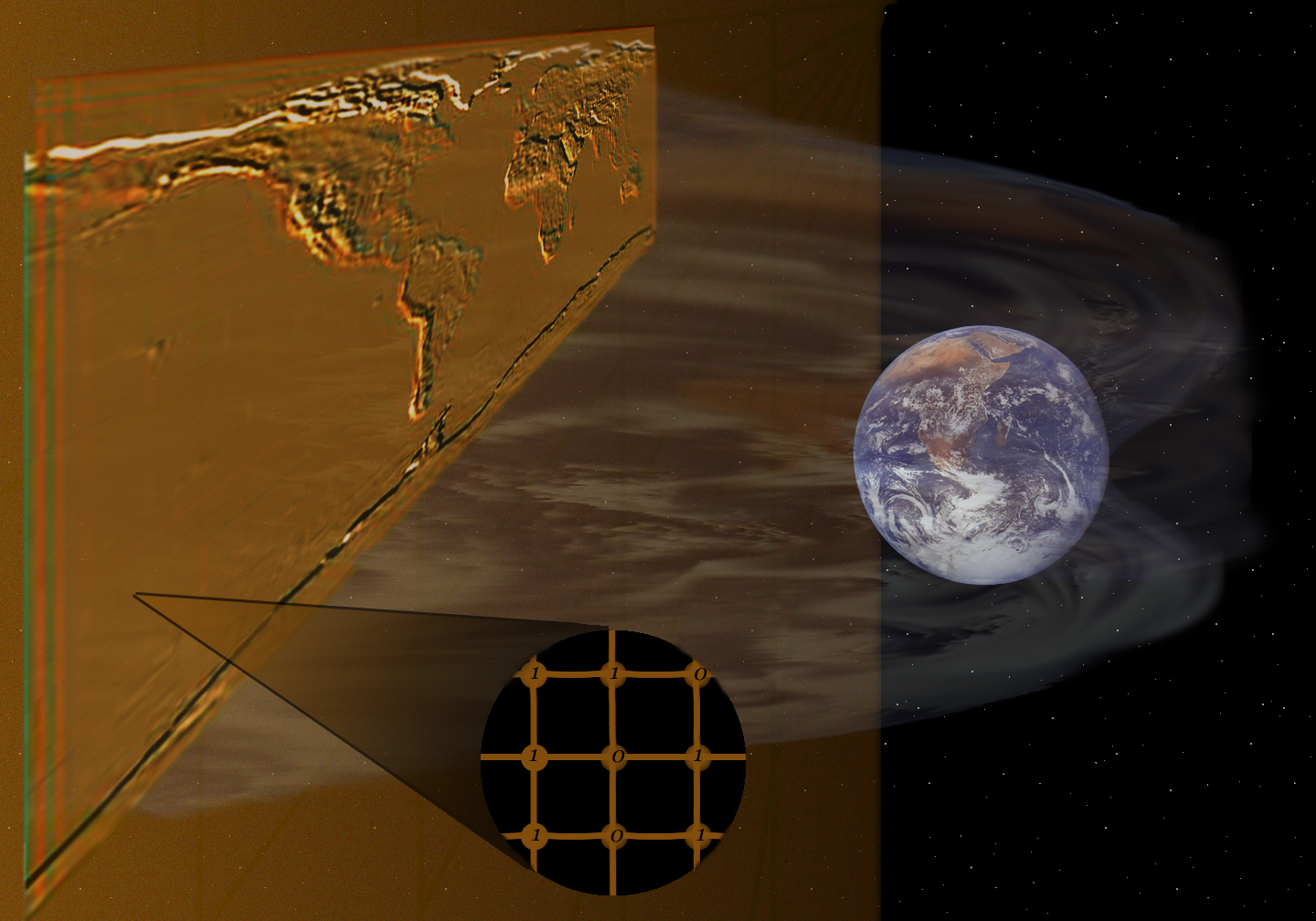
Is our world a hologram?
Three days have passed, and some interesting developments emerged.
Today a publication did get submitted to arXiv containing a derivation of gravitational acceleration exactly along the lines as I described in my blog on Monday. However, this paper was not submitted by Verlinde, but by Indian cosmologist and theoretical physicist Thanu Padmanabhan. Verlinde still seems to have refrained from publishing anything.
What is happening here?
Could this be a coincidence? A newspaper article announcing a not yet published scientific development, followed a few days later by someone else submitting a paper containing the very same announcement?

Thanu Padmanabhan
Well, this would not be the first time a new development in physics gets progressed (and submitted for publication) in parallel. In any case, the assumption that Professor Padmanabhan does not spend his weekend reading Dutch newspapers is unlikely to be wildly off. Also, Padmanabhan does not indicate that he got inspiration from my Monday blog: Certainly you won't find in his article a citation to any blog. ;)
More importantly, as was remarked by one of the commenters to my Monday blog, Padmanabhan had already published in this area, and seemed to be on the same track as Verlinde.
To be continued...





The atom labeled psi (Z) pulsates at the frequency {Nhu=e/h} by cycles of {e=m(c^2)} transformation of nuclear surface mass to forcons with joule values, followed by nuclear force absorption. This radiation process is limited only by spacetime boundaries of {Gravity-Time}, where gravity is the force binding space to psi, forming the GT integral atomic wavefunction. The expression is defined as the series expansion differential of nuclear output rates with quantum symmetry numbers assigned along the progression to give topology to the solutions.
Next, the correlation function for the manifold of internal heat capacity energy particle 3D functions is extracted by rearranging the total internal momentum function to the photon gain rule and integrating it for GT limits. This produces a series of 26 topological waveparticle functions of the five classes; {+Positron, Workon, Thermon, -Electromagneton, Magnemedon}, each the 3D data image of a type of energy intermedon of the 5/2 kT J internal energy cloud, accounting for all of them.
Those 26 energy data values intersect the sizes of the fundamental physical constants: h, h-bar, delta, nuclear magneton, beta magneton, k (series). They quantize atomic dynamics by acting as fulcrum particles. The result is the exact picoyoctometric, 3D, interactive video atomic model data point imaging function, responsive to keyboard input of virtual photon gain events by relativistic, quantized shifts of electron, force, and energy field states and positions.
Images of the h-bar magnetic energy waveparticle of ~175 picoyoctometers are available online at http://www.symmecon.com with the complete RQT atomic modeling manual titled The Crystalon Door, copyright TXu1-266-788. TCD conforms to the unopposed motion of disclosure in U.S. District (NM) Court of 04/02/2001 titled The Solution to the Equation of Schrodinger.