




As a member of the public, how can you determine whether Tylenol, also known as acetaminophen, causes autism? One approach is to use common sense. Consider this logical statement: during pregnancy, about half of mothers experience illness or pain that Tylenol can relieve. If Tylenol were to cause autism, we would expect to see tens of millions of individuals with severe autism. In a more rigorous examination of this issue, the Society for Maternal-Fetal Medicine published findings in the American Journal of Obstetrics and Gynecology in 2018. (1)
A more sensible approach is to consider how long autism has been recognized compared to the introduction of Tylenol.
Autism was first described in 1908 as part of what researchers referred to as “Childhood Schizophrenia.” It has likely been around much longer but we can prove it was around at elast that long.
In contrast, Tylenol became widely marketed and used only in 1955. This timeline makes it clear that Tylenol could not be a cause of autism; it would be like attempting to give birth without ever having been pregnant. The cause must precede the effect.
If you are a pregnant woman (and yes, some individuals who identify with other genders but are biologically female can also become pregnant), please consult your doctor and follow their recommendations for medication. Even if this evidence shows no general issues, medications can interact in complex ways in certain situations.
Recently, there has been an increase in the reported cases of autism. For many years, it was acknowledged that not everyone diagnosed with autism is significantly impaired by it. There was also a form of high-functioning autism known as Asperger's syndrome. Additionally, there was a category called “pervasive developmental disorder not otherwise specified,” which served as a catch-all for individuals exhibiting some autism traits but not all. Eventually, it became clear that all of these classifications represent varying levels of autism severity, with some individuals hardly showing any autistic traits at all, and only a small percentage truly experiencing a disability due to it. What about the White House?
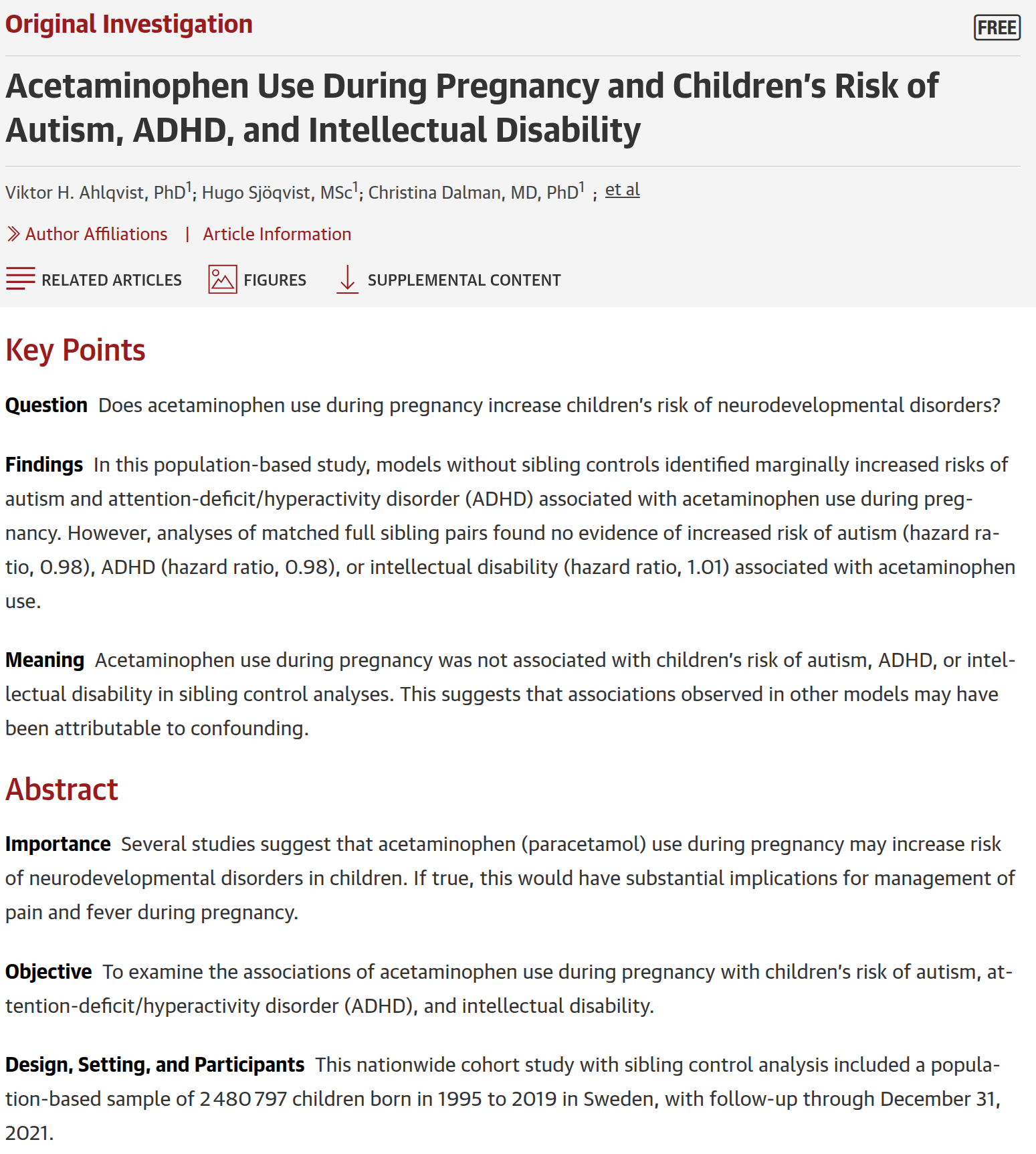
What about the White House’s statement of facts? They cite a study involving 8,856 children born from 1993 to 2005 and another study with 996 participants. Both studies suggested there could be a link between acetaminophen use during pregnancy and developmental issues. However, the White House, RFK, and Trump’s statements overlook a much larger study that examined 2,480,797 children born between 1995 and 2019, with follow-up information available until 2021. This study includes 251 times more participants and a longer observation period. It found that:
“Acetaminophen use during pregnancy was not associated with children’s risk of autism, ADHD, or intellectual disability in sibling control analyses. This suggests that associations observed in other models may have been attributable to confounding factors.”
This topic is personal for me.
I know this issue intimately because my little sister was diagnosed with autism around 3rd grade. I want to express my frustration regarding the monumental ignorance we are seeing.
This was in the 90s, and at that time, there was minimal effort to provide support for kids like her. She attended a special school where many children had multiple disabilities, such as deafness, and a few faced language barriers because they spoke only Spanish and could not learn English. To communicate and engage with her peers, she taught herself sign language and Spanish without any formal lessons.
Recognizing her ability to communicate, we had to advocate for her to be diagnosed as mildly intellectually disabled so she could attend a more mainstream school. Once she was in regular junior high and high school, she excelled, consistently making the honor roll. She later chose to attend culinary school in college, graduating with honors on the dean's list.
Since then, she has worked as a sous chef at a local deli. While she faces some challenges due to the way her brain functions differently, she is far from disabled by them. In fact, the most significant barriers she encountered in her life were the systemic attitudes and support structures in place when she was a child.
The Tylenol Tweet of 2017.
Steven Crowder would drink Brawndo because it has electrolytes, but at least he was original in referencing an old tweet that was likely intended to be sarcastic or humorous within the constraints of 2017’s 140 character limit on Twitter.
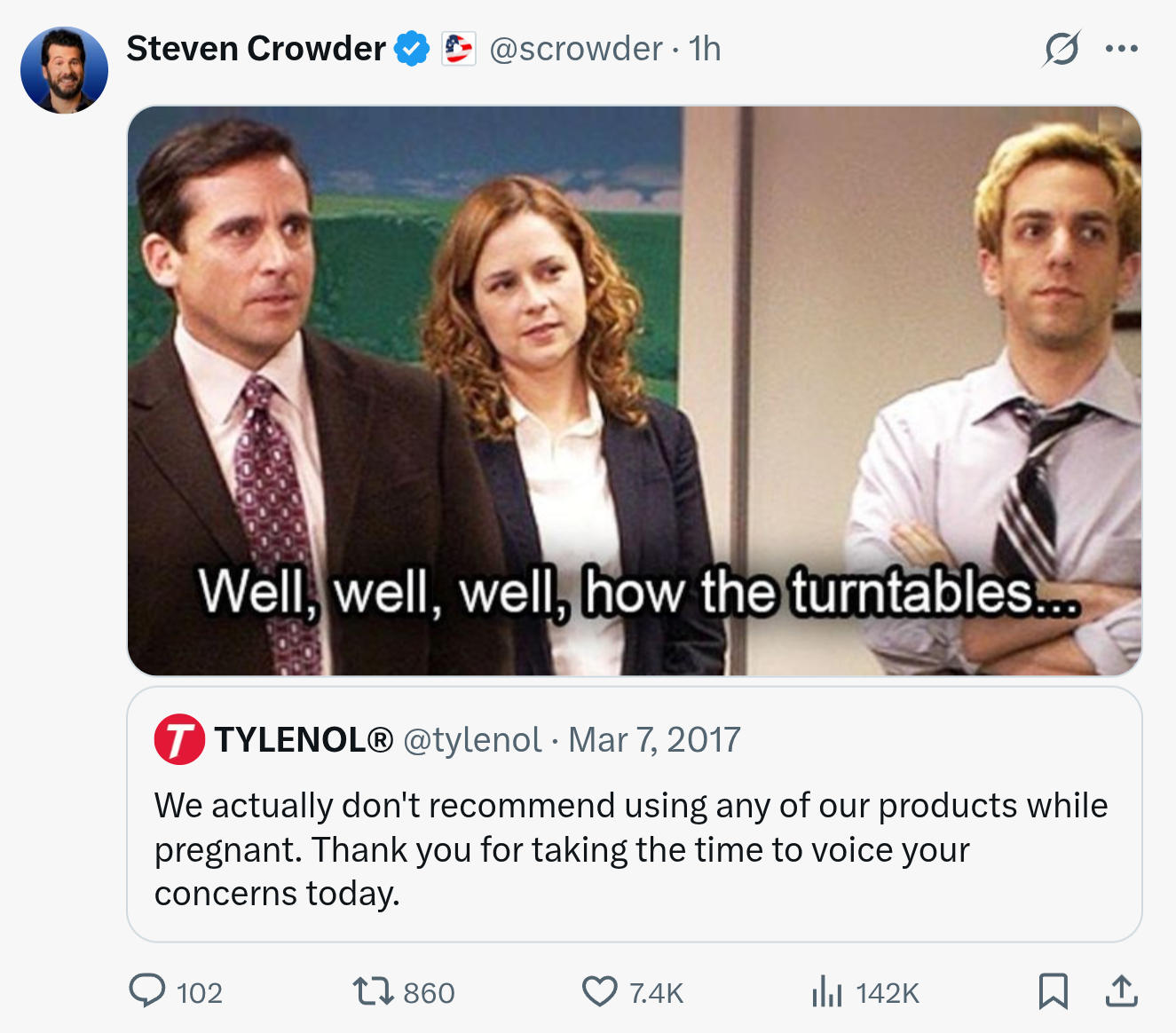
At least we can assume Crowder was joking a bit here. Meanwhile we see so many others uncritically retweeting about this.
But what about the likes of Piers Morgan, Gillian Anderson, Patrick Bet-David, Michael Knowles, and Joe Rogan? Rogan, being a comedian like Crowder, even used a thinking emoji to show he was considering the context. The others, however, seem to take the tweets seriously. Did COVID-19 cause so many people to lose their sense of sarcasm and humor? It’s astonishing to see people tweeting in 2017 while acting as if they don’t recall how unseriously Twitter was taken in the 2010s. For instance, Tylenol didn’t even bother to get verified with a blue checkmark. Although the account appears serious, it seems to employ sarcastic humor—something that many brand accounts do to engage their audience.

It's a simple fact that medications are recommended by doctors, not by the medications themselves. Tylenol has long been recommended as the safest option for reducing fever and pain during pregnancy, as unchecked fever can be harmful to both the mother and the child. Again, with that being the case, if it caused autism, we’d see more than 3-4 million cases we’d see maybe at least half of people having it. (At which point, if everyone is autistic, then no one is.)
It’s bewildering that well-paid, well-known media personalities struggle to understand this. People who were on Twitter back then have forgotten what Twitter was like back then. At least the comedians seem to grasp the nuances of contextual humor, which at that time had to fit in 140 characters. This situation raises a troubling question: Are those who fail to understand this just lacking common sense?
I refuse to believe the name people are really unable to grasp this. What we are witnessing is that they are self-interested political operators making statements influenced by their agendas. Namely, get mor clicks, make more money. Their followers who trust them more than they do their own doctors.
If you are a pregnant woman (and yes, some individuals who identify with other genders but are biologically female can also become pregnant), please consult your doctor and follow their recommendations for medication.
I also have a substack by the way. There I tend to post more pure opinions
References
Prenatal acetaminophen use and outcomes in children https://www.ajog.org/article/S0002-9378(17)30128-X/fulltext Volume 216, Issue 3PB14-B15March 2017
Schizophrenic autism: clinical phenomenology and pathogenetic implications https://pmc.ncbi.nlm.nih.gov/articles/PMC1489853
Revisiting Bleuler: relationship between autism and schizophrenia Published online by Cambridge University Press: 02 January 2018 https://doi.org/10.1192/bjp.196.6.495
Use of Negative Control Exposure Analysis to Evaluate Confounding: An Example of Acetaminophen Exposure and Attention-Deficit/Hyperactivity Disorder in Nurses' Health Study II Am J Epidemiol. 2019 Apr 1;188(4):768-775. doi: 10.1093/aje/kwy288. https://pubmed.ncbi.nlm.nih.gov/30923825/
Association of Cord Plasma Biomarkers of In Utero Acetaminophen Exposure With Risk of Attention-Deficit/Hyperactivity Disorder and Autism Spectrum Disorder in Childhood https://pubmed.ncbi.nlm.nih.gov/31664451/ JAMA Psychiatry. 2020 Feb 1;77(2):180-189. doi: 10.1001/jamapsychiatry.2019.3259.
Acetaminophen Use During Pregnancy and Children’s Risk of Autism, ADHD, and Intellectual Disability. JAMA Published Online: April 9, 2024 2024;331;(14):1205-1214. doi:10.1001/jama.2024.3172 https://doi.org/10.1001/jama.2024.3172


Comments