

Banner
    Indus Script - Pictograms Or Language?
    By News Staff | April 23rd 2009 01:00 AM | 7 comments | Print | E-mail | Track Comments
    In the 19th century, the Rosetta Stone allowed scholars to translate symbols left by an ancient civilization and decipher the meaning of Egyptian hieroglyphics. 

    But many mysteries remain about the symbols found on other ancient artifact, including those of a people that inhabited the Indus valley on the present-day border between Pakistan and India. Some experts question whether the symbols represent a language at all, or are merely pictograms that bear no relation to the language spoken by their creators. 

    The Indus people were contemporaries of the Egyptian and Mesopotamian civilizations, inhabiting the Indus river valley in present-day eastern Pakistan and northwestern India from about 2600 to 1900 B.C. This was an advanced, urbanized civilization that left written symbols on tiny stamp seals, amulets, ceramic objects and small tablets. 
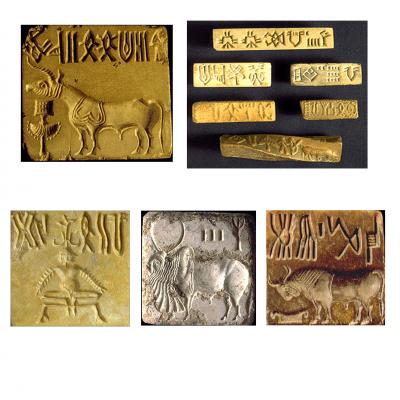

    Examples of the Indus script. The four square artifacts with animal and human iconography are stamp seals that measure one or two inches per side. On the top right are three elongated seals that have no iconography, as well as three miniature tablets (one twisted). The tablets measure about 1.25" long by 0.5" wide.  Credit: J. M. Kenoyer / Harappa.com

    "The Indus script has been known for almost 130 years," said Rajesh Rao, a UW associate professor of computer science and engineering and lead author of the study who is also an Indian native with a longtime personal interest in the subject. "Despite more than 100 attempts, it has not yet been deciphered. The underlying assumption has always been that the script encodes language."

    In 2004 a provocative paper titled "The Collapse of the Indus-Script Thesis" claimed that the short inscriptions have no linguistic content and are merely brief pictograms depicting religious or political symbols. That paper's lead author offered a $10,000 reward to anybody who could produce an Indus artifact with more than 50 symbols.

    So Rao led a statistical study of the Indus script, comparing the pattern of symbols to various linguistic scripts and nonlinguistic systems, including DNA and a computer programming language. The results in Science say they have found the Indus script's pattern is closer to that of spoken words, supporting the hypothesis that it codes for an as-yet-unknown language. 

    "We applied techniques of computer science, specifically machine learning, to an ancient problem," said Rao. "At this point we can say that the Indus script seems to have statistical regularities that are in line with natural languages." 

    The U.S.-Indian team of computer scientists and mathematicians looked at the statistical patterns in sequences of Indus symbols. They calculated the amount of randomness allowed in choosing the next symbol in a sequence. Some nonlinguistic systems display a random pattern, while others, such as pictures that represent deities, follow a strict order that reflects some underlying hierarchy. Spoken languages tend to fall between the two extremes, incorporating some order as well as some flexibility.

    The new study compared a well-known compilation of Indus texts with linguistic and nonlinguistic samples. The researchers performed calculations on present-day texts of English; texts of the Sumerian language spoken in Mesopotamia during the time of the Indus civilization; texts in Old Tamil, a Dravidian language originating in southern India that some scholars have hypothesized is related to the Indus script; and ancient Sanskrit, one of the earliest members of the Indo-European language family. In each case the authors calculated the conditional entropy, or randomness, of the symbols' order. 

    They then repeated the calculations for samples of symbols that are not spoken languages: one in which the placement of symbols was completely random; another in which the placement of symbols followed a strict hierarchy; DNA sequences from the human genome; bacterial protein sequences; and an artificially created linguistic system, the computer programming language Fortran.

    Results showed that the Indus inscriptions fell in the middle of the spoken languages and differed from any of the nonlinguistic systems. If the Indus symbols are a spoken language, then deciphering them would open a window onto a civilization that lived more than 4,000 years ago. The researchers hope to continue their international collaboration, using a mathematical approach to delve further into the Indus script.

    "We would like to make as much headway as possible and ideally, yes, we'd like to crack the code," Rao said. "For now we want to analyze the structure and syntax of the script and infer its grammatical rules. Someday we could leverage this information to get to a decipherment, if, for example, an Indus equivalent of the Rosetta Stone is unearthed in the future."

    Co-authors are Nisha Yadav and Mayank Vahia at the Tata Institute of Fundamental Research in Mumbai, India; Hrishikesh Joglekar, a software engineer from Mumbai; R. Adhikari at the Institute of Mathematical Sciences in Chennai, India; and Iravatham Mahadevan at the Indus Research Center in Chennai. The research was supported by the Packard Foundation and the Sir Jamsetji Tata Trust.


    Comments

    Even if a small linguistic component is added – rebus principle or punning (Witzel Kyoto, 2009 or Sproat in his presentations) or acriphony is added, it qualifies for full literacy. I assume some ’sound coding’ would have been useful to them atleast on some occasions.. the longest seal is 17 characters non-analomous and 26 characters analomous. I have never said that what Farmer is saying is necessarily fully wrong, but even Parpola has been reading them mostly as logograms with a linguistic component. So how much of what Farmer is saying is new apart from the fact that he popularized the idea? These men have been saying almost the same thing and fighting with each other?Till 2900 BC Egypt and Mesopotamia were considered proto-literate even if their texts are shorter(not non-literate!!!!)- even if there is small difference between the 2 maybe the Indus system was more expressive than Egyptian proto-literate- because conditional entropy, order of signs, combinations probably did play a major role in meaning in the Indus script (Korvink). ????Terminologies pertaining to literacy cannot be changed unless all scholars agree – and any demands to change terminology must be met with suspicion, naturally. Only a very small portion of the IVC has been excavated, you know, 5% maybe! Even Farmer agrees “Judging from modern examples and research in the linguistic history of South Asia, the Indus Valley was probably intensely multi linguistic throughout its history. This may have provided the Indus emblem system with an advantage over ordinary writing as a means of providing the civilization with social cohesion. The fact that the majority of inscriptions rely on a surprisingly small core of symbols suggests that the meaning of Indus signs could have potentially been known by almost or all (ALL!!) of the population, resulting in a pervasive quasiliteracy far beyond that achieved in Mesopotamia or Egypt.” (c) No other civlization mass produced writing or (”writing”!!). (d) Where else did they have public signboards then apart from the Indus?
    I can instead cite Farmer and declare it the most literate civilization on erth. And he and I could be saying the same thing. I say such terms must be avoided. if they had learned how to use the rebus principle , they would have used it whenever the need arose. Seal writing is always short . Sproat’s smoking gun cannot be used to test the stability or the complexity of the system. It has weaknesses. It cannot also be used to prove that the Indus script didn’t have a linguistic component.

    Sujay Rao Mandavilli

    logicman
    The Steve Farmer article cited is available as a free download, together with many more excellent articles and resource links here: http://www.safarmer.com/downloads/


    Given that the objects are interpreted as seals, perhaps they are simply records of taxes paid.  The area in question has long been a trade crossroads where languages meet.  Perhaps the symbols represent a bureaucratic pidgin for taxes paid on fish, animals and produce sold, and perhaps fees paid for permits to set up stall in the markets.


    The tin man of Oz sets up his market pitch.


    There is, of course, another plausible hypothesis, again based in the known geology of the Indian subcontinent.  The symbols could be the first recorded attempt by scientists to explain why there has been so much talk of earthquakes lately.
    The Harappans had the oldest “signboard” in the world, apparently. They mass produced writing (or “writing”) . According to Parpola, 1/10th of
    Mohendodaro (100 square metres) has yielded 2100 seals (with 9000 characters?). Or more than one character per person. I declare the Indus the most literate civilization on earth as every body could ‘read and write’ – Farmer.
    This makes the debate so shallow it is nearly ridiculous. After all what then is the difference beteween the Indus and civilizations which did not yield any trace of writing? History is a subject after all and is taught everywhere in the world. Don’t mislead people deliberately and try to deceive them by using wrong terminology!

    Very painstaking work has been done by Michael Korvink on the structure of the Indus script. it runs to 210 pages

    Looking at the various statistical analysis, count of sign frequencies, and calculating the entropy in Indus writing I wonder why nobody distinguishes between different text classes or artefact types. Bryan Wells in his dissertation "Epigraphic Approaches To Indus Writing" defined different text classes based on different sign patterns. He also shows that sign usage depends on the artefact, e.g. seals versus tablets versus potter marks. Altogether this indicates the possibility of different context of the inscriptions, e.g. economic versus narrative. These differences have a big influence on the statistic of signs, sign pattern, and sign inventory not recognized before.

    Pleased to announce the publication of my paper ‘The reconfirmation and reinforcement of the Indus script’ . This shows why the Indus script was a logo-syllabic script and longer texts certainly existed in the Indus. This shows why Sproat’s smoking gun is wholly invalid. If Farmer chooses to disagree with me, he has to reply to me point by point. Back to square one

    http://www.scribd.com/doc/46387240/Sujay-Indus-Script-Final-Version-Fina...

    sujay

    Few sensible scholars will be able to deny that the Indus script was a logo-syllabic script. Facts about the Dholavira signboard
    (a) It is one of the most famous of Harappan inscriptions.
    (b) It was very large in size.
    (c) It was located in Far from Mesopotamia Dholavira and in one of the furthest sites from Mesopotamia.
    (d) It hung over the citadel there.
    (e) It must have represented the name of the place and must have been closely tied to speech: note the sign repetition.
    (f) The sign which was used as a determinative was a very common Indus sign.
    (g) The sign used as a determinative appears to have been also similar to determinatives in other writing systems.
    (h) The Indus script was also related to Proto-Elamite which means it probably had a linguistic component.
    (i) The other signs with which the determinative was used were also common Indus signs.
    (j) Few sensible scholars will now dispute the fact that the Indus script was a logo-syllabic script on the basis of this evidence.
    (k) Few sensible scholars will deny the fact that speech encoding was one of the major functions of the Indus script and had this feature had reached a very precocious maturity.
    (l) This inscription was apparently more closely tied to speech than most proto-Elamite inscriptions.
    (m) Dholavira was not even the most important of sites.
    (n) The fact that it was hung over the citadel meant it was meant to be read by elites.
    (o) It was put to the most frivolous use.
    (p) Speech encoding would have been a prized possession: no one would have used it just for a decorative signboard at far-from-Mesopotamia Dholavira. Why would a man who had inscribed this, done so (a) if nobody else could read it (b) why would he have learnt to encode speech only to inscribe this signboard? This automatically implies the existence of longer texts. It also shows that the Indus elites used more complex forms of communication.
    (q) Even if we assume that speech-encoding was added in Mature Harappan 3B, this logic would still hold good.
    (r) This logic is already accepted by mainstream Indus archaeologists as a precursor to the existence of longer texts

    please refer to the book by Jane Macintosh (Mcintosh 2008 p 374) "The Harappans did not create monumental art or architecture on which such inscriptions may have been written. The nearest that the Harappans came to this is the Dholavira signboard which is quite possibly the tip of the iceberg of a now vanished public inscriptions.Farmers arguments fail to account convincingly for the structural regularities that analysis have revealed in the use of Harappan signs. These strongly seem to support the hypothesis that the Indus script represent a writing system"
