

Banner
    Lots Of Dark Matter Near The Sun, Says Computer Model
    By News Staff | August 9th 2012 11:44 AM | 14 comments | Print | E-mail | Track Comments
    Dark matter, up to 25 percent of the universe, hasn't actually been found. It is a hypothesis, though not an unreasonable one, given that something must create a gravitational force.

    But science has mapped the motions of more than 400 stars, up to 13,000 light-years from the Sun, and calculated the mass of material in the vicinity of the Sun in a volume four times larger than ever considered in the past and found it isn't there, disputing prior studies claiming 3-6 times more 'dark matter' than expected using Jan Oort's discovery that the density of matter near the Sun was nearly twice what could be explained by the presence of stars and gas alone.

    What's wrong?  Computer simulations, basically. So a group of researchers has created another one and this time they say all the other numerical models were biased, always tending to underestimate the amount of dark matter. How does anyone know this model is not biased, since dark matter can't be measured and measured data and calibration is the heart of any accuracy determination?  Indeed.
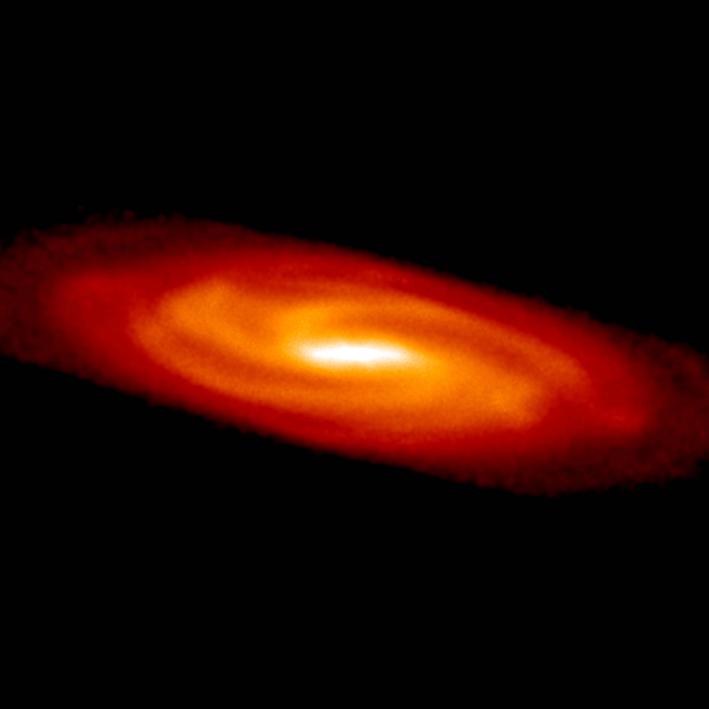

    A high resolution simulation of the Milky Way used to test their mass-measuring technique. Picture: University of Zurich

    But a new group has claimed a new unbiased technique that recovered the correct answer from the simulated data - building a model to match data would get you fired in the private sector, since that means it won't work for any other problem, but academia is more forgiving. Applying their technique to the positions and velocities of thousands of orange K dwarf stars near the Sun, they obtained a new measure of the local dark matter density and now say it is there.

    "We are 99% confident that there is dark matter near the Sun," says lead author Silvia Garbari. They find more dark matter than expected at 90% confidence, meaning there is a 10% chance that this is merely a statistical fluke. Silvia explains: "This could be the first evidence for a "disc" of dark matter in our Galaxy, as recently predicted by theory and numerical simulations of galaxy formation, or it could mean that the dark matter halo of our galaxy is squashed, boosting the local dark matter density."

    Some are placing their bets on dark matter being a new fundamental particle that interacts only very weakly with normal matter, but strongly enough to be detected in experiments deep underground. An accurate measure of the local dark matter density is vital for such experiments, says co-author Prof. George Lake. "If dark matter is a fundamental particle, billions of these particles will have passed through your body by the time your finish reading this article. Experimental physicists hope to capture just a few of these particles each year in experiments like XENON and CDMS currently in operation. Knowing the local properties of dark matter is the key to revealing just what kind of particle it consists of."


    Citation: Silvia Garbari, Chao Liu, Justin I. Read, George Lake. A new determination of the local dark matter density from the kinematics of K dwarfs. Monthly Notice of the Royal Astronomical Society. 9 August, 2012. 2012arXiv1206.0015G.


    Comments

    > Dark matter, up to 25 percent of the universe

    It is far, far more than just 25%

    Hank
    No, you are confusing universe with mass.
    Want more no-nonsense, independent science? Buy Science Left Behind
    Halliday
    Hank:

    Technically, "dark matter" makes up about 25% of the mass-energy of today's universe.  It made up a significantly greater portion of the mass-energy of the universe at the time of the emission of the Cosmic Microwave Background (CMB) radiation.

    You are also correct that it makes up a significantly greater portion of the matter (mass) of both today's universe, and that of the past.

    David

    Hank
    Sure, it must be around 83% of matter and that is why the first commenter was confused - but only 25% of the universe, since that is only 5% matter and the rest is whatever 'dark energy' turns out to be.
    Want more no-nonsense, independent science? Buy Science Left Behind
    Halliday
    Hank:

    I understood what you thought was the confusion of "the first commenter".  However, I was also trying to point out that any "% of the universe" is not actually meaningful.  One must be comparing things of the same "kind", and in the same units for any such comparison of "proportion" to make any sense.

    This is why I emphasized "mass-energy":  That is the "kind" of "stuff" being compared, and the units of such "stuff" is the units used in the comparison.  (The other is the matter [mass] of the universe.  What if one were to attempt to compare the volume of various constituents of the universe?)

    Additionally, the comparison is not static, it is time dependent (present universe vs. some past time for the universe).  This is why I specified "today's universe", vs. some past time (like when the CMB radiation was emitted).

    Such are necessary for full understanding, rather than the use of vague, unstated assumptions.  (It's about science, after all.  ;)  )

    David

    If the dark matter is in a disc, doesn't that imply it is interacting with a force other than gravity and pobably stronger than the weak force? It would need to interact with its own particles to reduce the energy and flatten into a disc.

    MikeCrow
    I don't think so, most of the mass of the galaxy is in a disk too.
    Never is a long time.
    KatSeiko
    I am not really believing in a force that we can not see or measure. It is just as plausible as "God" being the creator of everything when stone-age man was unable to imagine things like evolution and the big bang. I am sure that there are other forces at work. Like the effect called vacuum energy. We measure them to an accuracy of maybe 10 digits after the comma. And when we try to upscale them to billions and billions of times to get a model for a galaxy, we are off by a few percent. Of cause, it is easy to make dark matter and dark energy take the fall for it. Or you can try to get your numbers straight. All the gas, the stars and planets in the galaxy create gravitational forces towards each other, and a black hole sits in the center. We don't know what it does to gravity when an object spins so fast that its outer layers may reach (or even break?) the limit of light speed. Every object becomes faster in spinning motion when they collapse, and according to model, a black hole is a star with multiple sun masses collapsed to the size of a pin needle head.
    Halliday
    Thomas:

    Do you actually think that "dark matter" is a "force"?

    Furthermore, "the effect called vacuum energy" is already a candidate for what is referred to as "dark energy".

    First off, both "dark matter" and "dark energy" are "blanket" placeholder terms for effects we see, and are able to measure (that's very important), that we scientists are not yet sure what is causing the measurable effects.

    "Dark matter" behaves, gravitationally and inertially, like any other form of matter.  The only difference is that whatever it is, it doesn't appear to interact electromagnetically like any other form of matter:  It doesn't absorb, reflect, or emit light at any wavelengths we have been able to probe; and it doesn't seem to "stick" to any other matter, or, apparently, even to itself.

    You are correct that we must work "to get [our] numbers straight."  There are even some of us that think at least part of the "problem" may have more to do with the use of Newtonian Mechanics and Gravity as an approximation, rather than full General Relativity.  (Admittedly, it's far easier to apply Newtonian Mechanics and Gravity than full General Relativity.  So its use is quite understandable.)

    However, "black holes", "brown dwarfs", "rough planets/planetoids", "weakly interacting massive particles", and other candidates, have all been considered as candidates for the "blanket" placeholder term labelled "dark matter".

    We actually do know, quite well, using General Relativity, what the effects of a "black hole" have on gravity.

    You are quite correct that "Every object becomes faster in spinning motion when they collapse".  However, "according to the model" of "black holes", in General Relativity, a spinning "black hole" does not "collapse to the size of a pin needle head."

    Only non-spinning "black holes" collapse to a "point" (according to the Schwarzchild solution, which is only a static and spherically symmetric solution to General Relativity [as it was derived to be] outside the event horizon, so, inside the event horizon, it doesn't even satisfy the conditions to which is was supposed to adhere [but that's an issue for another time and place]).

    Spinning "black holes" satisfy a very different solution to General Relativity:  The Kerr solution.  In this case, the matter is concentrated into a ring or disk, not a "point", so there is no trouble, whatsoever, with conservation of angular momentum.

    David

    I largely agree with you Thomas. Since Dark Matter is nothing more than unaccounted-for mass that produces an excess of gravity, it doesn’t seem reasonable to make up a religious-like name for it. I mean, of course it’s a mystery, but why make it even more mysterious? You list some great candidates that could better explain the mystery. Black Holes by nature/definition are far from entirely-understood and could be the source of the excess gravity, especially super-massive ones. IOW, why not attribute the missing matter to black holes and attribute the excess gravity to under-assessments of their mass and/or their behavior? This is called a “hypothesis” and it’s done all the time in science. While it might be countered with “but DM is a hypothesis”, I would disagree. DM takes a known and attributes it to an absolute unknown, instead of attributing it to a partially-unknown (BETTER candidate). DM is like attributing an animal’s Magnetoception to God rather than a yet-to-be-fully-understood instinct/gland/sense.

    Halliday
    Mark:

    You are (more or less) correct that " Dark Matter is nothing more than unaccounted-for mass that produces an excess of gravity".

    The "religious-like name for it" ("Dark Matter", as you wrote it [scientists usually use all lower case]) is nothing more, nor less, that a "blanket" placeholder for whatever that "unaccounted-for mass that produces an excess of gravity" may be (even if it is nothing more than another difference between Newtonian Mechanics and Gravity vs. General Relativity, or some other theory of gravity).

    It's simply a name/moniker.

    As I've already told Thomas, above, "black holes" and other candidates have and are already being considered as "dark matter" candidates.  (However, "super-massive" "black holes" are easily dismissed, due to the observational lack of gravitational lensing such objects would exhibit.  Smaller "black holes" with sufficiently minute "micro-"lensing may still be candidates, but then we start to run into an issue of how could so many small mass "black holes" be roaming through our galaxy?)

    So, like I (essentially) told Thomas:  "dark matter" isn't the hypothesis, in and of itself, but is a "blanket" placeholder for the actual, individual candidate hypotheses (or a combination thereof).  It allows us to talk about multiple hypotheses at once.  It also provides for a "blanket" term under which we may catalog the observational characteristics (and lack thereof) of this "unaccounted-for mass that produces an excess of gravity".  (Isn't "dark matter" a simpler moniker than something as cumbersome as "unaccounted-for mass that produces an excess of gravity"?)

    David

    blue-green

    As far as us mortals are concerned, the main thing to remember about dark matter is that it does not interact with us or any of the colorful matter that we have come to know and love. It because of this lack of interaction that it cannot be observed directly or even remotely easily. The happy lesson to take home is that we are indeed shiny objects in the center of all that glows and glitters. Light doesn't give a fig about dark matter. Neither do 99.999% of the chemical reactions going on about us. The Standard Model may only cover a 4% minority in terms of matter and energy, and yet, we are in the middle of all that is bright and shiny and jumps about. Dark matter is like the somber foundations of a building. It's necessary, and yet, you really don't notice it in daily life …. unless there is an “earthquake”, which could be a metaphor for a big bang or gravitational collapse; out-of-sight, out-of-mind and over the horizons. Dark energy is like the atmosphere around a building. Necessary, yet far removed from interacting with the luminous beings inside.

    David, Thomas, blue-green et al.,
    As an interested scientist but not a physicist I'd like to thank you for these exchanges which have been very clear and very helpful to those of us trying to follow the developments.

    With all due respect to our Nobel Prize winning physicists,
    For an alternate theory to the General Theory of Relativity, please refer to my face book. The graphics cannot be copy/pasted.

    In a consistent way, this new theory explains all of the known gravity related phenomena such as:

    1- Galileo’s experiment,
    2- Accumulative effects of gravity,
    3- The governing laws of gravity,
    4- The bending of light, as it passes nearby a star or a distant galaxy,
    5- The extreme force of gravity near black holes,
    6- The existence of dark matter in the entire universe,
    7- The density gradient observed in the Dark Matter concentrations in solar systems and galaxies,
    8- The existence of dense halos of dark matter around galaxies,
    And particularly,
    9- The instantaneous effect of the gravitational force, with speeds that by far exceed the speed of light in space, and
    10- There is no need for curved space dimensions

    If you would, please look at my face book, “Bahram Esmailzadeh”. It provides enough details to persuade anyone of its useful potential.

    I would appreciate any kind of comment you might have in regards to this new theory.
    Thank you for your time.

    Take care and may everyone have a very pleasant day.
    Bahram965@gmail.com
