

Plant compounds from a South African daffodil may be used to treat depression, according to a University of Copenhagen study, where they tested those substance in a laboratory model of the blood-brain barrier.
Substances from the South African plant species Crinum and Cyrtanthus – akin to snowdrops and daffodils, respectively – have characteristics that enable them to negotiate the defensive blood-brain barrier, a key challenge in all new drug development.
Obviously you should not run out and start eating daffodils just yet. The lab test does not show which compounds can be used in drug development.
Associate Professor Birger Brodin says, "Several of our plant compounds can probably be smuggled past the brain's effective barrier proteins. We examined various compounds for their influence on the transporter proteins in the brain. This study was made in a genetically-modified cell model of the blood-brain barrier that contains high levels of the transporter P-glycoprotein. Our results are promising, and several of the chemical compounds studied should therefore be tested further, as candidates for long-term drug development.
"The biggest challenge in medical treatment of diseases of the brain is that the drug cannot pass through the blood-brain barrier. The blood vessels of the brain are impenetrable for most compounds, one reason being the very active transporter proteins. You could say that the proteins pump the drugs out of the cells just as quickly as they are pumped in. So it is of great interest to find compounds that manage to 'trick' this line of defence."
Discovering a new cure in 'Nature's medicine chest' will also take interdisciplinary work between chemists and biologists.
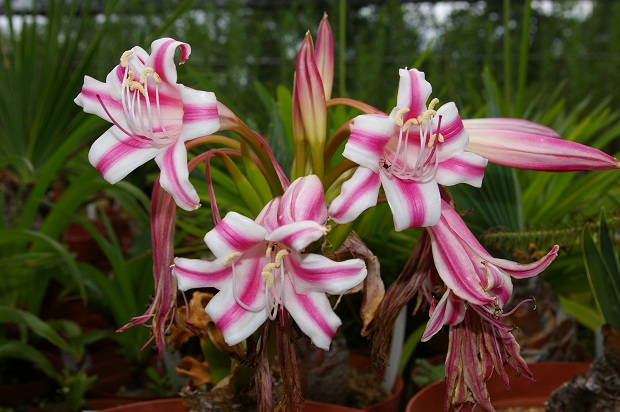
Crinum from South Africa. . Photo: Gary I. Stafford
Throughout evolution, plants have developed a number of substances as defenses against herbivores and disease and some of those plant compounds can also be used as medical drugs.
André Huss Eriksson, a research scientist at Bioneer:FARMA, and Associate Professor Birger Brodin contacted Associate Professor Anna Jäger of the Department of Molecular Drug Research and Associate Professor Nina Rønsted of the Natural History Museum of Denmark, who both work with medicinal plants that affect the central nervous system to collaborate on this new work.
"In my research group, we have had a long-term focus on the body’s barrier tissue – and in recent years particularly the transport of drug compounds across the blood-brain barrier. More than 90 per cent of all potential drugs fail the test by not making it through the barrier, or being pumped out as soon as they do get in. Studies of natural therapies are a valuable source of inspiration, giving us knowledge that can also be used in other contexts," said Birger Brodin.
Citation: Eriksson, A. H., Rønsted, N., Güler, S., Jäger, A. K., Sendra, J. R. and Brodin, B. (2012), 'In-vitro evaluation of the P-glycoprotein interactions of a series of potentially CNS-active Amaryllidaceae alkaloids', Journal of Pharmacy and Pharmacology. doi: 10.1111/j.2042-7158.2012.01536.x

Substances from the South African plant species Crinum and Cyrtanthus – akin to snowdrops and daffodils, respectively – have characteristics that enable them to negotiate the defensive blood-brain barrier, a key challenge in all new drug development.
Obviously you should not run out and start eating daffodils just yet. The lab test does not show which compounds can be used in drug development.
Associate Professor Birger Brodin says, "Several of our plant compounds can probably be smuggled past the brain's effective barrier proteins. We examined various compounds for their influence on the transporter proteins in the brain. This study was made in a genetically-modified cell model of the blood-brain barrier that contains high levels of the transporter P-glycoprotein. Our results are promising, and several of the chemical compounds studied should therefore be tested further, as candidates for long-term drug development.
"The biggest challenge in medical treatment of diseases of the brain is that the drug cannot pass through the blood-brain barrier. The blood vessels of the brain are impenetrable for most compounds, one reason being the very active transporter proteins. You could say that the proteins pump the drugs out of the cells just as quickly as they are pumped in. So it is of great interest to find compounds that manage to 'trick' this line of defence."
Discovering a new cure in 'Nature's medicine chest' will also take interdisciplinary work between chemists and biologists.

Crinum from South Africa. . Photo: Gary I. Stafford
Throughout evolution, plants have developed a number of substances as defenses against herbivores and disease and some of those plant compounds can also be used as medical drugs.
André Huss Eriksson, a research scientist at Bioneer:FARMA, and Associate Professor Birger Brodin contacted Associate Professor Anna Jäger of the Department of Molecular Drug Research and Associate Professor Nina Rønsted of the Natural History Museum of Denmark, who both work with medicinal plants that affect the central nervous system to collaborate on this new work.
"In my research group, we have had a long-term focus on the body’s barrier tissue – and in recent years particularly the transport of drug compounds across the blood-brain barrier. More than 90 per cent of all potential drugs fail the test by not making it through the barrier, or being pumped out as soon as they do get in. Studies of natural therapies are a valuable source of inspiration, giving us knowledge that can also be used in other contexts," said Birger Brodin.
Citation: Eriksson, A. H., Rønsted, N., Güler, S., Jäger, A. K., Sendra, J. R. and Brodin, B. (2012), 'In-vitro evaluation of the P-glycoprotein interactions of a series of potentially CNS-active Amaryllidaceae alkaloids', Journal of Pharmacy and Pharmacology. doi: 10.1111/j.2042-7158.2012.01536.x




In this blog the scientist Associate Professor Birger Brodin is quoted as saying :-
Genetically modifying and combining dog and human genes into kidney cells to test 9 plant alkaloids effects on the resulting cell's ability to still be able to remove or 'pump' out drugs in itself seems quite amazing to me. Yes, it would be good to find ways of circumventing the blood brain barrier for many drugs, including anti-depressants and cancer drugs but this could surely also have potentially some other quite deleterious effects upon Pgp's very extensive functionality around our bodies, in our intestines, kidneys, adrenals and blood for example and even upon our resistance to horizontal gene transfer from the GMO Bt antibiotic resistant bacteria in our GMO food in our intestines?
According to this scientific report called 'GMO Myths and Truths' The transfer of genetically modified (GM) genes from food to intestinal bacteria has already been documented to have occurred in a study on humans, which found that 'the intestinal bacteria of a person whose diet included soy carried sequences unique to the GM soy that was part of their diet'. see reference 165 below. This is already occurring before we then go on in this study to interfere with what is left of MDR1 and P-gp's ability to maintain these human and animal internal membrane's blood barriers to horizontal gene transfer from antibiotic and spray resistant GMOs and their Bt bacteria for example.
A scientific study on mice has demonstrated that foreign DNA present in GMO food can be transferred from the digestive tract to the bloodstream of animals that eat this GMO food. The foreign, horizontally transferred GMO DNA was also found in white blood cells and in the cells of many other tissues of the mice. See reference 170 below. Even worse it has been found in the organs of their babies :-Do other people feel a bit nervous about this or am I just being neurotic by imagining these potentially deleterious effects of these plant alkaloid GMO experiments on P-glycoprotein 1 (Pgp) also known as multidrug resistance protein 1 (MDR1) that in humans is encoded by the ABCB1 gene, further enhancing the ability for dangerous horizontal gene transfer of the DNA in antibiotic resistant, insecticidal Bt bacteria from the GMO food in our guts to occur?