Banner
Pilot Study: Fibromyalgia Fatigue Improved By TENS Therapy

Fibromyalgia is the term for a poorly-understood condition where people experience pain and fatigue...

High Meat Consumption Linked To Lower Dementia Risk

Older people who eat large amounts of meat have a lower risk of dementia and cognitive decline...

Long Before The Inca Colonized Peru, Natives Had A Thriving Trade Network

A new DNA analysis reveals that long before the Incan Empire took over Peru, animals were...

Mesolithic People Had Meals With More Tradition Than You Thought

The common imagery of prehistoric people is either rooting through dirt for grubs and picking berries...

User picture.
News StaffRSS Feed of this column.

News Releases From All Over The World, Right To You... Read More »

Blogroll


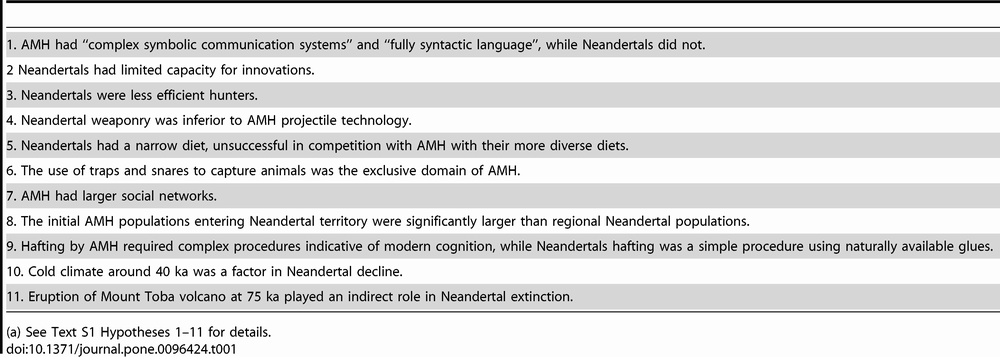
It's common to perceive Neanderthals as more big-headed primitives and Cro-Magnon as more like us, but we were all primitive cavemen. It takes a biologist to really know the difference.

So if you think Neanderthals were stupid and primitive, it's time to think again.  

The oldest sections of transform faults, such as the North Anatolian Fault Zone and the San Andreas Fault, produce the largest earthquakes, putting important limits on the potential seismic hazard for less mature parts of fault zones, according to a new presentation ("Fault-Zone Maturity Defines Maximum Earthquake Magnitude") at the Seismological Society of America 2014 Annual Meeting in Anchorage.

Babies begin to learn about the connection between pictures and real objects by the time they are nine-months-old, according to a new paper in Child Development.

Babies can learn about a toy from a photograph of it well before their first birthday, the scholars from Royal Holloway, University of London, and the University of South Carolina found. 

Researchers familiarized 30 eight and nine-month-olds with a life-sized photo of a toy for about a minute. The babies were then placed before the toy in the picture and a different toy and researchers watched to see which one the babies reached for first.

New research has helped unpick a long-standing mystery about how dietary fibre supresses appetite.

In a study led by Imperial College London and the Medical Research Council (MRC), an international team of researchers identified an anti-appetite molecule called acetate that is naturally released when we digest fibre in the gut. Once released, the acetate is transported to the brain where it produces a signal to tell us to stop eating.

The research, published in Nature Communications, confirms the natural benefits of increasing the amount of fibre in our diets to control over-eating and could also help develop methods to reduce appetite. The study found that acetate reduces appetite when directly applied into the bloodstream, the colon or the brain.

Direct current - DC - electricity is used by us every day. If you see a blocky black thing on a power cord, that is a transformer and it turns alternating current (AC) electricity into DC that is used by a device.

In the early days of mass electricity, it was Tesla (and then Westinghouse) versus Edison to create an electricity standard. Edison eventually lost because high-voltage AC electricity meant it could go longer distances - and that meant fewer dirty power plants in city neighborhoods. But the device you are reading this on uses DC power, because it needs to work in a 0 and 1 state and with AC, that 1 is always changing. Tell an electrical engineer you want your two-pole transistor to work with three-phase AC and he will throw a copy of Kreyszig at you.

 A new paper suggests that dopamine release is increased in obsessive-compulsive disorder (OCD) and may be normalized by the therapeutic application of deep brain stimulation (DBS). The authors of the paper in Biological Psychiatry
 characterize dopamine as the 'elixir of pleasure' because so many rewarding stimuli – food, drugs, sex, exercise – are correlated to its release in the brain.

Yet research also indicates that when drug use becomes compulsive, the related dopamine release becomes deficient in the striatum, a brain region that is involved in reward and behavioral control.