Banner
Pilot Study: Fibromyalgia Fatigue Improved By TENS Therapy

Fibromyalgia is the term for a poorly-understood condition where people experience pain and fatigue...

High Meat Consumption Linked To Lower Dementia Risk

Older people who eat large amounts of meat have a lower risk of dementia and cognitive decline...

Long Before The Inca Colonized Peru, Natives Had A Thriving Trade Network

A new DNA analysis reveals that long before the Incan Empire took over Peru, animals were...

Mesolithic People Had Meals With More Tradition Than You Thought

The common imagery of prehistoric people is either rooting through dirt for grubs and picking berries...

User picture.
News StaffRSS Feed of this column.

News Releases From All Over The World, Right To You... Read More »

Blogroll

Washington, DC (April 24, 2014) — Many kidney failure patients in Australia who could benefit from undergoing dialysis at home are being treated in hospitals and dialysis units, according to a study appearing in an upcoming issue of the Clinical Journal of the American Society of Nephrology (CJASN). This is creating significant costs for healthcare providers and causing unnecessary disruptions to patients' lives.

If you really care about the climate, you can stop filling out surveys and complaining about what people believe and do something more meaningful than buy carbon credits - you can give up meat. 

And 11 other things that can separate you from the pack that are more interested in uniform bans and mitigation. Those won't work. Take the initiative and it doesn't matter what anyone else does.

A new report, Strategies for Mitigating Climate Change in Agriculture by Mitigation 2014, says it can eliminate the climate nosedive that will occur if people continue to eat meat and use air conditionin. It just needs people in richer countries who claim they care about emissions to show it.

A research team lead by Academy Professor Kari Rissanen at the University of Jyväskylä has discovered a new water-soluble fluorescent detection system that is extremely sensitive to pyrophosphate (PPi).

Pyrophosphate has a key role in energy transduction, DNA replication and other metabolic processes that are dysregulated in cancer cells.

The discovery might lead to the development of a method for early detection of cancer cells.

Scientists at the University of Liverpool have been part of a ten-year project which has successfully sequenced the genetic code of the tsetse fly – making major advances in disease control possible.

Tsetse flies are unique to Africa and can infect people bitten by them with sleeping sickness, a disease which damages the nervous system and is fatal if untreated. This kills over 250,000 people each year.

Traditional methods of control such as releasing sterile males, trapping and pesticide spraying are expensive and difficult to implement. Sleeping sickness can also evade the immune system, making a vaccine hard to create, so the genetic information will allow researchers to develop alternative strategies to control the disease.

Modesto, CA (April 25, 2014) - Six new almond-related research studies will be presented next week in San Diego at the American Society of Nutrition (ASN)'s Scientific Sessions and Annual Meeting, held in conjunction with Experimental Biology 2014 (EB). The conference attracts an international audience of approximately 13,000 leading scientists specializing in various health disciplines.

The science presented will reveal new insights on the effects of almond consumption on overall diet quality and health status, abdominal adiposity, measures of appetite and satiety, and cardiovascular risk factors.

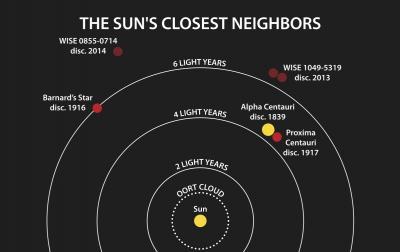
A "brown dwarf" star with the catchy name of  WISE J085510.83-071442.5 appears to be the coldest of its kind.

When people think of stars, they think of hot fusion plasma bubbling and erupting.  WISE J085510.83-071442.5,  7.2 light-years away, making it the fourth closest system to our sun, is instead as frosty as Earth's North Pole.

The locations of the star systems that are closest to the Sun.
The year when each star was discovered to be a neighbor of  the
Sun is indicated. The brown dwarf WISE J085510.83-071442.5
is the fourth nearest system to the Sun. Credit: Janella Williams,