Banner
Pilot Study: Fibromyalgia Fatigue Improved By TENS Therapy

Fibromyalgia is the term for a poorly-understood condition where people experience pain and fatigue...

High Meat Consumption Linked To Lower Dementia Risk

Older people who eat large amounts of meat have a lower risk of dementia and cognitive decline...

Long Before The Inca Colonized Peru, Natives Had A Thriving Trade Network

A new DNA analysis reveals that long before the Incan Empire took over Peru, animals were...

Mesolithic People Had Meals With More Tradition Than You Thought

The common imagery of prehistoric people is either rooting through dirt for grubs and picking berries...

User picture.
News StaffRSS Feed of this column.

News Releases From All Over The World, Right To You... Read More »

Blogroll
The universe we can see is made up of billions of galaxies, each containing anywhere from hundreds of thousands to hundreds of billions of stars.

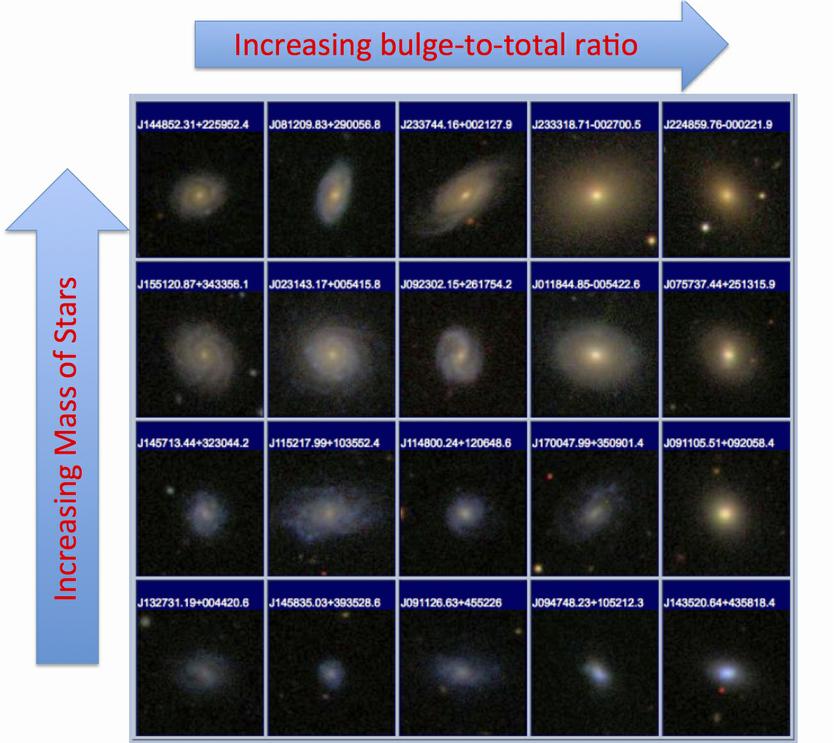
Large numbers of galaxies are elliptical in shape, red and mostly made up of old stars. Another (more familiar) type is the spiral, where arms wind out in a blue thin disk from a central red bulge.

On average stars in spiral galaxies tend to be much younger than those in ellipticals.

Now a group of astronomers led by Asa Bluck of the University of Victoria in Canada have found a (relatively) simple relationship between the color of a galaxy and the size of its bulge – the more massive the bulge the redder the galaxy.
Relativity says that spacetime is smooth, and only big things can warp it, in ways that are exactly known. Quantum theory says that the smallest parts of the universe are constantly fluctuating and dramatically uncertain. How can something be both smooth and fluctuating, both exact and uncertain?

How, in other words, can we make a quantum theory of gravity? It's unknown. String theory and loop quantum gravity have tried, but a unified theory has remained out of reach.

Enter – of all things – condensed matter physics.

SensaBubble is a chrono-sensory mid-air display system that generates scented bubbles to deliver information to people using different senses. The bubble-based technology creates bubbles with a specified size and frequency, fills them with an opaque fog that is optionally scented, controls their route, tracks their location and projects an image onto them.

Man or woman? Male or female?

Modern sociological woo about gender aside, in humans and other mammals, the difference between the sexes depends on one single element of the genome: the Y chromosome. It is present only in males, where the two sexual chromosomes are X and Y, whereas women have two X chromosomes. Thus, the Y is ultimately responsible for all the morphological and physiological differences between males and females.

Shark data collected by citizen scientists may be as reliable as data collected using automated tools, according to results published April 23, 2014, in the open access journal PLOS ONE by Gabriel Vianna from The University of Western Australia and colleagues.

While creating new springs to support a cephalopod-inspired imaging project, a group of Harvard researchers stumbled upon a surprising discovery: the hemihelix, a shape rarely seen in nature.