Banner
Pilot Study: Fibromyalgia Fatigue Improved By TENS Therapy

Fibromyalgia is the term for a poorly-understood condition where people experience pain and fatigue...

High Meat Consumption Linked To Lower Dementia Risk

Older people who eat large amounts of meat have a lower risk of dementia and cognitive decline...

Long Before The Inca Colonized Peru, Natives Had A Thriving Trade Network

A new DNA analysis reveals that long before the Incan Empire took over Peru, animals were...

Mesolithic People Had Meals With More Tradition Than You Thought

The common imagery of prehistoric people is either rooting through dirt for grubs and picking berries...

User picture.
News StaffRSS Feed of this column.

News Releases From All Over The World, Right To You... Read More »

Blogroll
Live electronic music is an oxymoron. Clearly if you have hired Paris Hilton as a deejay, you are not hiring her because she is any sort of keen ear. If she never showed up, the music would go on.

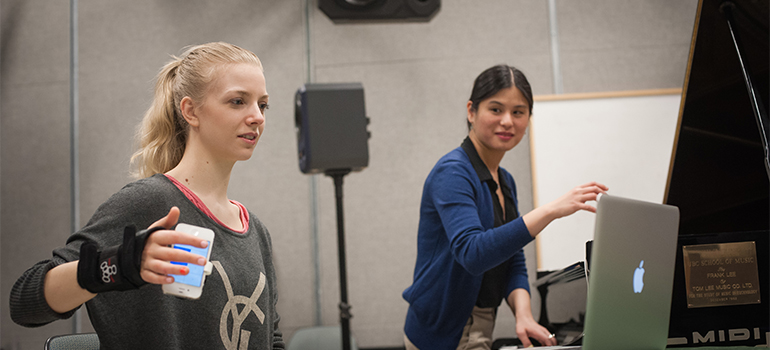
University of British Columbia music professor Bob Pritchard has seen enough uninspiring laptop music sets to know what is wrong with the genre - backing tracks can only take you so far - and has an idea how to fix it.

Pritchard and UBC’s Laptop Orchestra believe digital cameras and other gadgets might just save live electronic music from itself - so they did a concert without actually touching their laptops. 

“That’s one of our rules,” says Pritchard, “Avoid touching the laptop!”

Self-healing materials can repair themselves by restoring their initial molecular structure after the damage and scientists from Evonik Industries
and the Karlsruhe Institute of Technology have developed a chemical crosslinking reaction that ensures good short-term healing properties of the material under mild heating.   

Researchers recently used an array of high-speed video cameras operating at 7,500 frames a second to capture the wing and body motion of Drosophila hydei
after they encountered an image of an approaching predator. 

The fruit flies are about the size of a sesame seed and rely on a fast visual system to detect approaching predators. And scientists found out that even Top Gun pilots might be envious of the screaming-fast banked turns and slick moves the flies employed. In the midst of a banked turn, the flies can roll on their sides 90 degrees or more, almost flying upside down at times.

In 2017, the British will introduce a new coin that should be difficult to counterfeit. 

The last time a Queen Elizabeth sat on the throne they tried the same thing, to deter “divers evil persons” from damaging the reputation of English coinage and, with it, the good name of the nation. And they tried it plenty of times since. And before.

As long as there has been money, there has been counterfeiting. Today, the Royal Mint estimates retailers lose about $25 million a year due to counterfeits and up to 3% of their £1 coins are fake.

How is nitrogen removed from the ocean? Some new findings may provide answers.

The debate centers on how nitrogen, one of the most important food sources for ocean life and a controller of atmospheric carbon dioxide, becomes converted to a form that can exit the ocean and return to the atmosphere where it is reused in the global nitrogen cycle. 

Researchers have argued over which of two nitrogen-removal mechanisms, denitrification and anammox, is most important in the oceans. The question is not just a scientific curiosity, but has real world applications because one mechanism contributes more greenhouse gases to the atmosphere than the other.

This news release is available in German.

Apoptosis is used by cells that are changed by disease or are simply not needed any longer to eliminate themselves before they become a hazard to the body—on a cellular level, death is part of life. Disruption of this process can lead to cancer or immunodeficiencies, but also to autoimmune diseases, in which cells attack their own body.