Banner
Synchrotron Could Shed Light On Exotic Dark Photons

There are many hypothetical particles proposed to explain dark matter and one idea to explore how...

The Pain Scale Is Broken But This May Fix It

Chronic pain is reported by over 20 percent of the global population but there is no scientific...

Study Links Antidepressants, Beta-blockers and Statins To Increased Autism Risk

An analysis of 6.14 million maternal-child health records  has linked prescription medications...

Pilot Study: Fibromyalgia Fatigue Improved By TENS Therapy

Fibromyalgia is the term for a poorly-understood condition where people experience pain and fatigue...

User picture.
News StaffRSS Feed of this column.

News Releases From All Over The World, Right To You... Read More »

Blogroll

Research carried out at MIT's Alcator C-Mod fusion reactor may have brought the promise of fusion as a future power source a bit closer to reality, though scientists caution that a practical fusion powerplant is still decades away.

Fusion, the reaction that produces the sun's energy, is thought to have enormous potential for future power generation because fusion plant operation produces no emissions, fuel sources are potentially abundant, and it produces relatively little (and short-lived) radioactive waste. But it still faces great hurdles.

"There's been a lot of progress," says physicist Earl Marmar, division head of the Alcator Project at the MIT Plasma Science and Fusion Center (PSFC). "We're learning a lot more about the details of how these things work."

Scientists at the Swedish medical university Karolinska Institutet have determined the first 3D structure of ZP3, a protein essential for the interaction between the mammalian egg coat and sperm. The findings, presented in Nature, gives a first glimpse into the molecular architecture of animal egg coats, with important implications for the future of human reproductive medicine and the possibility of developing novel contraceptives.

With up to half of a person's body mass consisting of skeletal muscle, chronic inflammation of those
muscles – which include those found in the limbs – can result in significant physical impairment.

According to University of Illinois kinesiology and community health professor Kimberly Huey, past research has demonstrated that the antioxidant properties of Vitamin E may be associated with reduced expression of certain pro-inflammatory cytokines, in vitro, in various types of cells. Cytokines are

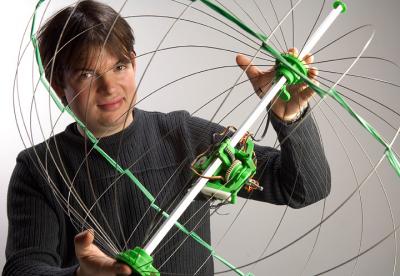
The first robot that can jump like a grasshopper and roll like a ball could play a key role in future space exploration. The 'Jollbot' has been created by Rhodri Armour, a PhD student from the University of Bath. It's hoped his creation, which can jump over obstacles and roll over smoother terrain, could be used for space exploration or land survey work in the future.

Rhodri Armour designed Jollbot as part of his Ph.D. thesis. Photo Credit: Nic Delves-Broughton, University of Bath)

Researchers using functional MRI (fMRI) have determined that the circuitry in the area of the brain responsible for suppressing memory is dysfunctional in patients suffering from stress-related psychiatric disorders. Results of the study will be presented today at the annual meeting of the Radiological Society of North America (RSNA).
Astronomers have uncovered strong evidence that brown dwarfs form like stars. Using the Smithsonian's Submillimeter Array (SMA), they detected molecules of carbon monoxide shooting outward from the object known as ISO-Oph 102. Such molecular outflows typically are seen coming from young stars or
protostars. However, this object has an estimated mass of 60 Jupiters, too small to be a star. Astronomers have classified it as a brown dwarf.