The evolutionarily recent over-reliance on wheat-based products could be a reason behind the current increases in dietary problems related to gluten, according to an expert in digestive disorders.
Genetic modification of food has happened for thousands of year. Tomatoes would still be the size of your thumb without genetic modification.
A 2012 study may mean tomatoes of the future could get that much better. They're big business, on the order of 15 million tons of the fruit for processing and fresh-market sales annually, so for decades food scientists in the tomato industry have selected varieties that are uniformly light green before they ripen, in order to produce tomatoes that can be harvested at the same time. But this characteristic is accompanied by an unintended reduction in sugars that compromises the flavor of the fresh fruit and its desirability for processing.
The atmosphere of exoplanet HD 189733b, about 60 light-years from Earth, changed dramtically after a violent flare on its parent star bathed it in intense X-ray radiation. Result: A powerful burst of evaporation.
Australopithecus sediba, a short, gangly hominid that lived in South Africa 2 million years ago, had a diet unlike virtually all other known human ancestors - trees and bushes.
A new study indicates that A. sediba ate harder foods than other early hominids like Paranthropus boisei, dubbed "Nutcracker Man" because of its massive jaws and teeth, which focused more on grasses and sedges.
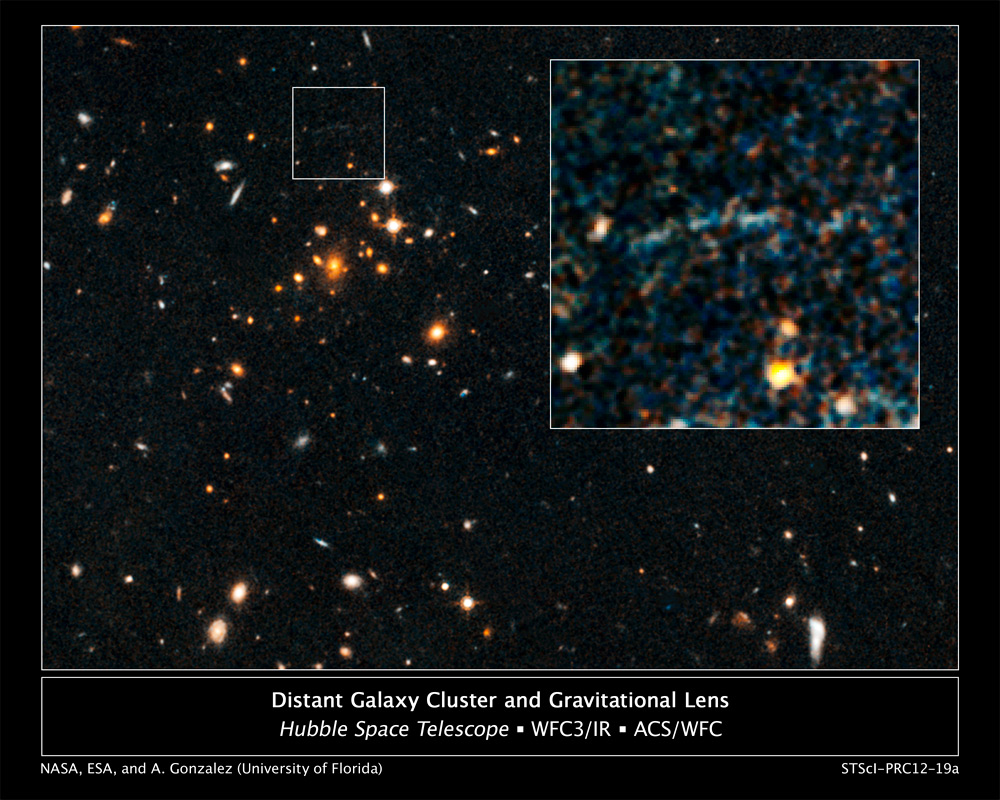
Astronomers have found a puzzling arc of light behind an extremely massive cluster of galaxies residing 10 billion light-years away. The galactic grouping was observed when the universe was roughly a quarter of its current age of 13.7 billion years and the giant arc is the stretched shape of a more distant galaxy whose light is distorted by the monster cluster's powerful gravity, the effect called gravitational lensing.
The puzzle is, the arc shouldn't exist.
While the world actually grows enough food to feed all its inhabitants, it isn't equally distributed. Nearly 500 million people in the developing world remain undernourished and, if projections hold true, that number could to 20% within a decade due to the impacts of climate change on global food production, according to a detailed analysis by The Partnership for Maternal, Newborn&Child Health (PMNCH), the World Health Organization (WHO), the UN System Standing Committee on Nutrition (UNSCN), 1,000 Days, World Vision International and partners.


 Here's Where Your Backyard Was 300 Million Years Ago
 Convergent Evolution Cheat Sheet Now 120 Million Years Old
 Synchrotron Could Shed Light On Exotic Dark Photons
 The Pain Scale Is Broken But This May Fix It