The long and complicated journey to detect the Higgs boson might finally have reached its goal, said experimental physicists at the European Laboratory for Particle Physics, CERN, near Geneva - and they said it with a telltale bump on a slide.
The Higgs boson is the final building block that has been missing from the "Standard Model," which describes the structure of matter in the universe. The Higgs boson combines two forces of nature and shows that they are, in fact, different aspects of a more fundamental force. The particle is also responsible for the existence of mass in the elementary particles.
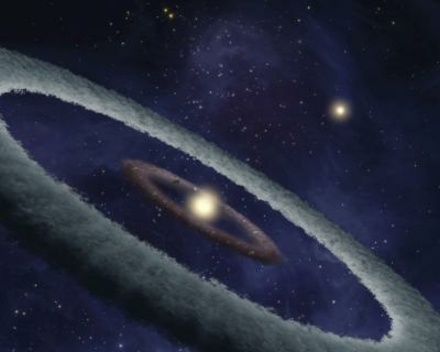
V1647 Ori resides 1300 light-years away in McNeil’s Nebula. It is a young Sun-like star spinning at high speed and spewing out super-hot plasma and astronomers have now been able to deduce what might be happening behind the dusty disc cloaking the star.
Three telescopes, XMM-Newton, Chandra, and Suzaku, have kept their eyes on it during two multi-year outbursts. The first lasted from 2003 to 2006; the second has been under way since 2008. During these extended outbursts the star displays faster growth in mass, a surge in X-ray emission and a dramatic increase in temperature to 50 million degrees celsius.
Older honey bees halt and even reverse the effects of brain aging when they are given roles typically handled by younger bees. This has led researchers to suggest that that social interventions may be as valuable as drugs for dealing with age-related dementia in humans.
The influence of aerosols and clouds represent one of the largest known uncertainties in the scientific understanding of trends in our past global climate - and also hinder predictions of future climate change.
Researchers have now shown that the rate of condensation of water on organic aerosol particles in the atmosphere can be very slow, taking many hours for a particle to change in size. This could have significant consequences for understanding how clouds are formed, affecting climate.
Aerosols are small particles less than 1 micrometer in diameter and clouds are liquid droplets of 1–1,000 micrometers in diameter.
If you want to understand the larger spatial patterns and timing of drought in the arid and semiarid areas of the American West, you will need to look at tree ring and oxygen isotope data.
Estimates of past precipitation are made from proxies like tree rings, which can record amounts of precipitation and temperature. But tree rings are better at recording what happens during the spring and summer, when the tree is growing, than in the winter when the tree is not. To people outside science, the fact that they do not provide the same information on past precipitation is a concern, but the differing results are a good thing to geologists.


 Here's Where Your Backyard Was 300 Million Years Ago
 Convergent Evolution Cheat Sheet Now 120 Million Years Old
 Synchrotron Could Shed Light On Exotic Dark Photons
 The Pain Scale Is Broken But This May Fix It