When shopping, we often find ourselves choosing between lower- and higher-cost items. But most people make a choice based on the first digit they see, according to a new study in the Journal of Consumer Research.
"Shoppers pay a disproportionate amount of attention to the leftmost digits in prices and these leftmost digits impact whether a product's price is perceived to be relatively affordable or expensive," write authors Kenneth C. Manning (Colorado State University) and David E. Sprott (Washington State University).
On long, dark winter nights, the constellation of Orion the Hunter dominates the sky. Within the Hunter's sword, the Orion Nebula swaddles a cluster of newborn stars called the Trapezium. These stars are young but powerful, each one shining with the brilliance of 100,000 Suns. They are also massive, containing 15 to 30 times as much material as the Sun.
Where did the Trapezium stars come from? The question is not as simple as it seems. When it comes to the theory of how massive stars form, the devil is in the details.
The rotating black hole has been described as one of nature's most perfect objects. As described by the Kerr solution of Einstein's gravitational field equations, its spacetime geometry is completely characterized by only two numbers — mass and spin — and is sometimes described by the aphorism "black holes have no hair.''
A particle orbiting a rotating black hole always conserves its energy and angular momentum, but otherwise traces a complicated twisting rosette pattern with no discernible regularity.
The ten warmest years on record have all occurred between 1997 and 2008 but the 2008 temperature in the US was not much different than the 1951-1980 mean, which makes it cooler than all the previous years this decade, say climatologists at the NASA Goddard Institute for Space Studies (GISS) in New York City.
The phenomenon of light emission by living organisms, bioluminescence, is quite common, especially in marine species. It is known that light is generated by chemical reactions in which oxygen molecules play an important part. In the animal world, these chemical reactions take place in special luminescent cells called photocytes. These are aggregated into complex light organs, in which the intensity of light is regulated by nerve impulses, and in which light can be modulated with the help of reflectors, lenses and filters. By these means, organisms can adjust the wavelength, diffusion and intensity of light according to need. But the exact mechanisms behind these processes remain shrouded in mystery.
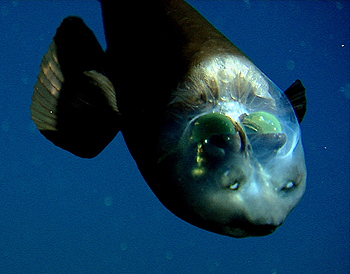
Researchers at the Monterey Bay Aquarium Research Institute recently solved the half-century-old mystery of a fish with tubular eyes and a transparent head. Ever since the "barreleye" fish Macropinna microstoma was first described in 1939, marine biologists have known that its tubular eyes are very good at collecting light. However, the eyes were believed to be fixed in place and seemed to provide only a "tunnel-vision" view of whatever was directly above the fish's head. A new paper by Bruce Robison and Kim Reisenbichler shows that these unusual eyes can rotate within a transparent shield that covers the fish's head. This allows the barreleye to peer up at potential prey or focus forward to see what it is eating.


 Synchrotron Could Shed Light On Exotic Dark Photons
 The Pain Scale Is Broken But This May Fix It
 Study Links Antidepressants, Beta-blockers and Statins To Increased Autism Risk
 Pilot Study: Fibromyalgia Fatigue Improved By TENS Therapy