Banner
Pilot Study: Fibromyalgia Fatigue Improved By TENS Therapy

Fibromyalgia is the term for a poorly-understood condition where people experience pain and fatigue...

High Meat Consumption Linked To Lower Dementia Risk

Older people who eat large amounts of meat have a lower risk of dementia and cognitive decline...

Long Before The Inca Colonized Peru, Natives Had A Thriving Trade Network

A new DNA analysis reveals that long before the Incan Empire took over Peru, animals were...

Mesolithic People Had Meals With More Tradition Than You Thought

The common imagery of prehistoric people is either rooting through dirt for grubs and picking berries...

User picture.
News StaffRSS Feed of this column.

News Releases From All Over The World, Right To You... Read More »

Blogroll

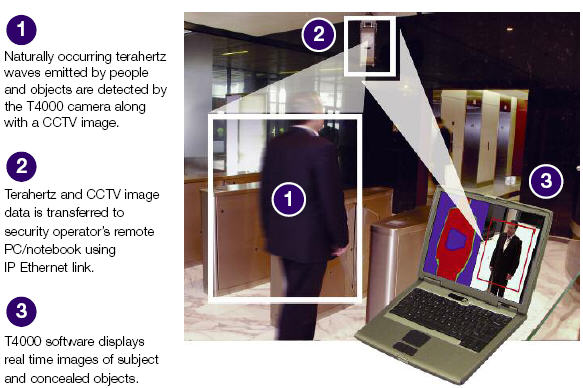
An interesting security imaging technology that can 'see' explosives, liquids, narcotics, weapons, plastics and ceramics hidden under clothing from 25 meters away is due to be unveiled at the Home Office Scientific Development Branch (HOSDB) Exhibition next week.

When you think 'green' in March, maybe you think of leprechauns or four-leaf clovers. Or maybe you think about Al Gore and hybrid vehicles clogging up the HOV lanes during rush hour.

But let's not forget the original 'green' mindset, say nutrition, experts, and it involves diet.

Here’s a sampling of some green foods UT Southwestern dietitians recommend for March which, along with being a chance to drink green beer, is also National Nutrition Month (no, the green beer does not count as nutrition):

Researchers at Johns Hopkins have discovered that two clinically different inherited syndromes are in fact variations of the same disorder. The team suggests that at least for this class of disorders, the total number and “strength” of genetic alterations an individual carries throughout the genome can generate a range of symptoms wide enough to appear like different conditions.

“We’re finally beginning to blur the boundaries encompassing some of these diseases by showing that they share the same molecular underpinnings,” says Nicholas Katsanis, Ph.D., an associate professor of ophthalmology at the McKusick-Nathans Institute of Genetic Medicine at Hopkins. “This is important progress for several reasons. First, knowing what’s going on molecularly and being able to integrate rarer conditions under common mechanisms allows us to potentially help more people at once. Second, clinicians can finally begin to offer more accurate diagnoses based on what really matters: the state of affairs at the cellular/biochemical level. In time, this will empower genetic counseling and much improved patient management.”

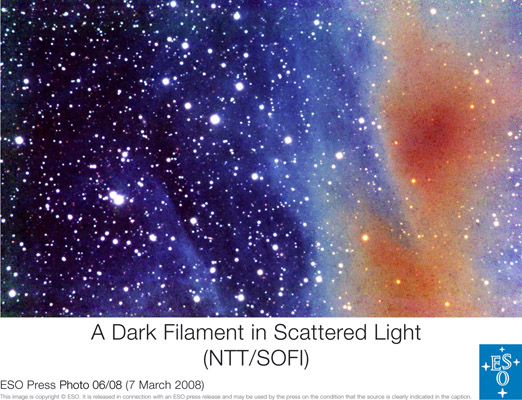
Astronomers using ESO's New Technology Telescope have measured the distribution of mass inside a dark filament in a molecular cloud with an amazing level of detail and to great depth, based on a new method that looks at the scattered near-infrared light or 'cloudshine.'

Dark clouds are feebly illuminated by nearby stars. This light is scattered by the dust contained in the clouds, an effect dubbed 'cloudshine' by Harvard astronomers Alyssa Goodman and Jonathan Foster. This effect is well known to sky lovers, as they create in visible light wonderful pieces of art called 'reflection nebulae'. The Chameleon I complex nebula is one beautiful example.

The vast expanses between stars are permeated with giant complexes of cold gas and dust opaque to visible light.

Tests on a ‘virtual physiological human’ (VPH) have simulated how well an HIV drug blocks a key protein in the lethal virus, say scientists in the UK. The method could pave the way to personalized drug treatments, such as for HIV patients developing resistance to their current regimes.

The human body is too complex to replicate using a single computer or even several computers strapped together. To fully simulate our inner workings, the VPH has to link networks of computers nation- and worldwide. With all this power assembled, scientists can then carry out studies of "supercomputing" proportions, such as the effects of a drug at the organ, tissue, cell and even molecular levels.

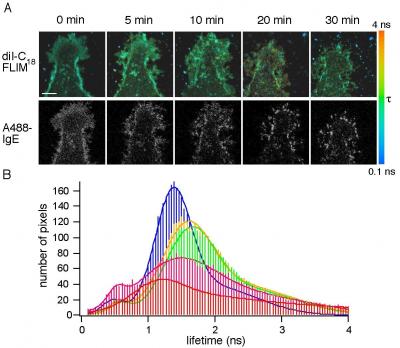
A team of Penn State University researchers is the first to demonstrate that lipid molecules in cell membranes participate in mammals' reactions to allergens in a living cell. The finding will help scientists better understand how allergy symptoms are triggered, and could contribute to the creation of improved drugs to treat them.

The team studied clusters of cholesterol-rich lipid molecules that they believe serve as platforms for the receptors that receive antibodies, the proteins that protect the body from allergens. In this case, the team examined IgE antibodies, which upon binding to their receptors initiate a cell's release of histamine--the substance that causes the unpleasant, but beneficial, mucous production, congestion, and itchiness associated with allergies.