Banner
Pilot Study: Fibromyalgia Fatigue Improved By TENS Therapy

Fibromyalgia is the term for a poorly-understood condition where people experience pain and fatigue...

High Meat Consumption Linked To Lower Dementia Risk

Older people who eat large amounts of meat have a lower risk of dementia and cognitive decline...

Long Before The Inca Colonized Peru, Natives Had A Thriving Trade Network

A new DNA analysis reveals that long before the Incan Empire took over Peru, animals were...

Mesolithic People Had Meals With More Tradition Than You Thought

The common imagery of prehistoric people is either rooting through dirt for grubs and picking berries...

User picture.
News StaffRSS Feed of this column.

News Releases From All Over The World, Right To You... Read More »

Blogroll

It's what you always feared. Your brain actually does react differently to donuts, according to fMRI-based research led by Marsel Mesulam, M.D., a neurologist at Northwestern Memorial Hospital.

Krispy Kremes, in perhaps their first starring role in neurological research, helped lead to the discovery.

In the study, subjects were tested twice -- once after gorging on up to eight Krispy Kreme donuts until they couldn't eat anymore, and on another day after fasting for eight hours. In both sessions, people were shown pictures of donuts and screwdrivers, while researchers examined their brains in fMRI's.


Krispy Kremes - All Your Diets Are Belong To Us.

Nancy Mathiowetz is “drowning in data” but so is almost everyone else.

The University of Wisconsin-Milwaukee sociology professor and president of the American Association for Public Opinion Research says the results of public opinion polls measure nearly every aspect of our lives today, from who we favor for public office to what kinds of cookies we prefer.

Mathiowetz views them as necessary and useful tools and, while not perfect, she says polls still are a reliable way for people to have their voices heard by lawmakers.

Anti-inflammatory drugs like aspirin may reduce breast cancer by up to 20 per cent, according to an extensive review carried out by experts at London’s Guy’s Hospital published in the International Journal of Clinical Practice.

But they stress that further research is needed to determine the best type, dose and duration and whether the benefits of regularly using non-steroidal anti-inflammatory drugs (NSAIDs) outweigh the side effects, especially for high-risk groups.

“Our review of research published over the last 27 years suggests that, in addition to possible prevention, there may also be a role for NSAIDs in the treatment of women with established breast cancer” says Professor Ian Fentiman from the Hedley Atkins Breast Unit at the hospital, part of Guy's and St Thomas' NHS Foundation Trust.

Scientists have discovered how to prevent certain craniofacial disorders in what could ultimately lead to at-risk babies being treated in the womb.

University of Manchester researchers, working with colleagues at the Stowers Institute for Medical Research in Kansas, have successfully treated mice with Treacher Collins syndrome – a rare genetic disorder characterised by underdeveloped facial bones, absent or deformed ears and occasionally cleft palate.

The team had previously found that the condition, which affects one in 10,000 individuals, was caused by a mutation in a single gene called TCOF1. They later discovered that this mutation causes cells, known as neural crest cells, to die prematurely in the early stages of pregnancy resulting in the facial anomalies.

Astrophysicists are having a heated debate over the wave structure of the Sun’s Corona - a debate which may one day influence solar weather forecasting and the theory behind fusion reactors. The Sun’s core is about 6000 degrees C, but its outer layer, the Corona, which is filled with a strong magnetic field, is 200 to 300 times hotter.

Last year American scientists thought they had cracked this paradox with research showing how high-energy Alfvén wave structures could super-heat the Corona.

The astrophysicists said they could detect Alfvén waves within the Corona – waves that have a corkscrew motion along the magnetic field at supersonic speed.


Alfvén waves or magneto-acoustic kink waves?

The Large Binocular Telescope on Mount Graham, Ariz., has taken celestial images using its twin side-by-side, 8.4-meter (27.6 foot) primary mirrors together, achieving first "binocular" light.

U.S., Italian and German partners in the telescope, known as the LBT, are releasing the images today. First binocular light is a milestone not only for the LBT, “now the world's most powerful telescope" but for astronomy itself, the partners say. The University of Arizona in Tucson is a quarter owner of telescope observing time.

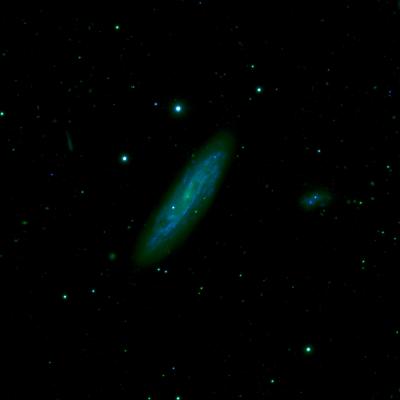
The first binocular light images show three false-color renditions of the spiral galaxy NGC 2770. The galaxy is 102 million light years from our Milky Way, a relatively close neighbor.