Banner
Pilot Study: Fibromyalgia Fatigue Improved By TENS Therapy

Fibromyalgia is the term for a poorly-understood condition where people experience pain and fatigue...

High Meat Consumption Linked To Lower Dementia Risk

Older people who eat large amounts of meat have a lower risk of dementia and cognitive decline...

Long Before The Inca Colonized Peru, Natives Had A Thriving Trade Network

A new DNA analysis reveals that long before the Incan Empire took over Peru, animals were...

Mesolithic People Had Meals With More Tradition Than You Thought

The common imagery of prehistoric people is either rooting through dirt for grubs and picking berries...

User picture.
News StaffRSS Feed of this column.

News Releases From All Over The World, Right To You... Read More »

Blogroll

In the first evidence of its kind to date, Yale researchers find that infants prefer individuals who help others to those who either do nothing, or interfere with others’ goals, it is reported today in Nature.

“This supports the view that our ability to evaluate people is a biological adaptation—universal and unlearned,” said the authors of the study.

The study included six-and-10-month-old babies whose preferences were determined by recording which of two actors they reached towards.

In the first experiment, infants saw a wooden character with large glued-on eyes known as “The Climber.” At first, the climber rested at the bottom of a hill.

Stanford University scientists say they can make wind power a steady, dependable source of electricity but it will require connecting wind farms throughout a given geographic area with new transmission lines, always a difficult sell for people who live in the affected area. The findings are published in the November Journal of Applied Meteorology and Climatology.

Wind is the world’s fastest growing electric energy source, say Cristina Archer and Mark Jacobson. but because it is intermittent it is not used to supply baseload electric power today. Baseload power is the amount of steady and reliable electric power that is constantly being produced, typically by power plants, regardless of the electricity demand.

Global cooling caused wars and migration in the past and global warming could do the same in the future, according to a study in Proceedings of the National Academy of Sciences (PNAS).

As temperatures decreased centuries ago during a period called the Little Ice Age, the number of wars increased, famine occurred and the population declined.

“Even though temperatures are increasing now, the same resulting conflicts may occur since we still greatly depend on the land as our food source,” said Peter Brecke, associate professor in the Georgia Institute of Technology’s Sam Nunn School of International Affairs and co-author of the study.

Remains of an ancient synagogue from the Roman-Byzantine era have been revealed in excavations carried out in the Arbel National Park in the Galilee under the auspices of the Hebrew University of Jerusalem.

The excavations, in the Khirbet Wadi Hamam, were led by Dr. Uzi Leibner of the Hebrew University’s Institute of Archaeology and Scholion – Interdisciplinary Research Center in Jewish Studies.

Dr. Leibner said that the synagogue’s design is a good example of the eastern Roman architectural tradition. A unique feature of the synagogue is the design of its mosaic floor, he said.


Mosaic floor found at site of newly discovered Galilee synagogue shows workman with woodworking tool.

Is there an objective biological basis for the experience of beauty in art? Or is aesthetic experience entirely subjective? This question has been addressed in a paper by Cinzia Di Dio, Emiliano Macaluso and Giacomo Rizzolatti. The researchers used fMRI scans to study the neural activity in subjects with no knowledge of art criticism, who were shown images of Classical and Renaissance sculptures.

The ‘objective’ perspective was examined by contrasting images of Classical and Renaissance sculptures of canonical proportions, with images of the same sculptures whose proportions were altered to create a comparable degraded aesthetic value.

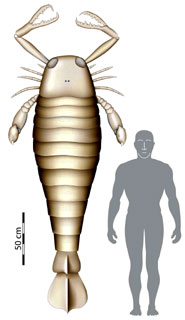
The discovery of a giant fossilised claw from an ancient sea scorpion indicates that when alive it would have been about two and a half meters long, much taller than the average man.

This find, from rocks 390 million years old, suggests that spiders, insects, crabs and similar creatures were much larger in the past than previously thought.

Dr Simon Braddy from the Department of Earth Sciences at the University of Bristol, co-author of an article about the find, said, ‘This is an amazing discovery.