




Unlike the social sciences, which are overwhelmingly women, and life sciences, which are about 50-50, the hard sciences have a true gender disparity and the search is always on for reasons why.
Most parents and many teachers believe that if middle-school and high-school girls show no interest in science or math, there's little anyone can do about it but new research indicates that self-confidence instilled by parents and teachers is more important for young girls than their initial interest.
While interest is certainly a factor in getting older girls to study and pursue a career in these disciplines, more attention should be given to building confidence in their abilities early in their education, says University of Wisconsin - Milwaukee Distinguished Professor Nadya Fouad. She is one of the authors of a three-year study aimed at identifying supports and barriers that steer girls toward or away from science and math during their education.
It's a high-priority question for members of organizations like the National Science Foundation (NSF) and the National Research Council as they ponder how to improve the numbers of women in STEM careers – science, technology, engineering and math.
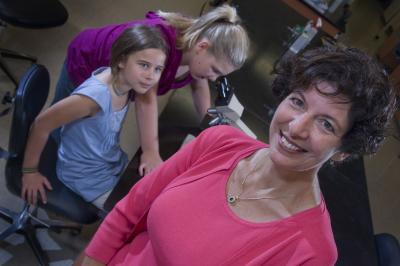
Many young students see math and science as difficult, and don't take any more classes than they have to, not realizing they are cutting themselves off from lucrative opportunities in college and careers. Recent studies show that girls have closed the gap with boys in mathematics, for example, but even now 20 percent of graduates with degrees in engineering are women yet only 11 percent of engineers are women.
"For the last 20 years, there has been all this work done on boosting interest of girls early on. But I don't think that's it," says Fouad, whose research has found evidence that confidence levels in math- and science-related tasks are lower for girls than for boys.
Complexity
The study tracked girls and boys in middle school, high school and their sophomore year in college in both Milwaukee and Phoenix, with the main goal of pinpointing when the barriers for girls appear and how influential they are. Co-authors include Phil Smith, UWM emeritus professor of educational psychology, and Gail Hackett, Provost at the University of Missouri–Kansas City.
Self-efficacy is not the only important factor for girls, the study uncovered. Results point to a complicated issue, says Fouad. For one thing, math and science cannot be lumped together when designing interventions because the barriers and supports for each discipline are not the same.
"There were also differences at each developmental level and differences between the genders," she says. That means interventions would need to be tailored for each specific subgroup.
Overall, however, parent support and expectations emerged as the top support in both subjects and genders for middle- and high-school students. Also powerful for younger girls were engaging teachers and positive experiences with them.
The study confirmed that old stereotypes die slowly. Both boys and girls perceived that teachers thought boys were stronger at math and science. For boys this represented a support, while for girls it acted as a barrier.
Top barriers for all age groups and disciplines were test anxiety and subject difficulty. But these differed between boys and girls. In addition, the genders formed their perceptions of math or science based on the barriers and supports, but they often arrived at different views.
Ultimately, it's perception, more than reality, that affects the person's academic and career choices, says Fouad.
Scholarly clout
That's the take-away message from her more than two decades of work. A fourth-generation college professor, Fouad studies cross-cultural vocational assessment, career development of women and minorities, and factors motivating people to choose certain careers.
She and Smith were among the first teams of researchers to empirically support a model that identified the prominent role that self-confidence and outcome expectations play in predicting career interests.
The next step in the NSF study on girls, and math and science is to examine the relationship between barriers and supports, and then to widen the view to include women who are not working in those fields despite having an educational background in math or science. Fouad received funding from UWM on this project and has just received a half-million-dollar grant to focus on women in engineering.



Comments