




Soil respiration of grass exceeds photosynthesis so grassy areas release more carbon dioxide than they bind, making them a source of CO2 rather than mitigation, whereas on summer days, tree absorption can cover the emissions from Munich's urban car traffic and even exceed them at times.
The new paper used biospheric field measurements in urban parks from April 2024 to February 2025 to validate their model results. They did so because other biogenic flux models use satellite data and that resolution is only around 500 meters, so green spaces and individual trees in a city are not getting meaningful inclusion. Therefore the actual vegetation area is significantly underestimated. The scholars developed a model that depicts CO2 flows hour-by-hour in urban areas and got the resolution down to 10 meters, so urban vegetation is represented more accurately than other models.
They concluded hat Munich's vegetation offsets from two percent to 2.8 percent of its annual human-caused CO2 emissions, with trees as the primary sinks, while grasslands release it. On some days, CO2 absorbtion exceed all of Munich's human emissions.
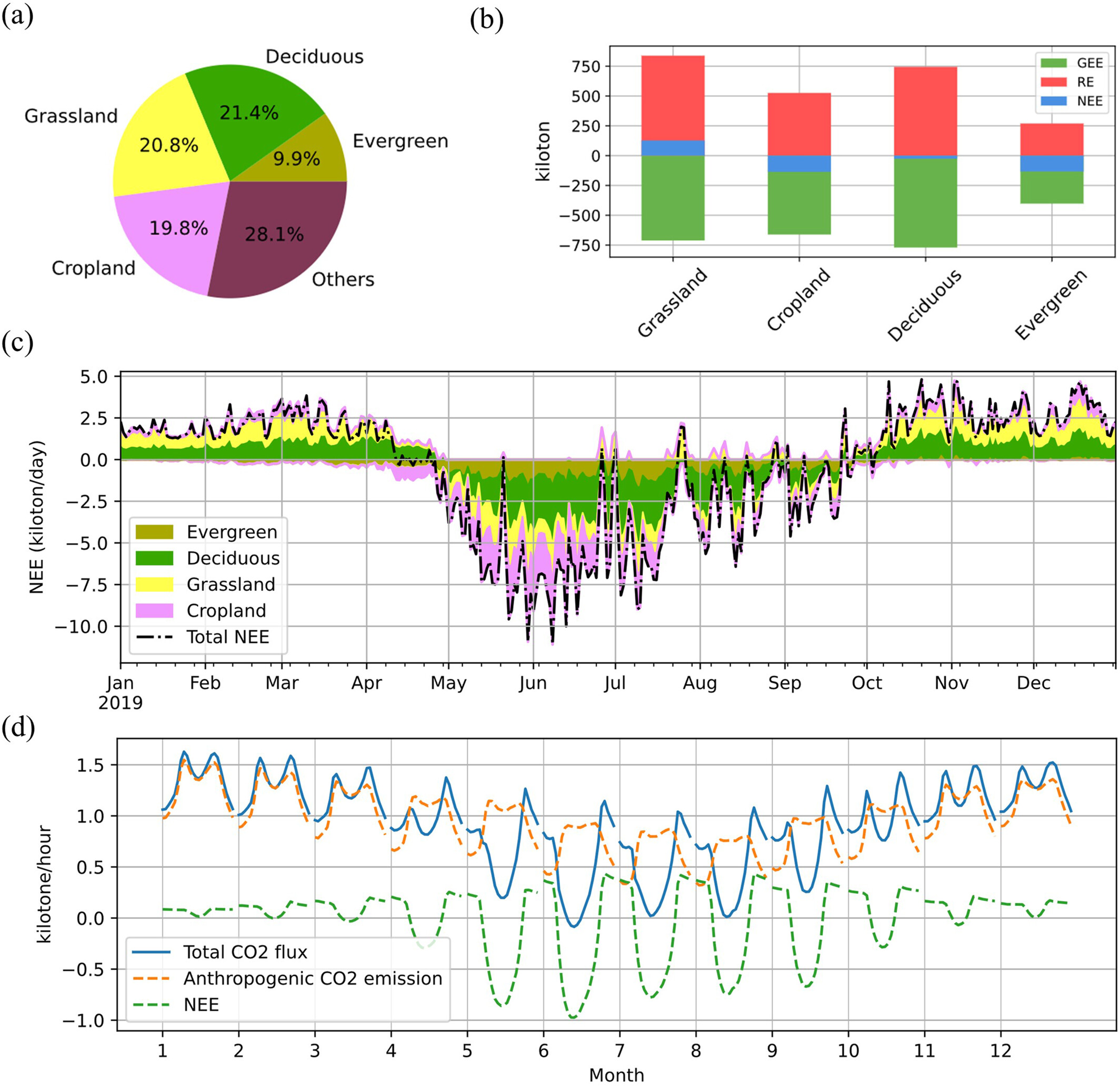
Contribution of different vegetation types to the total NEE and the comparison between anthropogenic CO2 emission and NEE within the Munich study area. (a) The coverage of each vegetation type. (b) The annual total CO2 flux of NEE, GEE, and Respiration. (c) Daily NEE contribution. (d) Comparison of the monthly diurnal cycle between anthropogenic CO2 emission and NEE in Munich.
That doesn't mean parks should be replaced by forests. Grassy areas are cheaper to maintain, remain cooler than asphalt or sidewalks, and provide quality of life benefits for people nearby.
Citation: Junwei Li, Jia Chen, Theo Glauch, Dominik Brunner, Julia Marshall, Nikolai Ponomarev, Haoyue Tang, Stavros Stagakis, 'Fine-Scale Estimation of Urban Biogenic CO2 Fluxes: A Novel Framework Integrating Multiple Versions of Vegetation Photosynthesis and Respiration Models and In Situ Measurements', Earth's Future, Volume14, Issue3, March 2026, e2025EF007458, https://agupubs.onlinelibrary.wiley.com/doi/10.1029/2025EF007458





Comments