

Banner
By Tommaso Dorigo | February 23rd 2010 05:49 PM | 16 comments | Print | E-mail | Track Comments
About Tommaso

I am an experimental particle physicist working with the CMS experiment at CERN and the CDF experiment at Fermilab. In my spare time I play chess...

View Tommaso's Profile
One of the few physics measurements that the LHC experiments are already in the position of producing, with the week-worth of proton-proton collision data they have collected last December, is that of the Bose-Einstein intereference between identical bosons.

I hope I will have a more thorough discussion of this intriguing quantum-mechanical effect soon, when the experiments will have produced results on it: ALICE, the experiment built to study nuclear collisions, has already shown the effect at a CERN public meeting two days before Christmas (see figure at the bottom of the post), so it is fair to assume that papers will soon flourish with a full-fledged measurement. For now, I just wish to give some basic introduction to the phenomenon, since I promised one to a couple of people today!

First of all, what is a Bose-Einstein correlation ? It is an effect connected with the very nature of the wave-function of bosons -particles which are endowed with a integer value of spin. The wave function of a particle "knows" about all its own properties; among them, position and momentum, of course, but also the identity of the particle it represents. And because wave functions are -well- waves, they may interfere with each other. The interference of waves may produce a enhancement, or a suppression, of their individual amplitudes: and amplitudes, in quantum mechanics, are the things with which one computes the probability to find a particle in some place, with some value of its measurable properties.

Bosons have wave-functions that interfere constructively: if you place a boson in a certain point of space, with certain characteristics, then the chance that additional identical bosons will be found in the same location, with the same characteristics of the first one, is enhanced! Bosons are "sociable", so to speak.

Incidentally, the opposite happens to fermions, particles of half-integer spin. The electron is the best example: the probability to find a second electron where there's one is zero, if the two have identical properties. This is the famous Pauli exclusion principle, on which the richness of our world is based: without it, all atoms would have all their electrons on the ground state, and they would have pretty similar chemical properties, preventing the diversity of Mendeleev's table.

But let's stick to bosons -the particles that stick to each other. How can we study whether bosons display this property in a particle collision ?

In general, a proton-proton collision at the LHC produces dozens of hadrons -mostly pions. Pions are particles made by a quark and an antiquark, bound together tightly by the strong force. There are three kinds of pions: positively and negatively charged, and neutral ones. The charged ones live on average about ten nanoseconds before disintegrating; they have therefore enough time to leave the interaction point and cross the silicon sensors which LHC detectors are endowed with at their center, depositing there a ionization charge with which clean tracks may be reconstructed.

What do we do with those tracks ? We measure their curvature in the magnetic field, and determine their energy and momentum. Now, if we find two tracks of the same charge (same direction of curvature in the magnetic field!), lying very close in angle, with the same momentum, then we may imagine that these are actually two pions -identical bosons!- that were mutually influenced during the production process by the quantum interference effect called "Bose-Einstein correlation". An excess of such pairs with respect to a simulation that does not include the quantum interference effect is all we need to demonstrate the phenomenon!

Past experiments have always relied on computing a ratio R of the signal sample divided by a reference sample of track pairs constructed in such a way that they should have no correlation: one thus gets a ratio equal to 1.0 if there is no effect, or a enhancement from 1.0 for track pairs with very close observable momenta if Bose-Einstein correlations are present.

Reference samples can be constructed in a variety of ways: for instance, by taking pairs of tracks of opposite charge: different-charge particles are not identical!; or by taking one track in one event, pairing it up with a track in the next event; or by pairing one track with another whose direction has been swapped by 180 degrees. In all cases, one ends up displaying the ratio R as a function of a specific property of the track pair: a variable which is called "Q-value", basically a measure of how different the two track momenta are. At small Q-value, one observes an enhancement with respect to the reference sample.

Below, for instance, is what was measured by the UA1 experiment at the CERN SppS proton-antiproton collider in the eighties:
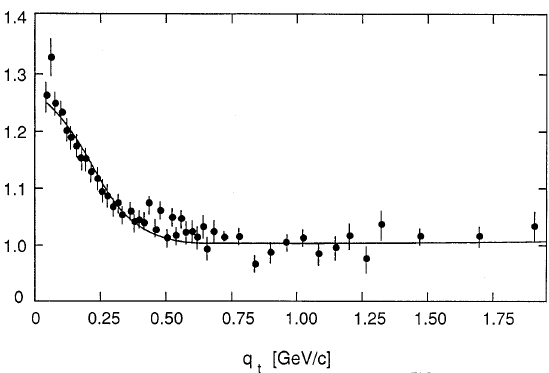


The enhancement at small Q-value is due to the interference of pions. The region of Q where the phenomenon extends tells us about how large is the region of overlap of the wavefunctions, where the interference produces its effect; the height of the enhancement is another parameter, which measures how strong is the correlation.

I hope I will be soon commenting on the first results on this effect measured at the LHC: while the above figure has been obtained by colliding protons with antiprotons at an energy of 630 GeV, nobody has yet measured it with protons against protons at 900 GeV, or a fortiori at the higher energy of 2.36 TeV. I do not expect a large difference, but it will be interesting to compare things.

And now an ounce of competition: I fear that the first experiment to show such results will again be ALICE, given the preliminary plot below, which they already showed last Christmas; and given the impressive speed at which they have shown to be capable to produce scientific publications. But eventually CMS and ATLAS will produce their own results, too!
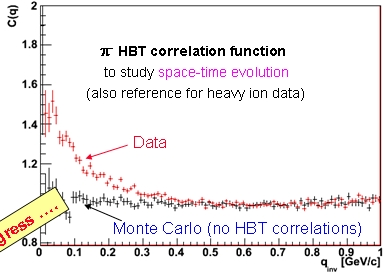
On the right you can see the preliminary result (the yellow box on the bottom right says "work in progress...") produced by ALICE. The signal appears, as in the case of the UA1 result, at the lowest values of Q; instead the Monte Carlo simulation, which does not include the quantum-mechanical interference, is flat.

I have however the impression that ALICE will not be beaten on this measurement for another reason besides the speed at which they can approve their results for public consumption: they have shown (see below) that their detector provides an impressive capability of distinguishing particles of different species by using the amount of ionization left by the charged tracks in the silicon layers -a feature shared by CMS and ATLAS but with smaller resolution. ALICE, which is optimized for high-density nuclear interactions, direly needs such a tool.
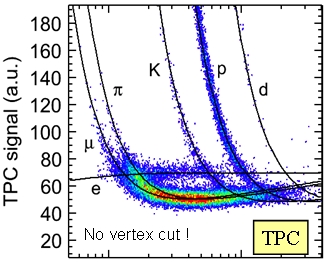
On the left, different particles (electrons, e; muons, ; pions, ; kaons, K; protons, p; and deuterons, d) populate the well-separated bands of points in this scatterplot. The bands appear when one displays for a particle the dE/dx -ionization energy loss per unit material thickness traversed - as a function of track momentum.

The extraction of a signal of Bose-Einstein correlations, which is a phenomenon connected with the particle identity, gets greatly eased by pairing up particles of the same species, rather than having to assume that every track is a pion. That is why a precise dE/dx is important.

In any case, time will tell... Stay tuned for these first interesting results!

Comments

Why is this an interesting measurement? The effect has been demonstrated in the past. You are just playing with your new toy and checking that everything works as planned, there is no inherent physics interest here. Or am I wrong?

dorigo
No, I think you are mistaken. There are articles dealing with detector performance, which show how experiments reconstruct known signals etcetera. But the phenomenon of Bose-Einstein correlations is not very well understood, and a measurement performed with a better detector, at an energy not yet investigated, is definitely worth making.

Cheers,
T.

a follow up question: why didn't TeVatron people measure this?
Thanks.

dorigo
Oh, that is a rather sociological question. The experiments at the Tevatron never found themselves in a situation when Bose-Einstein correlations were one of the very few measurements made possible by the data collected. Of course, at a hadron collider there are more possible analyses than people undertaking them, when there is a reasonable amount of collisions to study. So people concentrate on "discovery physics", or on measurements which have more interest to them.
The Bose-Einstein correlations were studied intensively by the LEP experiments, instead, because this effect is one of the leading systematic uncertainties in the determination of the W boson mass.

Cheers,
T.

Tommaso's answer is fine. But I am also surprised that this relatively easy analysis has not been carried out at the Tevatron. It would make a nice project for an undergraduate thesis, for example. And recent summary articles like to compare how the height and width in the correlation plot vary with energy and the kind of interaction (e+e- vs. hadron collider).

Michael

Hi Slava,

good question. These physics measurements do not tell us something fundamental about the standard model, or anything like that. But the phenomenon is a potentially important aspect of hadronization, for which we have only models, not a theory. Monte Carlo models need to be tuned to match the data, hence the need for more measurements at the LHC.

This correlation was important for the precision measurements of the W boson at LEP. Correlations between pions from different W decay products could have a direct impact on the jets that are used for reconstructing W mass peaks. There is a review article and even a dedicated paper by the DELPHI Collaboration.

Bose-Einstein correlations should also give some insight into heavy-ion collisions, but I know little about that.

Finally - yes, we are playing with our new toy. Why not take a look at Bose-Einstein correlations, if they are there and kind of neat? :)

regards,
Michael

dorigo
Hi Michael,

oops, shoud read all comments before answering them one by one! but that's just a demonstration that great minds think alike :)

Cheers,
T.

When the LHC gets up to full speed,
if a Higgs is found somewhere between 110 and 200 GeV,
could these techniques be used by the LHC
to look for Bose-Einstein condensates of Higgs ?

Any guess as to when that might happen ?

Tony Smith

dorigo
Hi Tony,

not in my lifetime... :)

Actually, your question is very interesting, and indeed, there are theorists who are exploring the possibility to measure Bose-Einstein correlations with Z bosons, for instance. See this paper: http://arxiv.org/abs/0801.2340 .

Cheers,
T.

Is anyone other than Kozlov (Dubna) (and maybe his Polish collaborators Utyuzh, Wilk, Wlodarczyk)
working on use of LHC to study Bose-Einstein of Z bosons etc ?

Tony Smith

dorigo
That, dear Tony, I do not know. Maybe a search in the Arxiv will reveal more studies though.
Cheers,
T.

About when the LHC might get up to full speed, an article by Lewis Page in The Register today (25 February 2010) said in part:
"... The LHC ... had been expected to fire up its circulating hadron beams once more following the Xmas break today. ...
Last night, it seems that a false alert within ... a new Quench Protection System (nQPS) ... able to automatically fire up rapid-acting heaters if a quench is detected ... triggered fifty ... heaters, causing the affected magnets to quench abruptly ...
For now, a limitation of 2000 amps current in the electrical connections which set off the nQPS has been imposed, which will prevent the jumpy heaters from triggering again. ...
control-room scientists said ... "We will carry on the beam commissioning program as planned with the above limitation in place for the moment. Still hope to put beam in tomorrow [26 FEb 2010] ... ".

Is it a good idea to assume that the quenching was due to a "false alert" and just put an amp limit on the nQPS heaters and push ahead anyway?

Could the "false alert" be symptomatic of not-yet-understood serious problems that could be found and solved by taking a few months to do a thorough inspection of the whole LHC instead of rushing to get some data (mostly for political reasons??) quickly?

Is this what Mike Harney meant when he said on your blog (comment on 7 September 2009) "... that LHC is definitely in "oscillation mode" ... the state of a project when it has lost convergence on becoming a reliable piece of hardware because it is in the process of not fixing root problems but rather doing a patch job which results in releasing a new set of gremlins that are waiting in the wings ...".

If so, maybe your remark "not in my lifetime ..." might apply to more than finding Higgs BEC.

Tony Smith

Tony,

Looking at the LHC logbooks, the cause of the QPS firing was analysed and understood pretty quickly. It was triggered by the voltage spike when the switches for the dump resistors were opened to finish ramping down the magnets. That voltage spike is normally filtered out, but in this case previous events in the ramp-down had caused the filters to be temporarily disabled.

Running with nQPS disabled up to 2000A should be fine - that is what they were doing last year, running up to the 2kA limit of safe operation with just the old QPS. Presumably that is just a temporary fix until they sort out the filters properly.

I don't see any reason to think that this is indicative of a deeper malaise. It's just the normal sort of hiccup you except commissioning a complex system - finding the hiccups is exactly why they're going through 2 months of commissiong at the moment.

dorigo
Tony, I do not believe that the LHC is in oscillation mode. There has been an impressive convergence, instead, after the september 2008 incident, and the machine has shown to be working impressively last December. Hiccups are always there in such complex systems at the start.

Cheers,
T.

Tommaso, do you agree with what Lucio Rossi said in Supercond. Sci. Technol. 23 (2010) 034001 (17pp) (published 22 February 2010),
particularly with the following:

"... The incident ... revealed a lack of adequate risk analysis ... and of understanding all consequences ... The lack of a global integration approach with thorough examination of the fault tree is one of the main lessons to draw.
...
In addition to the ‘trivial’ mistake of a bad splice, a more subtle defect, related to a lack of continuity in the copper stabilizer, is now evident and is worrying since it is diffused around the machine. ...".

How seriously do you regard the copper stabilizer continuity problem that "is diffused around the machine"?

Tony Smith

dorigo
Tony, I am not an engineer, and I have not put my hands on the LHC project, so my opinions are not very trustworthy. I have the impression, though, that the sentence you quote concerning the fault tree is correct.
I also think that the LHC is a project with too many weaknesses. The main concern I have is that if something breaks (even minor problems, not 6-ton helium explosions) at a rate of once every 6 months, the project is dead. It takes months to warm up and cool down the magnets.

Cheers,
T.

Add a comment

The content of this field is kept private and will not be shown publicly.
  • Allowed HTML tags: <sup> <sub> <a> <em> <strong> <center> <cite><TH><ul> <ol> <li> <dl> <dt> <dd> <img> <br> <p> <blockquote> <strike> <object> <param> <embed> <del> <pre> <b> <i> <table> <tbody> <div> <tr> <td> <h1> <h2> <h3> <h4> <h5> <h6> <hr> <iframe><u><span>
  • Lines and paragraphs break automatically.
  • Web page addresses and e-mail addresses turn into links automatically.
CAPTCHA
If you register, you will never be bothered to prove you are human again. And you get a real editor toolbar to use instead of this HTML thing that wards off spam bots.

