

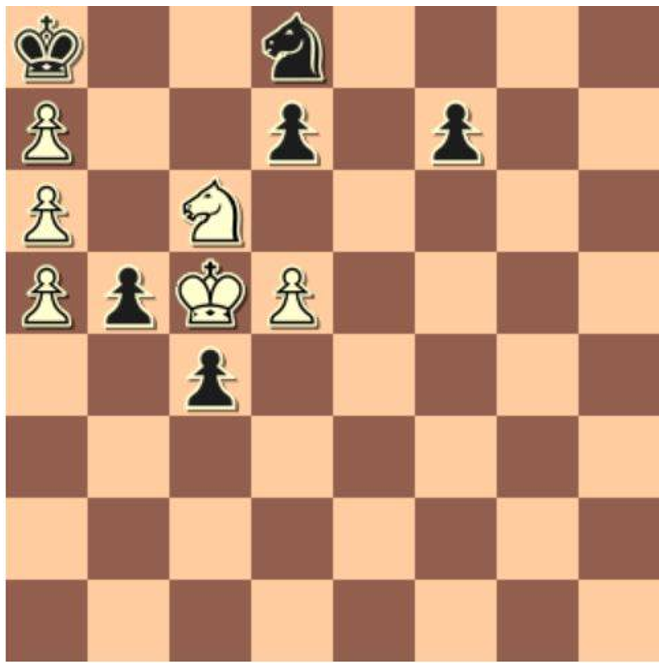
It seems like white is able to grab a knight for free. However, that would be not a wise idea, as the c4 pawn would then be free to run down to become a queen. You can easily convince yourself that 1.Nxd8? c3! wins for black. White also has its own knight en prise in the starting position, so a move not involving a knight move will result in its demise. E.g., 1.Kb6 seems a desirable attacking move to make, but 1....dxc6 2.dxc6 Nxc6! again turns the tables.
1.Nd4 springs to mind as a move that maintains control - over the potentially running c4 pawn, and over the possible run of the f7 pawn too. However, the intricate variations following 1.Nd4 Kxa7! should soon convince you that there is no win in sight for white there either. Similar conclusions await 1.Nb4 f5!.
How to proceed? You are invited to take a step back and ask yourself whether there isn't some well-concealed opportunity for white... I will leave the question open for a day or two before I post the solution below.
I composed this study in 1989, but I don't think I ever published it. I only remember submitting it to the scrutiny of a chess master during a tournament, and he was unable to solve it. So if you can't find the solution, do not worry - you are in good company!
---------------------------------------

So, a lot more than two days have passed - but here is the solution anyway: the problem cannot be solved unless one realizes that in the given position black can only have made one move to reach it: 0. ..., b7-b5!
The reason is simple: none of the black pieces except the pawn on b5 can have been in a different square. Let us examine them one by one.
- the black knight on d8 cannot have jumped there from either of the two free squares b7 or e6, as in both cases the white king would have been in its check with black to move, which is impossible. Hence the black knight did not make the last move;
- the d7 and f7 pawns never moved from their original square, as it is obvious.
- the c4 pawn also obviously cannot have made the last move;
- the black king cannot have moved to a8 from either of the free squares b8 or b7, as in both cases it would have been in check by pieces that in turn cannot have reached that square beforehand: in the case of the b8 square, the king would have been en prise by both the a7 pawn and the Nc6, which is impossible; and in case of the b7 square, there is no way that the a6 pawn could have moved there to check a black king on b7, as the squares from which it could have moved to a7 (a6 or, in case of a capture, b5) are occupied by other pieces.
There remains to observe that the b5 pawn cannot have come from the b6 square, as it would have been an illegal position (white king in check, and black to move); and neither can it have come from a6 or c6 by capturing something in b5, as both those squares are also occupied.
From the above it transpires that indeed the diagrammed position was reached by the last black move 0. ...b7-b5. This enables white to play 1.axb6 en passant!
After the en-passant capture, black loses by force, as it is not hard to prove. E.g., 1.... c3 2.Nd4 f5 3.Kc4, when white cashes in the c3 pawn and then moves back the king to promote a pawn. Or 1....dxc6 2.dxc6 Ne6+ (if 2....Nxc6 3.Kxc6 c3 4.Kc7 c2 5.b7+ Kxa7 6.b8=Q+ and mate next) 3.Kd6, and black is powerless against white's advanced pawns.
If you are outraged by the solution and think this is a sort of a swindle, a trick - thing again. The irrefutable proof by retrograde analysis that the last move was b7-b5 is entirely part of normal chess problems practice. But indeed, it makes the problem a bit harder to solve!


Comments

