




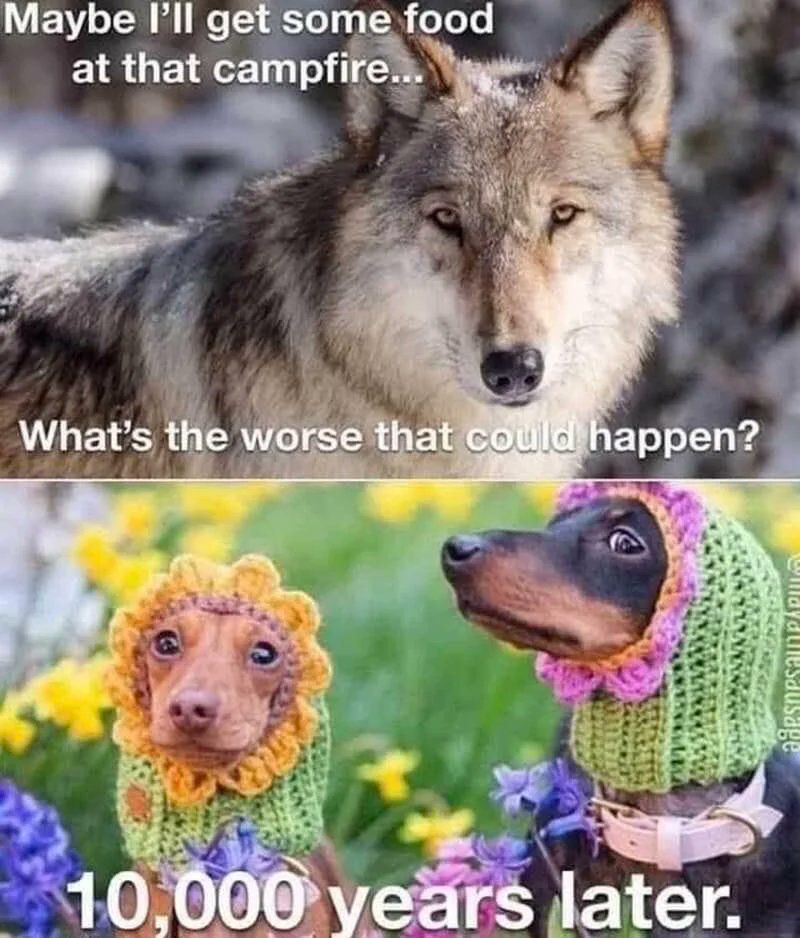
A new study of bones recovered from Gough’s Cave and Pınarbaşı says we may have been dressing pets up in funny outfits even farther back. Evidence shows they were actually accompanying us on walks over 14,000 years ago, even before agriculture created the spark of civilization.
Funny memes aside, though it is known dogs split off from wolves during the last Ice Age, proving association with humans is another matter because they were nearly identical. The thing that changed first was behavior. Wolves that were not friendly were chased away or killed, nicer ones were allowed to co-exist and eventually got fed, etc. Those wolves eventually bred with other moderately tempered wolves and resulting generations became more domesticated.
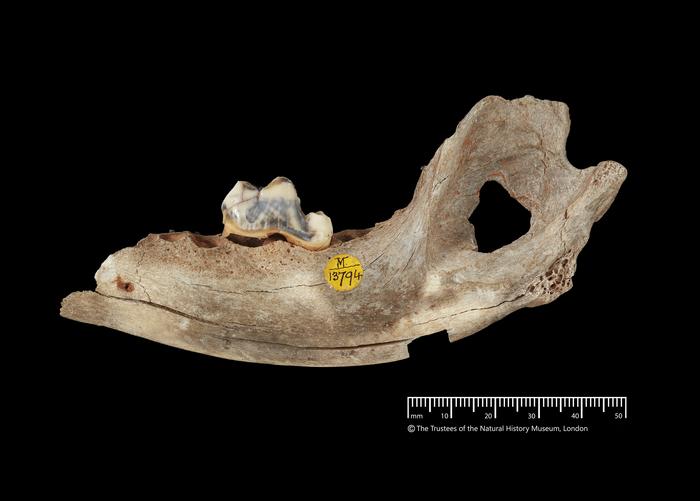
14,300 year-old dog jawbone from Gough’s Cave in Somerset, England. Credit: The Trustees of the Natural History Museum, London
The new work involved reconstruction of whole genomes from Ice Age remains which were compared with over modern and ancient animals. it reveals that dogs were common in Europe and Asia before previously known. Another paper measured bone collagen isotopes to reveal what they ate. The analysis of remains in Turkey showed they ate what humans ate, like fish, which infers they were being actively fed by people. Dogs can fish but it is not likely to be a key source of food because of the energy needed and the differing diets shows dogs were present in southern Europe and Asia (née Epigravettian to social science, they didn't call themselves anything) to Magdalenian (central Europe) areas during the Pleistocene.
That means dogs may be the first human generically-modified species, even before plants, though done by behavioral traits over generations rather than precisely.
And their presence in gravesites means the emotional attachments were also strong.
Citation: William A. Marsh, Lachie Scarsbrook, Eren Yüncü, Lizzie Hodgson, Audrey T. Lin, Maria De Iorio, Olaf Thalmann, Mark G. Thomas, Mahaut Goor, Anders Bergström, Angela Noseda, Sarieh Amiri, Fereidoun Biglari, Dušan Borić, Katia Bougiouri, Alberto Carmagnini, Maddalena Giannì, Tom Higham, Ophelie Lebrasseur, Anna Linderholm, Marcello A. Mannino, Caroline Middleton, Gökhan Mustafaoğlu, Angela Perri, Joris Peters, Mike Richards, Özlem Sarıtaş, Pontus Skoglund, Rhiannon E. Stevens, Chris Stringer, Kristina Tabbada, Helen M. Talbot, Laura G. Van der Sluis, Silvia M. Bello, Vesna Dimitrijevic, Louise Martin, Marjan Mashkour, Simon A. Parfitt, Sonja Vukovic, Selina Brace, Oliver E. Craig, Douglas Baird, Sophy Charlton, Greger Larson, Ian Barnes&Laurent A. F. Frantz, 'Dogs were widely distributed across western Eurasia during the Palaeolithic', Nature 651, 995–1003 (2026). https://www.nature.com/articles/s41586-026-10170-x





Comments