

New results from the T2K collaboration have been presented at a KEK Physics Seminar today, and they are really interesting stuff. In a nutshell, six electron neutrino events have been seen by their far detector, illuminated by a pure and intense beam of muon neutrinos. The estimated backgrounds from non-oscillating-neutrino sources are estimated to amount to 1.5+-0.3 events, and the observed counts thus constitute a 2.5-standard-deviation effect, hopefully a first hint of direct detection of nu_mu -> nu_e oscillations.
If you are a veteran in particle physics, you seldom get excited by 2.5 sigma results. But this one should be singled out: it represents in my opinion a solid evidence of the oscillation process. To explain why I believe this result will be confirmed with additional data collected by T2K, I need to show a few figures from the seminar.
First of all, what is T2K ? It is an experiment in Japan which uses the superkamiokande detector to detect neutrinos shot at it from an intense proton beam produced at a facility located xxx km away. The protons are impinged on a target and from the resulting hadrons a beam of neutrinos is extracted. Muon neutrinos, that is: the technology to produce intense beams of these particles dates back to the late sixties and early seventies, when neutral currents were still only the dream of a few visionaries, among them Glashow, Salam, and Weinberg.
Indeed, neutrinos are surprisingly important particles -they were there when charged-current weak interactions were first figured out by Fermi in the thirties; they were there when the Z boson was first indirectly seen in neutral current bubble chamber exposures. Neutrinos were there at LEP, when the invisible Z decays allowed to figure out that three is the magic number of light generations of matter fields.
And of course, neutrino physics is central today in High-Energy Physics, with the puzzles it presents. While the LHC is running at full steam and still gives no indication that any new physics will ever be found at the high-energy frontier, many smaller endeavours around the world are patiently collecting neutrino signals from the cosmos, from the atmosphere, from the sun, and from accelerators. The understanding of fundamental physics we may hope to achieve from these experiments is big, and the chance is much larger -we know that there is a lot to measure and study which we have not figured out yet in neutrino physics!
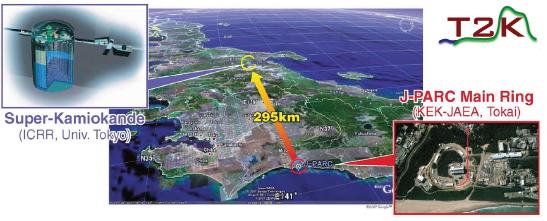
Now, let me not divagate further. The proton beam of J-PARC, in Tokai, sends neutrinos 295 km away to the Kamioka mine (see above), the burial site of the large water tank which first observed neutrino oscillations. The statistics analyzed this far corresponds to 1.4 E20 protons on target -the funny but effective unit of measurement used in accelerator neutrino experiments to size up the data. Protons interacting with the target produce pions, which decay into muons and muon neutrinos. The latter traverse first a "near detector", which is important for flux normalization and to reduce beam-related systematic uncertainties; and then travel underground to the Kamioka mine, where few of them produce detectable interactions in the large body of water making up the SK (SuperKamiokande) detection element.
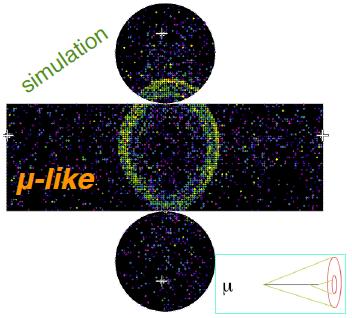
What happens when a neutrino interacts with water in SK ? The neutrino may interact by charged-current or by neutral-current interactions. Let us concentrate on the former: the neutrino becomes its corresponding charged lepton (a muon, that is), imparting some momentum to the recoiling nuclear target. The charged lepton then travels in water at superluminal speed, producing a ring of Cherenkov photons (sort of a "shock wave") which the photomultiplier tubes of SK are ready to detect. The resulting pattern is a beauty to observe, such as in the picture below.
One feature of the T2K setup which is worth mentioning is the optimization of the angle of production of the neutrino beam. Since high-energy neutrinos cause annoying backgrounds due to neutral current interactions, while at sub-GeV energy the signal is cleaner, the neutrino beam produced at J-PARC is set up to be emitted "off-axis", i.e. at 2.5 degrees off the direction of the incoming protons as they hit the target. This way, the energy of neutrinos is kept at a values which maximizes the observability of the quasi-elastic charged-current signal.
The signal of electron-neutrino interactions in SK is extracted by applying a very careful selection of the features of the Cherenkov radiation detected in the tank. Among the backgrounds that need to be separated is the diphoton decay of neutral pions produced in the neutral-current interaction of a muon neutrino. The photons create electron-positron pairs, which produce multiple ring topologies.
Other cuts involve a fiduciality of the position where the interaction took place, and energy requirements. I cannot discuss these in detail here, and invite the interested reader to have a look at the slides of the seminar.
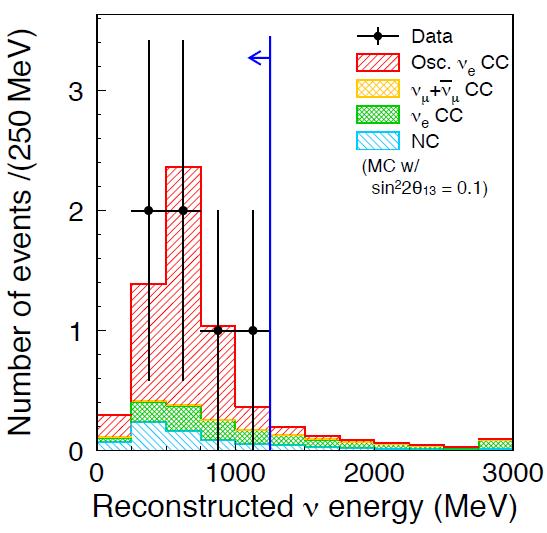
In the end, from the number of neutrinos directed at the SK detector, the number of background events which pass all electron-like selection criteria is computed at 1.5 events. Systematics are carefully evaluated and result in a 20% uncertainty on the prediction. And finally, the data is unblinded, and the number of electron-like events observed is six. It is a shame that my flight to Geneva is about to board, because I would be happy to do justice to the very interesting cross-checks and studies that allow T2K to estimate backgrounds and related systematics... Maybe another time. The figure below shows the reconstructed energy of the six final candidates, which well agrees with the shape of the expected electron signal (if oscillations occur).
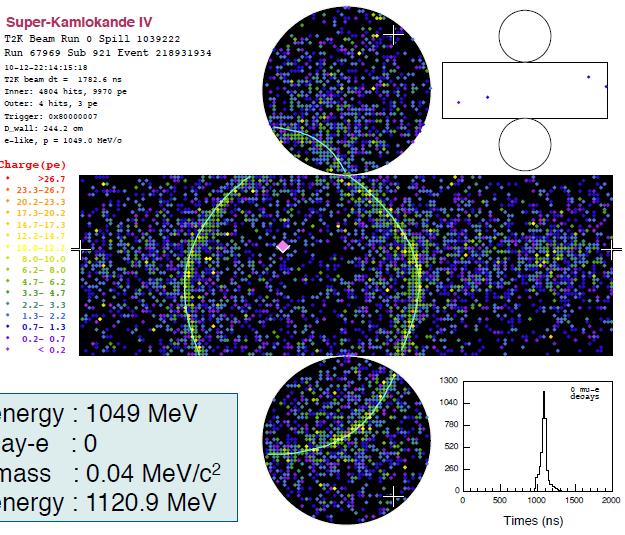
Below you can see an event display of one of the six candidates: the nice ring distributes on the surface of the tank and well agrees with the expected shape of an electron Cherenkov signal. This is a beautiful picture, worth the cover of a textbook... Remind it to me in ten years!
In conclusion, I am happy to see that there are "good" 2.5 sigma effects arising sometimes... For once, I would be willing to bet FOR this to be a real signal. Any takers ?

If you are a veteran in particle physics, you seldom get excited by 2.5 sigma results. But this one should be singled out: it represents in my opinion a solid evidence of the oscillation process. To explain why I believe this result will be confirmed with additional data collected by T2K, I need to show a few figures from the seminar.
First of all, what is T2K ? It is an experiment in Japan which uses the superkamiokande detector to detect neutrinos shot at it from an intense proton beam produced at a facility located xxx km away. The protons are impinged on a target and from the resulting hadrons a beam of neutrinos is extracted. Muon neutrinos, that is: the technology to produce intense beams of these particles dates back to the late sixties and early seventies, when neutral currents were still only the dream of a few visionaries, among them Glashow, Salam, and Weinberg.
Indeed, neutrinos are surprisingly important particles -they were there when charged-current weak interactions were first figured out by Fermi in the thirties; they were there when the Z boson was first indirectly seen in neutral current bubble chamber exposures. Neutrinos were there at LEP, when the invisible Z decays allowed to figure out that three is the magic number of light generations of matter fields.
And of course, neutrino physics is central today in High-Energy Physics, with the puzzles it presents. While the LHC is running at full steam and still gives no indication that any new physics will ever be found at the high-energy frontier, many smaller endeavours around the world are patiently collecting neutrino signals from the cosmos, from the atmosphere, from the sun, and from accelerators. The understanding of fundamental physics we may hope to achieve from these experiments is big, and the chance is much larger -we know that there is a lot to measure and study which we have not figured out yet in neutrino physics!

Now, let me not divagate further. The proton beam of J-PARC, in Tokai, sends neutrinos 295 km away to the Kamioka mine (see above), the burial site of the large water tank which first observed neutrino oscillations. The statistics analyzed this far corresponds to 1.4 E20 protons on target -the funny but effective unit of measurement used in accelerator neutrino experiments to size up the data. Protons interacting with the target produce pions, which decay into muons and muon neutrinos. The latter traverse first a "near detector", which is important for flux normalization and to reduce beam-related systematic uncertainties; and then travel underground to the Kamioka mine, where few of them produce detectable interactions in the large body of water making up the SK (SuperKamiokande) detection element.
What happens when a neutrino interacts with water in SK ? The neutrino may interact by charged-current or by neutral-current interactions. Let us concentrate on the former: the neutrino becomes its corresponding charged lepton (a muon, that is), imparting some momentum to the recoiling nuclear target. The charged lepton then travels in water at superluminal speed, producing a ring of Cherenkov photons (sort of a "shock wave") which the photomultiplier tubes of SK are ready to detect. The resulting pattern is a beauty to observe, such as in the picture below.

One feature of the T2K setup which is worth mentioning is the optimization of the angle of production of the neutrino beam. Since high-energy neutrinos cause annoying backgrounds due to neutral current interactions, while at sub-GeV energy the signal is cleaner, the neutrino beam produced at J-PARC is set up to be emitted "off-axis", i.e. at 2.5 degrees off the direction of the incoming protons as they hit the target. This way, the energy of neutrinos is kept at a values which maximizes the observability of the quasi-elastic charged-current signal.
The signal of electron-neutrino interactions in SK is extracted by applying a very careful selection of the features of the Cherenkov radiation detected in the tank. Among the backgrounds that need to be separated is the diphoton decay of neutral pions produced in the neutral-current interaction of a muon neutrino. The photons create electron-positron pairs, which produce multiple ring topologies.
Other cuts involve a fiduciality of the position where the interaction took place, and energy requirements. I cannot discuss these in detail here, and invite the interested reader to have a look at the slides of the seminar.
In the end, from the number of neutrinos directed at the SK detector, the number of background events which pass all electron-like selection criteria is computed at 1.5 events. Systematics are carefully evaluated and result in a 20% uncertainty on the prediction. And finally, the data is unblinded, and the number of electron-like events observed is six. It is a shame that my flight to Geneva is about to board, because I would be happy to do justice to the very interesting cross-checks and studies that allow T2K to estimate backgrounds and related systematics... Maybe another time. The figure below shows the reconstructed energy of the six final candidates, which well agrees with the shape of the expected electron signal (if oscillations occur).

Below you can see an event display of one of the six candidates: the nice ring distributes on the surface of the tank and well agrees with the expected shape of an electron Cherenkov signal. This is a beautiful picture, worth the cover of a textbook... Remind it to me in ten years!

In conclusion, I am happy to see that there are "good" 2.5 sigma effects arising sometimes... For once, I would be willing to bet FOR this to be a real signal. Any takers ?




And neutrinos are also being patiently collected from nuclear reactors. Tommaso, I may be wrong but I think that if you follow the arrow from your diagram above showing the Japanese neutrinos being beamed through hundreds of kilometres of underground rock, the arrow coincidentally also points to the epicentre of the recent Japanese earthquake.
There are many neutrino experiments like the K2K and the Super-Kamiokande that have been and are still being conducted in Japan, one which may have been operating coincidentally at the closest town to the Japan earthquake's epicentre when it occurred.
Recently this article and paper at http://www.technologyreview.com/blog/arxiv/26773/?nlid=4495 was released entitled 'Atmosphere Above Japan Heated Rapidly Before M9 Earthquake' which claims that :- 'Infrared emissions above the epicenter increased dramatically in the days before the devastating earthquake in Japan, say scientists.Geologists have long puzzled over anecdotal reports of strange atmospheric phenomena in the days before big earthquakes. But good data to back up these stories has been hard to come by'.
'In recent years, however, various teams have set up atmospheric monitoring stations in earthquake zones and a number of satellites are capable of sending back data about the state of the upper atmosphere and the ionosphere during an earthquake'.
'Last year, we looked at some fascinating data from the DEMETER spacecraft showing a significant increase in ultra-low frequency radio signals before the magnitude 7 Haiti earthquake in January 2010Today, Dimitar Ouzounov at the NASA Goddard Space Flight Centre in Maryland and a few buddies present the data from the Great Tohoku earthquake which devastated Japan on 11 March'.
'Their results, although preliminary, are eye-opening.They say that before the M9 earthquake, the total electron content of the ionosphere increased dramatically over the epicentre, reaching a maximum three days before the quake struck. At the same time, satellite observations showed a big increase in infrared emissions from above the epicentre, which peaked in the hours before the quake. In other words, the atmosphere was heating up.These kinds of observations are consistent with an idea called the Lithosphere-Atmosphere-Ionosphere Coupling mechanism'.
'The thinking is that in the days before an earthquake, the great stresses in a fault as it is about to give cause the releases large amounts of radon.The radioactivity from this gas ionises the air on a large scale and this has a number of knock on effects. Since water molecules are attracted to ions in the air, ionisation triggers the large scale condensation of water. But the process of condensation also releases heat and it is this that causes infrared emissions'.
"Our first results show that on March 8th a rapid increase of emitted infrared radiation was observed from the satellite data," say Ouzounov and co. These emissions go on to effect the ionosphere and its total electron content. It certainly makes sense that the lithosphere, atmosphere and ionosphere are coupled in a way that can be measured when one of them is perturbed'.
'The question is to what extent the new evidence backs up this idea.The Japan earthquake is the largest to have struck the island in modern times and will certainly turn out to be among the best studied. If good evidence of this relationship doesn't emerge from this data, other opportunities will be few and far between'.
Tommaso, how can we be sure that there is no connection between these man-made neutrino, collider and nuclear experiments and changes in the geomagnetosphere, the lithosphere, the atmosphere and the ionosphere which are coupled in some way that we don't yet understand?