

Banner
    A Bound On Neutrino Speeds From Nomad
    By Tommaso Dorigo | November 4th 2011 04:48 AM | 31 comments | Print | E-mail | Track Comments
    About Tommaso

    I am an experimental particle physicist working with the CMS experiment at CERN. In my spare time I play chess, abuse the piano, and aim my dobson...

    View Tommaso's Profile
    The Arxiv today features a quick-and-dirty study of the occurrence of electron-positron pair signal in the NOMAD detector, which obtains very strong bounds on the superluminal behaviour of energetic muon neutrinos like the ones whose speed has been recently and famously measured by OPERA.

    A few punctualizations: first of all when I say "quick and dirty" it should not be read in the pejorative sense: it is a reasonable study which makes some approximations, which are inessential for the conclusions that the author (P.Cattaneo) reaches. Of course if the study is quick and dirty it means it could be done more carefully and cleanly, as the author in some way acknowledges; but it clearly transpires that the result would not end up being much different.

    Second, you might be wondering what have electron-positron pairs to do with neutrino speeds, and what the heck is NOMAD. So let me make a step back for the benefit of those of you who do not know the answer to these two questions.
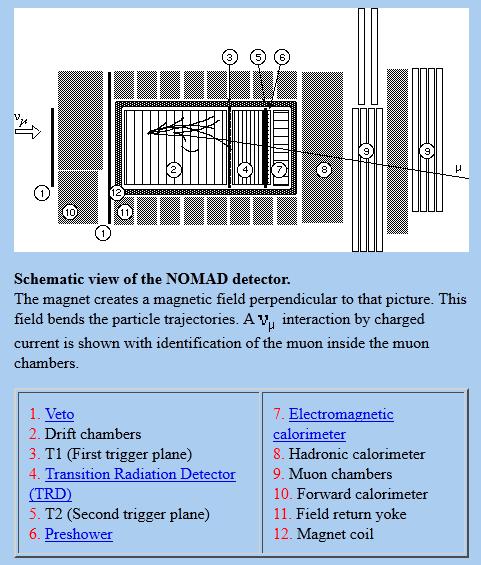
    NOMAD first. NOMAD (Neutrino Oscillation Magnetic Detector) is a venerable neutrino experiment which ran in the late nineties at CERN, looking primarily for a signal of muon neutrino oscillations into tau neutrinos. A high-intensity beam of muon neutrinos with mean energy of 24 GeV was provided by the CERN SpS in the years 1996-1998 through the interactions of a total of 40 billions of billions of 450 GeV protons with a beryllium target. A sketch of the components of NOMAD, stolen from the official web site of the experiment, is shown on the right: muon neutrinos arrive from the left, and their charged-current interactions with a nucleus produce a energetic muon and a hadronic shower.

    The features of NOMAD make it sensitive to the production of electron-positron pairs produced by the beam of neutrinos as they radiate part of their energy. The radiation process has been shown by Cohen and Glashow to be bound to occur at a significant rate if muon neutrinos in the beam are superluminal. Indeed, already a few weeks ago the ICARUS detector at the italian Gran Sasso laboratories "ruled out" the OPERA speed measurement on the basis that the observed energy spectrum of muon neutrinos did not show any depletion of high-energy neutrinos as would instead be expected if neutrinos were superluminal and thus radiated out energy during their 730-km underground trip from CERN to Gran Sasso.

    While the fact that ICARUS does not see the effect of the radiation of electron-positron pairs off the CERN neutrinos is a circumstantial proof that none of that occurs, one could on the other hand ask oneself whether those electron-positron pairs could be visible along the neutrino beam path: a direct observation of those pairs would turn the tables. That is what the author tried to do using the old NOMAD data. Since electron-positron pairs had been searched in NOMAD for other purposes during the lifetime of the experiment, it is a simple matter to dig out the relevant information.

    The result is simple: accounting for other sources of electron-positron pairs, no more than O(1) such events can be ascribed to neutrino radiation in the total NOMAD dataset. O(1) is a scientific notation to mean "of the order of one event". What would be the number of observed pairs instead if the neutrinos had been superluminal (with the speed measured by OPERA), and had therefore been arriving into NOMAD radiating part of their energy in the form of converting photons ? It is shown in the figure below. The expected flux of these pairs has been computed as a function of their total using the energy distribution of neutrinos of different species in the beam, accounting for the radiation process which of course depends on the neutrino energy. The pairs predicted to be contributed by muon neutrinos, the ones of which the beam is mostly made of, are shown in black.
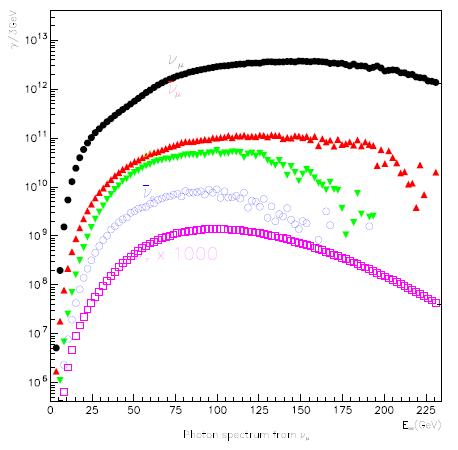


    What you should get away is that the vertical scale is logarithmic and that the predicted pairs are not O(1), but O(trillions). So the fact that these pairs were not observed  completely rules out the compatibility of Cohen and Glashow's calculation with the OPERA result. One must accept that either the muon neutrinos from CERN oscillated into some sterile form which did not lose energy by radiation of neutral current in its propagation, or that the speed measurement is incorrect.

    Cattaneo uses the data to estimate the fractional surplus of energy above c of all the neutrino species in the beam which would produce O(1) or less electron-positron pairs in the NOMAD data. For muon neutrinos, the bound is of the order of 10^-9, thus of the same order of magnitude of the bound on the superluminal speed of the neutrinos observed from the burst of SN1987A.

    Of course after the ICARUS result this is just an additional proof, and all the objections to the conclusions one may draw remain: the radiation might not occur if the neutrinos had some special properties we have so far not understood yet.


    Comments

    vongehr
    Amazing how after all the discussions we had you still go on to hype every single measurement in a completely one sided, orthodoxy defending way. It is people like you that turn science into a dangerous religion, into established dogma, and like all proper Jesuits, you actually go to bed thinking you are something better than the rest, don't you?
    How many measurements that are completely consistent with ultra fast velocities over short distances near CERN will you keep presenting to us as "bounds on speed" and "refutations of OPERA"? Tomorrow somebody finds no black hole in Gran Sasso. Oh yeah - OPERA is refuted!
    People are watching your kind - many wake up and become aware of that they are never told the whole story by scientists. Climate warming denial is up from 50% to 80% in the US due to people becoming skeptical of scientists spinning everything in order to sell whatever they want. Vaccination rates are dropping. Congratulations. Is that what you wanted? Well, you achieved it.
    dorigo
    Perhaps you did not notice it, Sascha, but NOMAD is at CERN. So the neutrinos arrive there after traveling a very short path. The observation of no radiation in NOMAD is therefore also an observation that whatever fantasious mechanism may produce neutrinos that choose to travel faster than light for a little and then settle to c is also bound by the NOMAD observation.

    Instead of crying you should use your neurons every once in a while. Your pet model is rather absurd and violates about a dozen laws of physics, but there is no reason to not confront it with experiment. Take the NOMAD specs now and do your homework, deriving a bound on the mechanism you claim. That is the way to do science, not writing trolling comments in honest blogs.

    Best,
    T.
    vongehr
    I know where NOMAD is. Thanks. I have no pet model by the way, so there is nothing that can violate a dozen laws of physics. Are you trying to start now to insinuate that I have pseudoscientific models in order to smear me? Very extremely low gutter style, but I expect no different. Thanks for nothing.
    (You know very well that NOMAD is a bound only based on assumptions that are moot in case the particles are superluminal. You know exactly what you are doing here! You may be able to deceive your minions, but not me.)
    Well, your paranoid delusions have certainly escalated recently...

    Hank
    He's doing what you say scientists should be doing; speaking his mind on issues without regard to who will think it's popular or what criticism he will get and has done it for 7 years just like he has done it on OPERA.  But you don't like what he says so you instead claim he is a shill for Big Physics.  Then he responds to your sniper rifle shots at him and you say he is smearing you.

    Talk about issues, not personalities.  This kind of back and forth is more Scienceblogs than Science 2.0.  Plus, Lubos is way better at insulting him (and me, and everyone else) so let that be his special thing.
    Want more no-nonsense, independent science? Buy Science Left Behind
    vongehr
    Dear Hank, I disagree with that he is "speaking his mind on issues without regard to who will think it's popular or what criticism he will get", but this may be just a matter of degree. For me, somebody who knows science from the inside and has almost never anything critical about all the shit that is going on is blind or a coward - there I said it. Not sure what you mean by "shill for Big Physics", but this term does not feel like what I ever claimed. Convenience and being a little wheel inside a system and being stoic about it is one thing, getting nasty if others point out that we stabilize a house of cards is another. (Example: My carbon footprint is huge and I live 40 years already very comfortably in a system that is based on gruesome exploitation of humans all over the world. You tell me so, I will not start smearing you, but admit it and see whether we can together do something about it.)
    About smearing and Lubos being better at insults: I do not need insults like mister T. T all of a sudden claims that I have some pet model that violates a dozen laws of nature. You will certainly admit that if I had a model (which I have not!) and there were even a single law of nature violated, T would surely have pointed that out in the previous discussions. He has not. So what is this about now? Precisely: A smear campaign! He wants to portray me as a pseudoscientific crackpot to his readers. This is ugly, as ugly a gutter level as one can possibly go down to between scientists. And it is totally consistent with mediocre scientists like him having suppressed emergent gravity for more than 50 years!
    Sorry to disagree with your high opinion of the 7 year Science2.0 click number generator. It isn't all gold that is yellow and shiny.
    Dear Sasche Vongehr

    this is a serious excellent, solid, reasonable and fair particle physics blog here which should not get pollutet with such off the base and science and scientists insulting comments.

    So may I kindly ask You to leave this place?
    I' m sure there are other sites in the web more appropriate for Your purposes and intentions ;-)...

    Thanks in advance for Your understanding

    Cheers

    vongehr
    Well since you addressed me so politely, let me answer. This blog is by no means "reasonable and fair" if it is throughout painting a biased, almost 100% positive picture because no criticism is allowed to decrease the support on the home front, regardless of how great the costs are. I will not leave this place as long as scientists are simply ignoring their own responsibility for the deeper and deeper troubles we are in. It is scientists like these who are directly responsible for that the public trust in science decreases, and sadly, as this is going on, distrust is entirely justified. If you cannot stand that the internet allows democratic discourse and transparency that shows what you do not want to see, disconnect. As long as you are out here, you will find conscientious people who are not afraid of transparency.
    Well said Dilaton, but probably on deaf ears.

    UvaE
    If he would leave, his broad-based and specialized criticism, knowledge and articles would be sorely missed. As a reader, you do have a choice of focusing on the articles and ignoring overheated diatribes--but keep in mind that they are two-way!
    Daniel de França MTd2
    Pay attention at this observation in the last paragraph: "the radiation might not occur if the neutrinos had some special properties we have so far not understood yet." 


    We will now kbetter by the end of this month, or probably earlier, given that OPERA is firing bunches of 1ns spaced by 500ns for 10 days, until this Sunday, November 6th, and will collect around 10 neutrinos. They will know with a very good precision the time which the neutrinos left CERN and arrived at Gran Sasso.


    Guys,

    A little reality check: We're on the brink of economical, social and environmental collapse.
    But I think we're also on the verge of several scientific breakthroughs that can save Earth and/or our not-so-sweet butts.

    I don't really care if we get to understand stuff (would be nice though).
    It's very well possible that the way our brains work prevents us from ever really understanding what the **** is really going on.
    A practical application however will do just fine.
    Free-ish energy, anti-gravity, warp drives, whatever.
    Unfortunately I don't have the knowledge or training to do it myself, so I'm depending on YOU.

    YOU need to fix the planet or find another place to go or humanity will fizzle and the way I see it that's not how it's supposed to end.

    So let's stop bickering and get to work because I want to see solutions in my lifetime.
    I don't know about you but I definitely don't want to die angry, sad or both.
    Please. Pretty please. Pretty pretty please?

    Okay? :-)

    vongehr
    A little reality check: We're on the brink of economical, social and environmental collapse.
    But I think we're also on the verge of several scientific breakthroughs that can save Earth
    Precisely! And how we did and do science has brought us here, too! With critique being silenced, science is getting worse. If science is just another religion and becomes the weapon of an elite that deceives the rest, then there is zero hope for that it helps at all. It will accelerate the decay and at most help to save a few rich and powerful ones for a little while longer than the rest.
    But Sacha my friend (if I may be so bold) surely you must realize that most if not all of these supposed perpetrators aren't really evil, but merely stupid.
    And if I've learned something in my 50 years on this dirtball it's that good old Friedrich was right when he wrote that "Mit der Dummheit kämpfen Götter selbst vergebens."

    We really need that breakthough. Our egos won't cut it. Honor won't cut it.
    And it's not going to happen if we spend our energy fighting windmills it is going to happen if we think and act outside the ******* box!
    I KNOW we can do this if we really really really try. Help me out. Help YOU out. Help US out.

    whitepanther65
    Hi Tommaso,I am puzzled by your sentence:
    "the radiation might not occur if the neutrinos had some special properties we have so far not understood yet."

    Glashow and Cohen's argument applies to the three neutrino flavors, since the neutral weak current involved treats on equal footing tau, muon and electron neutrinos.  We know that neutrinos oscillate between the three mentioned flavors, but this kind of radiation would be effective independently of oscillations. So my impression is that we know neutrinos properties well enough, and the radiation from superluminal neutrinos is unavoidable. Do you have something else in mind when you mention "special properties"? 

    On the other hand, there are ways to escape Glashow and Cohen's arguments. One, rather radical, is to hypothesize that energy-momentum conservation is not universally valid. 
    dorigo
    Hi Paolo,

    my sentence was quite general, in fact... I have nothing specific in mind, but if muon neutrinos oscillate into some other form which does not radiate weak currents, you might avoid the bound. Or if 4-momentum conservation is violated. Who knows what a theorist can put together!

    Cheers,
    T.
    whitepanther65
    I'm afraid theorists cannot put together much, in this specific case. I believe no dynamical model can be invented that is consistent with the OPERA anomaly and the other relevant experimental constraints. In other words, sterile neutrinos won't work, extra dimensions won't work, any "new physics" or "Beyond the Stnadard Model" physics won't work.  A bold claim? Maybe, but I am ready to defend it. I cannot explain my arguments in five lines here unfortunately...
    "I believe no dynamical model can be invented that is consistent with the OPERA anomaly and the other relevant experimental constraints"

    Here is a speculative idea: What if there is an underlying dynamical symmetry between photons traveling in vacuum and long-range neutrinos whose flavor oscillations are being suppressed by propagation in Earth? If conditions are such that this non-trivial gauge symmetry is unbroken, photons and single-flavor neutrinos may be viewed as dual components of the same field. Special Relativity and Lorentz symmetry would be then automatically reinforced regardless of the relative speed of neutrinos and their average energy.

    dorigo
    I have trouble with your idea Ervin, but that is probably because I am too dumb. Photons (bosons) and neutrinos (fermions) fitting in the same quantum-mechanical description sounds like an extreme form of SUSY to me though. In any case I take it as an example that there is an infinite number of theories one can put together, which is okay because then we can use Occam's razor to cut through them.

    Cheers,
    T.
    I am having trouble with Sascha at the moment he took a spray at science because his paper was rejected because it embodied retro-causality by what he said in the spray. Then he sprays at Tommaso calling what he is doing unscientific in perpetuating a myth because Sascha determines there are laws nuetrinos are not allowed to violate.

    Sorry Sascha I am fan but yeah I can't support you in this one, I don't think Tommaso is doing anything other than providing results. Nuetrinos might just violate all your beloved laws out of spite because non of us know how all this thing works we can't assume there are any sacred laws.

    You basically argued the same thing in your spray when science said time causality was sacred you complained and gave them a serve ... so are you the decider of which and what laws are sacred then?

    It may interests physicists to learn of the interest historians of mathematical logic have in the experiment. First a little background. Einstein's logical orientation was entirely constructivist, as he made very clear in the paper he regarded as the fullest expression of his views, "Geometry and Experience. " So I think you have to understand constructivism--especially as it was formulated at the time Einstein was developing relativity--if you want to understand the relativity of simultaneity, which is what the CERN experiment calls into question. And that really is the question: does the CERN experiment reveal a logical flaw in the relativity of simultaneity?

    We go back quite far with constructivism. Because the ancient paradoxes, such as Zeno's were regarded as having logical content (that is, they led unimpeachably to mutually exclusive conclusions), Aristotle felt that there must be some ad hominem intervention in any argument in order to avoid it ending in paradox. Paradox was unavoidable in every argument, and had to be avoided.

    Interest in this point of view was revived by Cantor, and led to the emergence of set theory around the turn of the century. Poincare's Science and Hypothesis seemed to confirm--by references to supposedly new Paradoxes--that argument led ineluctably to paradox and that paradox had to be "avoided." That point of view had somehow to be expressed in every argument.

    Of course, if you have been following the recent renaissance in the historiography of set theory, you know that many of the ideas of set theory which seemed to confirm the constructivist point of view, have now been discounted. Above all, various set theory paradoxes have been revealed as having no logical content. The landmark book in the renaissance of set theory historiography is A. Garciadiego, BERTRAND RUSSELL AND THE ORIGINS OF THE SET-THEORY 'PARADOXES.' Physicists have never even heard of this book, but if you had some notion that there was such a thing as Russell's paradox, or that it had any logical content, you will be abruptly disabused of that notion as you read that book, and you will realize that you are not fully in the picture as regards relativity. Not flattering to ones amour propre, but better to proceed humbly than wrongly.

    The effect of the new set theory history is to undermine Einstein's confirmation of the constructivist point of view, which he took from Poincare, above all, but also from other contemporary confirmations of constructivism. In short, when Einstein came to formulate the relativity of simultaneity, he did so intending to make an arbitrary intervention in the argument. Since the intervention could not be identified (especially in the 1905 paper, in which it is implicit), it has long been felt--especially by those who insist on logical content in their arguments, and who feel that there is logical content in the relativity of simultaneity--that there is no constructivist intervention in the relativity of simultaneity.

    But there is. It was made explicit in the "trial run" of "Geometry and Experience," the short book RELATIVITY, THE SPECIAL AND GENERAL THEORIES. It is not fully understood that the "clock" and "train" experiments (the latter of which is used in RELATIVITY) are the same experiment, and can be mechanically transposed into each other. It is thus in RELATIVITY that the constructivist intervention placed by implication in the 1905 paper, is made explicit in RELATIVITY. It is interesting to note that when RELATIVITY was first translated into French and Italian, the translators did not accurately translate the text. Certainly unconsciously, they tried to correct the logical flaw in the relativity of simultaneity by changing the text. I won't discuss those changes here, but you can find them in those translations.

    However, the Lawson English translation is an accurate translation of the original German of the passage in dispute. Here is the passage in which we find the constructivist intervention in the relativity of simultaneity:

    Are two events (e.g. the two strokes of lightning A and which are simultaneous with reference to the railway embankment also simultaneous relatively to the train? We shall show directly that the answer must be in the negative. When we say that the lightning strokes A and B are simultaneous with respect to be embankment, we mean: the rays of light emitted at the places A and B, where the lightning occurs, meet each other at the mid-point M of the length AB of the embankment. But the events A and B also correspond to positions A and B on the train. Let M1 be the mid-point of the distance AB on the traveling train. Just when the flashes (as judged from the embankment) of lightning occur, this point M1 naturally coincides with the point M but it moves?with the velocity?of the train.

    This passage is by now so familiar that we think there can be nothing new to be seen in it. But there is: it is the term, "naturally coincides" ("fallt zwar...zusammen" in the German). Among the definitions of this experiment is the Euclidean one that the coincidence of two points is a point. However, Einstein does not define a "natural" coincidence of two points. Note that if we simply drop the term "naturally" we run into a situation in which Einstein has told us to assume two Cartesian coordinate systems, but now leaves us with one, since, following from the definition of the coincidence of two points, if two parallel coordinate systems coincide at one point, they coincide at all points and are one coordinate system, not two. We have been led to a contradiction, if we drop "naturally" and M and M' coincide according to Euclidean geometry. If the term is retained, we have an argument "including" a term which has no logical role in the argument.

    Of course, constructivism accounts for the latter. As you will read in "Geometry in Experience," Einstein felt there had to be such an element in every argument in order for the argument to avoid paradox. However, the assumption has always been that Einstein did not actually practice that point of view in formulating the relativity of simultaneity, because he never indicated explicitly where he practiced it in the relativity of simultaneity, nor could anyone identify where he did so. Thanks to the insights provided by the renaissance in the historiography of set theory, we now know where he did so.

    So the question is: does the CERN experiment provide confirmation of the presence of "natural" coincidence in the relativity of simultaneity, thus revealing a logical flaw in the relativity of simultaneity? I note that some objections to the CERN experiment are on the grounds that idoes not follow the relativity of simultaneity. However, if there is, logically speaking, no relativity of simultaneity, then what is the protocol of the CERN experiment?

    Note another question which is becoming ripe for investigation: so far, there is only one disproof of the Pythagorean theorem which has been regarded as having logical content: general relativity. However, if we cannot logically reach general relativity because of the presence of "natural" coincidence in the relativity of simultaneity, then the question arises: is there a constructivist intervention in the Pythagorean theorem? If so, where precisely is it?

    dorigo
    Dear John,

    I oscillate between tagging this as an off-topic comment (and thus ignoring it) and trying to make sense of it in the light of the original post. In any case let me answer you this way: it is way too early to give for granted that superluminal motion is possible, thus moving on to speculate on causes and implications. This is at least my stand.

    Best,
    T.
    Oh, I understand that. Nevertheless, the CERN experiment raises settled questions, so you should start revisiting them. The place to do so is Einstein's intellectual orientation. I already see comments relating the CERN experiment directly to the relativity of simultaneity. So I think you will be restudying the relativity of simultaneity far sooner than you imagine. You should be prepared by understanding the intellectual climate out of which the relativity of simultaneity arose. It is impossible to do that without understanding the history of set theory. The link between set theory and Einstein is, of course, Poincare. But that only leads you into general considerations of constructivism, which points directly at the relativity of simultaneity, as Einstein himself said very clearly in "Geometry and Experience." He doesn't use that title in order to provide something vague and general. He really means geometry and he really means experience.

    Oh also, two things:

    1. Read Garciadiego's book. You will find it more difficult going than you imagine, given that it deals with early principles of set theory which are, today, taken as well settled.

    2. You asked about the relation of the comment to your article. It has to do with the two diagrams you use. Compare them to the diagram Einstein uses in RELATIVITY for the train experiment. What is the relation between the two? Or better yet, what would Einstein say is the relation between the two. Remember than the relationship between M and M' in the diagram--a relationship which EInstein describes as "natural" coincidence--is what, today, we call a spacetime point.

    Be careful! Einstein was not flighty when it came to Euclid. if you are going to dissect these three diagrams, use a tweezers, not an axe.

    Sorry to keep posting, but another result of studying Einstein in connection with set theory is that he felt that reality was progressive. I don't think that that is the position of anyone who subscribes to the Standard Model, but it was his position. In general, those who support the Standard Model have to watch out for vanity. They themselves would never subscribe to a model which did not have logical content. Since it was never clear where Einstein made his constructivist intervention, they could safely subscribe to it, since it reaffirmed their sense of self-worth. But don't go out on a limb. If there are problems with the settled questions, face them. There was, we know now, a lot of sloppy thinking about mathematical logical at the turn of the century. Russell, as you will see in Garciadiego's book, was very, very sloppy, and Poincare was not much more than a scientific publicist. Grattan-Guinness takes him severely to task in THE SEARCH FOR MATHEMATICAL ROOTS. What did Poincare understand about logic. Grattan-Guineess says, "not much." And yet we have no evidence that Einstein ever criticized--or seriously investigated--Poincare's contentions. The contentions of early set theory were sensational and spectacular--they were fireworks. Now we know that they were dazzling, but without logical content.

    Jose Ferreiros has revealed Cantor's intellectual preoccupations, which cast grave doubt on Cantor's procedures (and Ferreiros' comments are not the only ones which cast grave doubt on Cantor's procedures).

    If you have been following the complete edition of Godel, you will be aware of the scathing remarks made by the editors on Godel's misunderstanding of issues, his intellectual sloppiness, his cursory treatment of results. The result is that there is now considerable doubt that there is no motivation--no target, nothing to be resolved, no goal to be attained--by Godel's theorems. We are at the point of asking: are they theorems at all? Where is the constructivist intervention in them?

    So this is a whole area which is going to come sneaking up on you as you discuss the CERN experiment. I think that when the record comes out, it will be seen that the experimenters were very well aware of the commentary being made by set theory historiography on the entire relativist enterprise. Above all, if there is no relativity of simultaneity, and the experimenters knew it, then you should look at the CERN experiment as something OTHER THAN a test of the relativity of simultaneity. It may well turn out that, sub rosa, relativity has been seen as flawed for some years now, and that as a result the Standard Model has ceased to be used as a protocol, and that it is not the protocol for the CERN experiment. We are probably in a quite different scientific environment from the one out of which your comments are coming, as well as the other comments I have read under your article. Have you considered this? Are you in a position to consider this. To put it another way, are you still evaluating behavior in terms of the principles of phrenology, when the scientific community has moved on to neurology?

    I said earlier that the discussion around the CERN experiment would come rapidly to focus on the logical content of the relativity of simultaneity, and the second CERN experiment confirms this. The paper is at

    http://arxiv.org/ftp/arxiv/papers/1109/1109.4897.pdf

    Note this comment from the paper:

    The two time-stamps are related by TOFc, the expected
    time of flight assuming the speed of light [13]. It is worth stressing that this measurement does
    not rely on the difference between a start and a stop signal but on the comparison of two event
    time distributions.

    You would think at first that this is the clock experiment, but it isn't. It is important, I think, to realize that since Einstein's notion of "natural" coincidence is not a definition, principle, assumption or deduction of the relativity of simultaneity, it is part of every aspect of the relativity of simultaneity. This occurs to me because in the CERN experiment, there is no assumption of the speed of light (although the results are compared to what is traditionally considered to be the speed of light, this being an entirely different use of the speed of light from the use Einstein makes of it, which is, as an assumption). The CERN experiment's question is, what is the speed of light? Neither of the CERN tests are tests of the relativity of simultaneity, that is, neither of the experiments proceed on the idea, Well, if we are going to experiment with light, our protocol must be the relativity of simultaneity. It does not pose any new challenge to the relativity of simultaneity of simultaneity. Instead, it confirms what I said in 2008, which is that the logical flaw in the relativity of simultaneity is the presence in that argument of the notion of "natural" coincidence of points. Its protocol has already abandoned the relativity of simultaneity, its protocol comes from the intellectual period AFTER quantum electrodynamics. I get the feeling from reading criticism of the CERN experiments that the critics are criticizing the experiments because their protocol is not quantum electrodynamics. Instead they should be asking, Why isn't quantum electrodynamics the protocol of these experiments? If you look at the CERN experiments, you see that "natural" coincidence forms no part of their geometry. This is because the CERN experiments reflects a point of view which does not include the notion of "natural" coincidence. They simply are not constructivist experiments. Again, I warn you to take account of how the new historiography of set theory has affected physics. I said this before, and it doesn't seem to me that any of your readers have done anything about it. But as more evidence piles up that the problem is with the logic of the relativity of simultaneity, you will be driven to read the book which, again, I am telling you to read: A. Garciadiego, BERTRAND RUSSELL AND THE ORIGINS OF THE SET-THEORETIC 'PARADOXES.' Leave your amour propre at the door, and read the book.

    The paper in which I talk about constructivism and its use in early twentieth-century arguments (not just relativity, although this is the paper in which I point out Einstein's use of "natural" coincidence) is here:

    http://ssrn.com/abstract=897085

    I also refer you to the Figure 5 in the new CERN paper and invite you to compare it to the train experiment diagram (involving points M and M') in Einstein's book Relativity: The Special and General Theories.

    This second experiment, and suggestions for further experiments, focus the discussion ever more precisely on the geometry of the relativity and a logical analysis of that geometry. This is what I said would happen when I first posted here, and so far that is what is happening. Soon the experiment focus will be entirely on testing the geometry of the relativity of simultaneity. The result will be more experimental verification of what I said a few years ago in my paper: the logical flaw in the relativity of simultaneity is that it contains the notion of "natural" coincidence, a notion which plays no logical role in the relativity of simultaneity.

    dorigo
    Hi John,

    I am sorry to be unable to answer your long posts meaningfully, but as I said they are off topic - I might be interested in this topic but I feel I cannot spend my time discussing it here. I did not remove them because maybe some other reader wants to have their say, but that's about all I can do.

    Best,
    T.
    That's fine, but if you do want to respond to them meaningfully, read Garciadiego. There must be a copy in a university library near you, although the book is now out of print. This book is to us what Poincare's La Science et l'hypothese was to Einstein--hopefully at a somewhat higher level of inquiry(!).

    We are still yet to see a calculation or experiment that rules out the 60 nanosecond advance occurring across the 18-metre (= 60 light-nanosecond) hadron stop at the end of the decay tunnel. See http://t.co/lOzF0IYF

    Shouldn't O(1) denote Big-O notation, as in complexity theory? Thus O(1) = O(trillions) = "some function with a constant finite upper bound." Is the use of O(X) to indicate "on the order of X" common in physics literature? This seems confusing (at least to computer scientists like myself).

    dorigo
    Well, yes, O(1) to me is a number of order unity. I confess I did not know the meaning you attribute to it.

    Cheers,
    T.
