

Banner
    OPERA Sees Tau Neutrino Appearance!!
    By Tommaso Dorigo | May 31st 2010 03:17 PM | 42 comments | Print | E-mail | Track Comments
    About Tommaso

    I am an experimental particle physicist working with the CMS experiment at CERN. In my spare time I play chess, abuse the piano, and aim my dobson...

    View Tommaso's Profile
    Not even a week has passed since the announcement by Carlo Rubbia that the ICARUS experiment is collecting its first neutrino interactions, that another experiment at the Gran Sasso Laboratory claims the international scene of neutrino physics. And this time with a real reason. Not the observation of the first events - the experiment in question, OPERA, has been active for more than three years now- but for the observation of a fundamental process that had never been seen before!


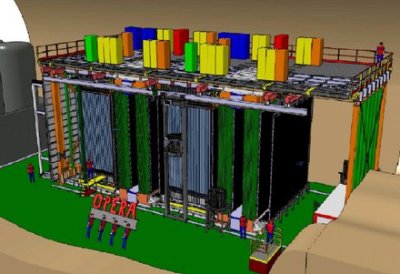
    It is official: the OPERA experiment (above, in a sketch) has found its first tau lepton in one of its bricks (a picture of a brick is shown below). What gives, I am hearing some of you ask. It means that a muon neutrino launched from the CERN laboratories in a 730 km course underground has oscillated into its brother, a tau neutrino, and that the latter has materialized into the charged partner, the tau lepton, inside the OPERA detector.

    In other words, the observation spells the direct detection of muon neutrino oscillations into tau neutrinos! This is great news for the whole community of high-energy physics (many dull writers would write "great nu's" I guess).

    In case you do not know it, neutrinos are neutral leptons, and together with the charged ones they make up "doublets" just like quarks do: matter is therefore organized into 12 kinds of particles, six quarks and six leptons, and divided into three "families", as shown in the diagram below.
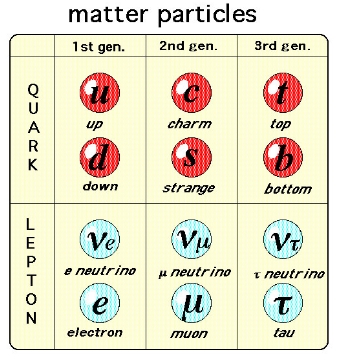


    The first family includes the up- and down quarks, the electron, and the electron neutrino; the second family has the charm- and strange quarks, the muon, and the muon neutrino; the third has the top- and bottom quarks, the tau lepton, and the tau neutrino. While only particles from the first family make up ordinary matter, all these 12 particles have similar properties, and their organization looks tidy and pleasant to the eye of a particle physicist.

    In the late 1990s the Super-Kamiokande experiment in Japan proved that neutrinos may "oscillate": they may change flavour, such that a muon neutrino may turn into an electron neutrino, or vice-versa. But a muon neutrino had never been directly seen turning into a tau neutrino yet.


    I wrote about the Opera experiment a few years ago. I will just mention here again, for those lazy enough to avoid clicking the above link, that the detector is built with a quite interesting concept: its core is made by a large number of 20-pound "bricks" (see picture on the right) that pack photographic emulsions; the latter are capable of tracking ionizing particles with micrometric precision.

    When an external detector observes that an interaction has occurred, it extrapolates all observed particles to the brick where the primary neutrino collision has taken place. The brick is extracted from the detector, and its photographic emulsions are developed, allowing the reconstruction software to track the particle trajectories with an accuracy good enough to identify a tau lepton decay, if one has occurred. Tau leptons, in fact, live only few tenths of a trillionth of a second, and in that time they travel only hundreds of microns away from their creation point.
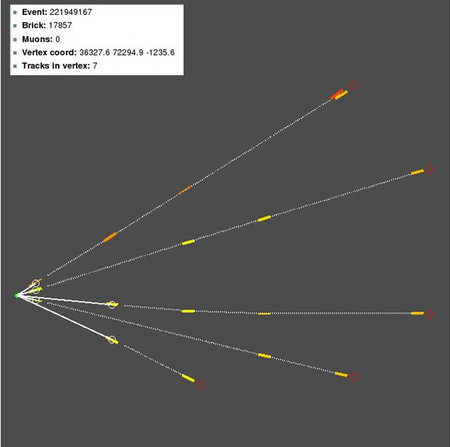
    So in a nutshell the idea is this: muon neutrino get produced at CERN. They travel underground, become tau neutrinos somewhere under northern Italy, and finally hit a nucleus of one of the OPERA bricks by emitting a W boson. The charged current interaction transforms the tau neutrino into a charged tau lepton; the lepton travels a millimeter or so, then decays into a few charged particles (say three). The three charged particles can be traced back by the precise reconstruction software, and what physicists see are a hard nuclear interaction, followed by a three-track vertex displaced enough to be unmistakably due to a long-lived particle (where "long" is an euphemism here!). Above, you can see a zoom-in view of a neutrino interaction reconstructed by the emulsion hits.

    The revolutionary concept will not have escaped an astute reader: OPERA gets dismantled piece by piece during data taking!

    There would be a lot to write about the physics of neutrinos and the importance of this research. However, I am rather turned off in my writing vein today by the fact that CERN has issued a very clear and explicative press release. I will for once rely on it parasitically... Here is a clip:

    [...]The neutrino puzzle began with a pioneering and ultimately Nobel Prize winning experiment conducted by US scientist Ray Davies beginning in the 1960s. He observed far fewer neutrinos arriving at the Earth from the Sun than solar models predicted: either solar models were wrong, or something was happening to the neutrinos on their way. A possible solution to the puzzle was provided in 1969 by the theorists Bruno Pontecorvo and Vladimir Gribov, who first suggested that chameleon-like oscillatory changes between different types of neutrinos could be responsible for the apparent neutrino deficit.

    Several experiments since have observed the disappearance of muon-neutrinos, confirming the oscillation hypothesis, but until now no observations of the appearance of a tau-neutrino in a pure muon-neutrino beam have been observed: this is the first time that the neutrino chameleon has been caught in the act of changing from muon-type to tau-type.

    Antonio Ereditato, Spokesperson of the OPERA collaboration described the development as: "an important result which rewards the entire OPERA collaboration for its years of commitment and which confirms that we have made sound experimental choices. We are confident that this first event will be followed by others that will fully demonstrate the appearance of neutrino oscillation".

    "The OPERA experiment has reached its first goal: the detection of a tau neutrino obtained from the transformation of a muon neutrino, which occurred during the journey from Geneva to the Gran Sasso Laboratory," added Lucia Votano, Director Gran Sasso laboratories.[...]

    The OPERA result follows seven years of preparation and over three years of beam provided by CERN. During that time, billions of billions of muon-neutrinos have been sent from CERN to Gran Sasso, taking just 2.4 milliseconds to make the trip. The rarity of neutrino oscillation, coupled with the fact that neutrinos interact very weakly with matter makes this kind of experiment extremely subtle to conduct. CERN's neutrino beam was first switched on in 2006, and since then researchers on the OPERA experiment have been carefully sifting their data for evidence of the appearance of tau particles, the telltale sign that a muon-neutrino has oscillated into a tau-neutrino. Patience of this kind is a virtue in particle physics research, as INFN President Roberto Petronzio explained:

    "This success is due to the tenacity and inventiveness of the physicists of the international community, who designed a particle beam especially for this experiment," said Petronzio. "In this way, the original design of Gran Sasso has been crowned with success. In fact, when constructed, the laboratories were oriented so that they could receive particle beams from CERN".

    At CERN, neutrinos are generated from collisions of an accelerated beam of protons with a target. When protons hit the target, particles called pions and kaons are produced. They quickly decay, giving rise to neutrinos. Unlike charged particles, neutrinos are not sensitive to the electromagnetic fields usually used by physicists to change the trajectories of particle beams. Neutrinos can pass through matter without interacting with it; they keep the same direction of motion they have from their birth. Hence, as soon as they are produced, they maintain a straight path, passing through the Earth's crust. For this reason, it is extremely important that from the very beginning the beam points exactly towards the laboratories at Gran Sasso. [...]

    While closing a chapter on understanding the nature of neutrinos, the observation of neutrino oscillations is strong evidence for new physics. In the theories that physicists use to explain the behaviour of fundamental particles, which is known as the Standard Model, neutrinos have no mass. For neutrinos to be able to oscillate, however, they must have mass: something must be missing from the Standard Model. Despite its success in describing the particles that make up the visible Universe and their interactions, physicists have long known that there is much the Standard Model does not explain. One possibility is the existence of other, so-far unobserved types of neutrinos that could shed light on Dark Matter, which is believed to make up about a quarter of the Universe's mass.


    Comments

    lumidek
    You may also detect tau neutrinos if you cook potatoes. But OPERA is faster than potatoes:...

    http://www.youtube.com/watch?v=zaT7thTxyq8
    http://motls.blogspot.com/2010/05/cern-sends-muon-neutrinos-gran-sasso.html


    dorigo
    Lubos, I have stopped reading your blog a while ago when it crashed systematically my browser (Mozilla firefox). Now I tried it again, and again it crashes. Solve the problems or I and a few others will be unable to read you.

    Cheers,
    T.
    lumidek
    Dear Tommaso, if there's something on my blog that keeps a portion of computer-ignorant and otherwise ignorant people that are similar to you away from my blog, I will, on the contrary, do my best to preserve this jewel. ;-)...

    Readers who are at least a little bit smarter concerning the IT technology than yourself have found dozens of ways how to read the blog in other ways, e.g.

    http://feeds.feedburner.com/LuboMotlsReferenceFrame

    http://www.google.com/reader/view/#stream/feed%2Fhttp%3A%2F%2Fmotls.blogspot.com%2Ffeeds%2Fposts%2Fdefault

    http://www.google.com/reader/m/view/feed/http://motls.blogspot.com/rss.xml


    The last one is used even by very old cell phones' owners.

    But don't get me wrong: once again, I am surely not encouraging *you* to learn how to click at any of the links above (or how to learn to use another browser - but be sure that legitimate Firefox is 100% compatible with my blog and 45% of my readers are Firefox users).
    Hmmm.......

    http://validator.w3.org/check?uri=http%3A%2F%2Fmotls.blogspot.com%2F&charset=(detect+automatically)&doctype=Inline&group=0

    Errors found while checking this document as XHTML 1.0 Strict!
    Result: 1772 Errors, 559 warning(s)

    LOL! And that's just the main page w/o all the stuff that's pull in as side dishes.

    I Firefox crashes on it, don't touch it with a barge pole.

    Well, maybe using Chrome.

    Great days!
    I wonder how much this one changes the previous results about oscillation or if it simply reinforces them, and what was the expected number of observed tau neutrinos... (Yes it'll probably take some minutes and a few clicks to find out but I'm thinking aloud!) Also, I don't quite get why people were peaceful about the neutrinos having mass all these years and they suddenly get animated about the invalidity of the standard model...

    lumidek
    Dear tulpoeid,...

    the expected number of tau leptons created in this experiment during the years is comparable to one and the exact number is not important so far. 

    What's more important is that the theories without any muon-tau neutrino oscillation would predict an almost strictly vanishing (zero) number of such events, because there are simply no "natural" GeV-like neutrinos flying around (that could create a 1.8 GeV tau lepton - because the Sun only has sub-MeV neutrinos or so, just count its temperature in MeV), so these theories are excluded. The single event is certainly due to the CERN source and it is enough to show that the oscillations have to exist.


    In the future, they may have many more events and "measure" the corresponding matrix element in the neutrino mass matrix but they're not there yet.

    The likely fact that the neutrinos have mass has been known since the late 1960s - before the Standard Model was completed. For decades, all people who had any clue about particle physics were pretty much certain about the neutrino oscillations. For the arguments and derivations that were relevant 12 years ago, for example, see my 1998 lectures on neutrinos (Majorana or Dirac) at

    http://cid-9cd81cfa06ff7718.skydrive.live.com/self.aspx/.Public/GooglePages/Complete%20lumajs/nu.pdf


    The pages 12-13 are dedicated to the evidence for neutrino oscillations and the derivation of the key oscillating formula. So your question is just a terminological one. 
    People who had a clue used the term "Standard Model" for an effective Lagrangian that does include the neutrino masses - whenever it is important. Because these masses only influence some very special experiments, the part of the "Standard Model" that is relevant for everything else excludes this neutrino mass sector - and it is this reduced "Standard Model" that had 19 parameters or so. With the neutrino masses, the number is close to 30 and it's been known for decades. 

    Also, it remains somewhat uncertain whether they're Majorana or Dirac particles (and masses) - that's what the "paper" above focused on. It's actually pretty likely now that the neutrino masses are Majorana masses, but despite this fact, the corresponding right-handed component of the spinor exists (which also allows the Dirac mass term) and the heavier eigenstate is very heavy, near the GUT scale.


    So the neutrino masses are not a real "beyond the Standard Model" observation.

    Cheers
    LM

    Wow thanks, sometimes it's enough to think aloud on the internets.

    "People who had a clue used the term "Standard Model" for an effective Lagrangian that does include the neutrino masses .... So the neutrino masses are not a real "beyond the Standard Model" observation."
    That was my impression but the buzz I observe since yesterday is somewhat different ... as if people were postponing digesting the existence of neutrino mass and getting ready for it!
    I also wonder if this affirmation shifted in any way the possibilities between Dirac/Majorana, it's obviously time for some reading.

    lumidek
    Dear tulpoeid, it was a pleasure. It may be useful to recall some points of the history and some points of the model building....

    In the late 1960s, Ray Davis performed the Homestake Experiments. Using chlorine detectors, only 1/3 of the solar neutrinos were seen - relatively to the number calculated from the known nuclear reactions in the Sun. The solar neutrino problem was born. The deficit was confirmed by many other types of experiments but the flavor changing was only directly observed by the Sudbury laboratory in 2001. The solar neutrinos are always below 20 MeV. Above 5 MeV, much of the flavor change is actually not due to the basic oscillation in the vacuum but because of the MSW effect - oscillation catalyzed by matter.


    This was the solar neutrino problem. There was a similar atmospheric neutrino problem: the ratio of the muon neutrinos and electron neutrinos from the muons created and decaying in the atmosphere didn't agree. IMB, MACRO, and especially (Super) Kamiokande experiments did the most accurate measurements in the last 10 years, showing the flavor change etc.

    Then there was some lab-based LSND experiment 2006 - and contradicting results from Miniboone in all the major details. Details not yet settled but the very fact of oscillations seems settled.

    Concerning the Lagrangians, one can write the "minimum" Standard Model without the right-handed neutrinos. But even in that case, it's possible to add the Majorana masses that only contain the left-handed, weakly-interacting and experimentally known 2-component spinor parts of the neutrino fields. According to the rules of effective field theory, one must add all renormalizable terms consistent with the symmetries etc. And the Majorana masses are surely among them - although they violate the lepton number by 2, being able to change the neutrino to an antineutrino in some sense.

    However, grand unified theories also imply that it's pretty natural to have an additional right-handed component which is able to complete the 2-component Weyl (or Majorana) spinor of the neutrino to a Dirac spinor, to make it analogous to the electrons (neutrinos just happen to be neutral). For example, SU(5) GUTs have 10+5 which has no right-handed neutrino. However, in SO(10) GUT, those 10+5 are completed to 10+5+1 = 16 which is a spinor of SO(10), and the additional 2-component spinor "1" added is the right-handed neutrino.

    While the components may be so that the number of 2-component spinors is even, the left-right symmetry is clearly broken much more heavily for the light neutrinos than e.g. for electrons which behave almost left-right symmetrically in QED etc. That's why one can still treat the left-handed and right-handed portions of the Dirac spinor separately. So there can exist both Majorana mass terms, that don't mix the two old and new part, and the Dirac mass terms that do mix them.

    Of course, many people - including Shelly Glashow and others - have looked to neutrino oscillations because it was one of the few accessible experiments in the dry period of experimental HEP physics. So of course, they had some reason to argue that even the qualitative picture is uncertain and deserves research. But I think that they have always agreed that the qualitative picture has been settled for more than a decade, to say the least.

    The remaining portion are the parameters. The lightness of the neutrinos is explained usually by the seesaw mechanism. A mass matrix whose entries are ((Mgut, Mew, Mew, 0)) has two eigenstates. The heavier one turns out to be Mgut or so. The lighter one is not exactly zero, the other diagonal entry, but it is close. More precisely, it is Mew^2/Mgut or so, try it. So if Mgut is very high - like the GUT scale - the light neutrino mass happens to be lighter than the electroweak scale Mew by the same factor (in the opposite direction). This estimate works, up to one order of magnitude or so (it's 14 orders of magnitude in both directions from 250 GeV, the electroweak scale Mew), and it is another circumstantial evidence in favor of the reality of the GUT scale near 10^{16} GeV.

    There's a lot of numerology research going on concerning the mass matrices for neutrinos which may be more or less reasonable (various guesses, trying to set some elements of the matrix to zero, or square roots of simple rational numbers, and so on). The latter group of projects probably includes most attempts by Kea or Carl Brannen while the intermediate point between the latter and the former includes papers by Tony Zee and many others. ;-)

    Best wishes
    Lubos

    dorigo
    I have to totally agree with Lubos - and I believe it's only weeks after the last time this embarassing thing last happened. Anyway, yes, I write time and again myself here that the neutrino masses did not force a revolution in physics, but just something like the rearrangement of the living room due to the arrival of a new baby.

    As for how Lubos can confidently say that OPERA expected about 1 event, that is because they are not crying loud to a discovery of anything, given reasonable values of the oscillation parameters. He is in the dark as much as the rest of us as to how many such events were predicted to be seen in the data analyzed so far (that is, some of us do know, but it is restricted information).

    Cheers,
    T.
    If only I could read your mind, Tomasso! LOL ;-)

    That's OK. I understand why the information is restricted. I'm a patient man.
    lumidek
    Dear Tommaso, imagine how better a human being you could be if admitted that I am actually always right....

    My comment that the expected number of events is of order one was actually not determined by sociological but scientific criteria - even though, I agree, the sociological arguments also make sense. You know, I actually think that physics works and that the outcome of this experiment could have been predicted already before the observations.

    Because one event was seen and because the theory works - agrees with the experiment - the predicted number of events should be comparable to one, too. If it were too much higher, it would be unlikely that they have only seen one. If it were too much lower than one, it would be unlikely to already see one. ;-)

    Cheers
    LM
    This is exciting stuff, Tomasso. Wolfgang Pauli would be very excited about this, if he were still alive. Thanks for posting.

    Best regards,
    Eric
    "As for how Lubos can confidently say that OPERA expected about 1 event, that is because they are not crying loud to a discovery of anything, given reasonable values of the oscillation parameters. He is in the dark as much as the rest of us as to how many such events were predicted to be seen in the data analyzed so far (that is, some of us do know, but it is restricted information)."

    According to several sources, the OPERA experiment set out expecting 15 tau neutrinos in 5 years of running. Here's a paper published last year:
    http://iopscience.iop.org/1742-6596/171/1/012066/pdf/1742-6596_171_1_012...
    which states that during the 2008 run they observed about 1700 neutrino interactions, and that for the 2008 and 2009 runs together, a total of 2 tau events would be expected.

    lumidek
    Good info. Well, so if this is 2 events, then one can write the probabilities to expect N events as Poisson distribution,...

    P(N) = exp(-2) 2^N / N!

    Note that the sum of P(N) from 0 to infinity equals one - recall the Taylor series for the exponential. The probability that the number of actually observed particles is 0,1,2,3... is 13,27,27,18... percent. So it's equally likely to see one as to see two, and all other numbers are less likely. A pretty generic agreement of theory with observations.

    I want to add a link concerning that 450 GeV 'event' discussed earlier. They guess it may be the fourth generation.
    http://www.newscientist.com/article/mg20627622.700-matter-the-next-gener...

    So Lubos, maybe it could be good with some sensitivity :)

    A scaled up variant?

    Maybe the same process as here with the muon?

    lumidek
    Dear Ulla, you may have missed it but your link leads to Nude Socialist, a crackpot magazine. But even this magazine manages to admit that the Tevatron people who know what they're talking about realize that this bold claim is not backed by the appropriate evidence. 
    In fact, John Conway quoted by NS wrote on this very blog that even if you took the fluke as a real signal, the signal doesn't have the fingerprints of a fourth generation. The point of their paper is that they can really falsify the fourth generation model.

    Saying that the fourth generation helps you to create a tau lepton in Gran Sasso is preposterous even a priori.

    Well, a search at google gave almost 6000 hits. And Reference Frame honoured it with a posting, so it could not be so bad. motls.blogspot.com/.../fourth-generation-and-scientific.html

    John Conway seems not at all negative according to this one https://indico.bnl.gov/getFile.py/access?contribId=131
    It fits, he says. He leaves the possibility open.

    CDF-proof is crackpottish too? http://www-cdf.fnal.gov/physics/new/top/2010/tprop/Tprime_v46_public/pub...

    And on Cornells arXive, also crackpottish? The Naturalness of the Fourth SM Family, arxiv4.library.cornell.edu/pdf/0905.2874v1
    Aaltonen et.al arXiv:0912.1057
    Bar-Shalom Hidden Symmetry, CP-Violation and Quark Masses https://indico.bnl.gov/getFile.py/access?contribId=134&sessionId=26&resI..., arXiv:1001.0569

    Lubos, you talk too much of crackpots. I'm only a novis, and can't know these things, but I soon think it is you that is His Excellency, Mr. Crackpot, himself. Please stop this talk. Nobody wins at it. You talk of humble correspondents, but the arrogancy is tremendous. Also you are free to change your opinion, and you do not have to stick to the Standard Model :) Leave the possibility open.

    lumidek
    Sorry, you are not only a crackpot. You are illiterate, too. The first file you link to doesn't exist.
    But all the others are the very same sources that *exclude* the fourth generation. The word "exclude" means to show that it is impossible. That's exactly the opposite of proving it, idiot.
    Hank
     You talk of humble correspondents, but the arrogancy is tremendous. 
    I have no perspective regarding any of the physics discussed but I want to see documentation before I ever believe Lubos claimed to be humble.
    Want more no-nonsense, independent science? Buy Science Left Behind
    lumidek
    I will happily provide you with that right away. I am called "your humble correspondent" - and Bill O'Reilly, who is also humble, is very lucky to share this phrase with me although he has used it first. ;-)
    If you don't know that I am humble, Hank, it indicates that your reading experiences in the scientific blogosphere are extremely humble, too.

    And that's the memo.
    >Bill O'Reilly, who is also humble

    splitting_headache_cause_by_retard_reactionimage.jpg

    dorigo
    You are being dishonest and dumb Lubos. We excluded the 4-th gen quark if it has a mass below a certain threshold, while the data leave the option open that it exists at a higher mass. If you do not digest this, walk away because you are giving wrong information and we certainly do not want it here. Further posts on this thread on your side will be censored if they insist in divulgating false statements.

    Best,
    T.
    lumidek
    Dear Tommaso,...

    I just claim the obvious fact that it is a lie to say that there exists evidence in favor of the fourth generation - something that both you and Nude Socialists did. There exists neither theoretical nor experimental evidence in this positive direction - while there exists a huge negative evidence against this option.


    And by the way, yes, I also think that there's no longer this option. The measurement of the Z-boson decay implies that there can't be any light fourth neutrino - or a family that contains it. The number of generations is measured to be 2.98 +- 0.1 or so. It means that the hypothetical neutrino has to be heavier not to appear in the Z decays, like above 40 GeV. But such a hypothetical neutrino, if unstable, is ruled out by LEP II, and if it is stable, it is excluded by direct dark matter searches.

    Appropriate wishes
    Lubos
    dorigo
    And I never said there is evidence in favor of the fourth generation, so yours is a lie, not mine.
    In any case, I think you need to read some material. I advise hep-ph/0706.3718 as a starter.

    Cheers,
    T.
    lumidek
    Please don't behave as a complete crook and please don't try to speak in this patronizing way (like recommending me preprints) because you have no credentials whatsoever to do that. ...

    You have written misleading hype about four generations in at least five articles of yours - and it is likely that Nude Socialist actually wrote the junk piece about the very same topic because they were inspired by your writing. It's the only explanation I have for them to find the same relatively obscure preprint that excludes t' and to interpret it in the opposite way - just like you.
    http://www.scientificblogging.com/quantum_diaries_survivor/higgs_mass_limits_130210_gev

    http://www.scientificblogging.com/quantum_diaries_survivor/450gev_quark_wouldnt_go_away

    http://dorigo.wordpress.com/2008/03/25/thou-shalt-have-three-generations/

    http://www.scientificblogging.com/quantum_diaries_survivor/blog/quote_week_audio_and_video_quarks

    http://www.scientificblogging.com/quantum_diaries_survivor/four_things_about_four_generations?quicktabs_1=0


    In those articles, you have interpreted the recent negative paper excluding the 4th quark in an interval as evidence for the t' quark even though the detailed properties of the signal disagree with that. In another one, you have even harassed Alejandro Rivero by telling him that by his preference for three generations, he may also be linked to politically incorrect string theory (among the likes of yourself). This link doesn't really exist at this point, but even if it did, it would be a huge argument in favor of three rather than against it.

    You have repeated the same untrue statement that there's no reason why the number should be three because all evidence is "easily circumvented" - while you have argued that the four generations make phenomenology more realistic, which is complete bullshit. To further argue that there's no reason for "three", you have quoted texts that were written 23 years ago, before the main experiments measuring "3" from the Z-boson decays were performed.

    You have completely failed to take this measurement into account because while light new neutrino species are impossible because of this Z width, heavy neutrinos are impossible because of LEP II if they should be unstable, and direct dark matter searches if they should be stable. You are just lying about the evidence.

    You mean this, the first one? http://motls.blogspot.com/2010/06/fourth-generation-and-scientific.html

    Or this? https://indico.bnl.gov/getFile.py/access?contribId=131&sessionId=26&resI...

    "Fits with or without signal, a signal that continue to grow." Well, it sounds like a possibility to me. Taken together with other 'anomalous' findings that do not suit the Standard Model, there MIGHT be something new here. This means not that it is prooved, stupido.

    I am no crackpot, because I am no physist. That should be clear to you.

    An analogy:

    If LHC finds eight Higgs particles Lubos will stay calm and say, oh no, That has no real significance. It may be a fake. It is only eight.

    I bet he will not do that :) Nor anybody else.

    I certainly won't, Ulla. : ) As for, Lubos, well?..................we shall see. ;-)
    lumidek
    I would be eager to make a big bet that it won't find eight Higgs bosons.
    You are clearly confusing a wishful thinking of a crackpot with reality. The LHC hasn't found 8 Higgs bosons and will not found 8 Higgs bosons and experiments haven't found any positive evidence for 4 generations, either. Instead, they found a nearly complete evidence against 4 generations. Your pathological dreams about a different scenario can't change the reality.
    You said it.

    In fact, I think you are very emotional when you say so :)

    You can bet on the net.

    I would be satisfied with a hint of a Higgs boson :) No significance what so ever.
    Why did LHC ever start if they really thought they would find nothing? Why do everybody so eagerly follow the work of LHC?
    So much money for nothing?

    In some situations the significance is no good measure.

    lumidek
    The LHC will certainly find the Higgs boson, or five of them or so (but not eight, e.g. because it is an even number and it is very unlikely for this number to be even - because the realistic Higgses have to come in complex representations, which have an even number of real components, and 3 - odd number - of the components are eaten by the W+,W-,Z bosons), and more likely than not, it will find SUSY. Even if it didn't find these things or none of these things, it has to find something new that is responsible for the unitarity of WW scattering - and physicists want to know what it is - and possibly other new things....

    It is about the cutting edge of the human knowledge and the actual value of the insights - that will extend our effective theories of particle physics by an order of magnitude - vastly exceeds the expenses.
    By significance?

    dorigo
    Just one comment guys and gals, because here we are drifting toward New Scientist kind of chat. My readers need to know that strictly speaking, we will NEVER be able to say whether we see 5, 8, or 3212 Higgs bosons, nor will we ever be able to say with certainty whether any one particular event is a Higgs boson production one.

    The reason is that we have backgrounds. Unlike in Opera, where backgrounds to tau appearance events are ridiculously small, events at a high-energy collider are always polluted with irreducible backgrounds. In Higgs search analyses even for the most striking signatures, like four muons, we will only be able to speak of the "probability" that an event is due to Higgs production.

    Cheers,
    T.
    lumidek
    Dear Tommaso,...

    a self-described physicist who can just look at a graph of backgrounds and who sees "lines" just like Zack from the Big Bang Theory may never be able to say such things. But I assure you that in X years, when the LHC collects the desired luminosity, the genuine physicists who actually understand what the graphs mean will be able to say how many Higgs bosons there are (near the EW scale, and - later - below the unification scales).

    Things may be unclear when one is looking at one graph or one experiment and completely misses the forest because of this single tree - but all the possibilities that you claim to be indistinguishable are distinguishable in principle and - in a vast majority in cases - also in practice because more than one tree has been seen. The larger number of inequivalent experimental results are reconciled, the higher certainty one can have about theories that do bring very specific answers to these questions - and refute all alternative answers.

    A particular event cannot be said to be due to the Higgs or something else with any certainty: after all, quantum mechanics implies that all conceivable intermediate histories contribute to the final probability amplitude (both Higgs-free and Higgs-containing histories are included in every event), if I use the Feynman path-integral description, and the resulting amplitudes that are mixtures of everything have a probabilistic meaning. So a single event can't ever be given a "unique history" even if the experiments measured  100% accurately everything that they can measure.

    But that doesn't mean that we can't say with certainty that can become arbitrarily good how many different Higgs species there are at low energies, or any other physically meaningful statement. Of course that in general, we can - and we've done it many times. Individual events are only predicted statistically but billions of sufficiently diverse events, when looked at in their entirety and when taking all their properties into account, can only be consistent with one theory, with one number of Higgs fields, and so on. All others may be disfavored and ruled out at a confidence level that becomes insanely "certain" pretty soon.

    Best wishes
    Lubos

    dorigo
    No, Lubos, you just do not get it. Please do not shed misinformation here. We will certainly be able to estimate (that is the word) how many Higgs events we have in our dataset, like "8+-5" or "3200+-100", but we will not be able to pick an event and say with certainty what it is.

    Cheers,
    T.
    lumidek
    Quite on the contrary, Tommaso. You're not getting it. Ulla or who was that was talking about the LHC's discovery of eight Higgs boson which manifestly, from the context (as the next paragraph clarifies), meant eight Higgs boson species, not the number of events which will surely be higher than eight, after years, and which is moreover ill-defined because it depends on the timing....

    It's obvious that Ulla's issue was about the number of species - for two reasons: 1) his comment followed our useless debates about the hypothetical fourth generation which is also a "number of species issue", 2) his comment made it clear that he thinks that everyone should find the number of Higgs bosons identified by the LHC to be an important result for making conclusions in physics. Of course, I do consider it an important result in the case of the number of species (however, I already know what it can't be) - but the number of events doesn't say anything "in isolation" because it has to be recalculated to the cross section, or compared to the number of other types of events. So it's manifestly not an important number and Ulla clearly wouldn't claim it is.

    So when you were talking about 3200 Higgses or whatever, you were also talking the number of Higgs species, even if you didn't realize that, and you said wrong things about it.


    What you're now saying about the number of events is strictly speaking also false. As I have emphasized, each individual event appears because its probability is not zero, its probability is calculated from the probability amplitude, and the probability amplitude always contains contributions from the Higgs as well as no-Higgs. All histories with the same initial and final state have to be summed over. So even in principle, it is impossible to say whether an event was caused by a Higgs or not. It's not just a measurement problem: both possibilities contribute.

    But they don't contribute directly and additively to the probability. If you could separate the events to "Higgs-less" and "Higgs-containing", even when it comes to their number, it would be equivalent to separating the probability for a particular final state to probabilities from the intermediate Higgs, and the background probability of a history without an intermediate Higgs.

    But quantum mechanics doesn't allow the probabilities to be added or split in this way. Instead, the total  probability is obtained by squaring the probability amplitude - and the latter is the sum over the two pieces. So its square also contains the interference terms, psi1* psi2 + psi2* psi1. Because of these mixed terms, it's just not true that the total probability is the sum over the Higgs-yes and Higgs-no  contributions, and the apparent fact that you think that the probability may be divided in this way shows that you don't understand quantum mechanics.

    Cheers
    Lubos
    Oh, my God. Is this real? Lubos, you don't get it. Are you really stupid?

    1. Ulla is a she (and no physicist).
    2. This was an analogy, and number eight came from the fourth gen muon 'discovery'.
    3. It was only made in purpose to show how incredible dumb Lubos claim about the importance of significance at this level is. His reasons for denying this are emotional?
    4. In fact, number four is a rather good example of possible Higgs bosons, depending on energy demand/amplitude.
    5.The real importance is in the modelling of our Universe, and in dark matter charachters. To get that hint it is not necessary to have so good CI. It is a sum of many details, and one is the fourth gen.
    6. If there is a fourth gen.then the search for Higgses are done in the wrong place?
    7. 3200 or whatever was also an analogy. You can say X.

    lumidek
    I don't care whether Ulla is he or she. But the fact that 8 came from the number of generations times two is exactly what I wrote above and what I have always assumed that you meant - and it is Tommaso who didn't get it because he thought that 8 was the number of events.
    You may have tried to find evidence that I was dumb but instead, you found a full and conclusive proof that everyone except for me on these pages is an idiot.

    The number of generations in Nature is 3, not 4, and the number of real Higgs components is probably 5, less likely 1, and possibly 9 or 21 if they Higgs sector is tripled over generations. There are a few less likely models with deconstructed and little Higgses etc. that could have a nonzero chance but they're unlikely enough for me to omit them. All other numbers, especially the even numbers, are much less likely, so all your remaining points are just pure rubbish.
    "Oh, my God. Is this real? Lubos, you don't get it. Are you really stupid?"

    Take it easy, Ulla. It's important to be able to discuss things calmly, even if you disagree. Once you start calling people names, you've lost the argument. Everything Lubos has contributed to this thread has been correct and clear and sensible.
    New Scientist is a popular magazine, in the worst sense of the word popular. Not a reliable source of information. Even so, in this case they only refer to "hints" of a fourth-generation quark. Typically, this language means you didn't really see something, but you wish you had. It could just as well have been "hints of supersymmetry" or "hints of extra dimensions", depending on your personal favorite. A fourth generation of particles is a simple and appealing idea, but as Lubos says, unlikely.

    "Well, a search at google gave almost 6000 hits."

    Fortunately we have ways of choosing among elementary particle theories that are more reliable than counting Google hits.

    (It should be known that lubos has a habit of posting in support of himself under various pseudonyms)

    I've done it thrice in my life and it was before you were born, anonymous idiot.
