




"We have the pleasure to announce that today at 12:14. immediately after turn on of the detector, tracks have been observed by one of the cryostats of T600 triggered by the internal phototube counters.
Purity is not yet optimal since purification of the liquid has started only 24 hours ago, but visible track lengths exceed already several tens of cm in the drift direction.
The high voltage on the cathode was 40 kV and it is now brought to the 70 kV nominal, corresponding to the field of 500V/cm.
Both a single vertical track and a large horizontal shower have been observed. The data collection continues at the rate of several events/hour in half of the T600 mass.
This is the beginning of the ICARUS operation.
We congratulate for this important achievement.
The ICARUS collaboration."
First of all, I must congratulate the ICARUS physicists for this long-sought goal. ICARUS has been in construction for a long time, and I am quite happy to see the detector finally starting to deliver the measurements it promised.
Second, I need to provide you with some background about what the experiment is about. You are perfectly well excused if, while trying to remain up-to-date with the major scientific endeavours in particle physics and particle astrophysics, the imminent start-up of Icarus escaped you. But Icarus is a big project, and we need to fill that information gap now.
ICARUS: 1 - the concept
The idea on which the Icarus detector is based was conceived by the volcanic Carlo Rubbia well before his discovery of the weak neutral bosons. It was 1977, and Carlo was coming out of a strong involvement in bubble chambers for the study of neutral currents, moving into the craziness of antiproton production to discover W and Z bosons -the sort of craziness that will win you Nobel prizes, if your balls are bigger than those of two or three lab directors.
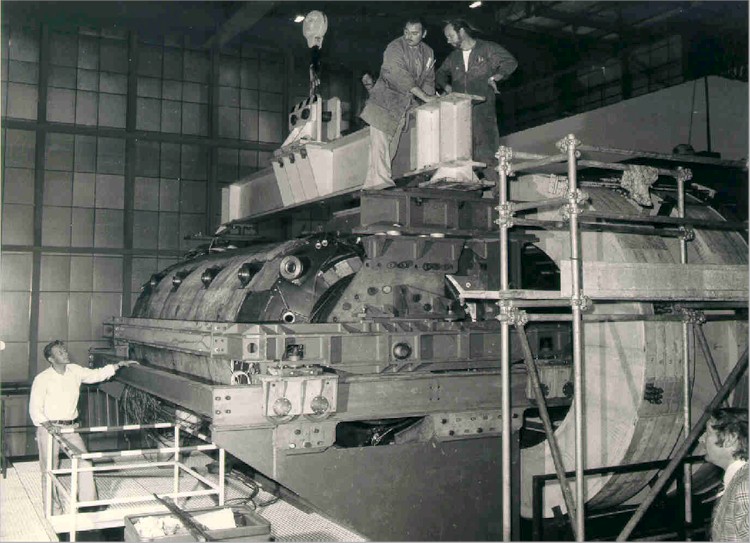 Only four years before then, the first neutral interactions of neutrinos with electrons had been observed by the Gargamelle experiment at CERN (see picture, right). Unfortunately, that was not his experiment.
His own bubble-chamber experiment at Fermilab had been competing to find the first evidence of neutrino interactions mediated by neutral currents. When a muon neutrino, produced by secondary decays from an accelerator beam, hits an electron of the material in the chamber through the emission of a Z boson, it leaves unseen as it arrived, and the only observable result is the emergence of a energetic electron, apparently recoiling against nothing. This signature, although exceedingly rare, it is quite striking, and hardly faked by anything else. One of the first historical pictures that constituted evidence for neutral currents is shown on the left below. Note that the curly track traveling upwards is quite characteristic of an electron, which emits bremsstrahlung photons (which later materialize as furher electron-positron pairs) as it travels through the liquid.
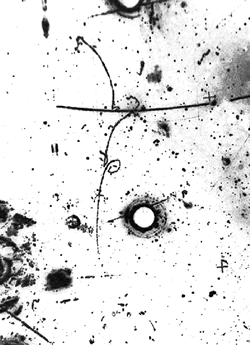 Due to the experimental challenges and maybe a worse experimental setup, the Fermilab group had had more trouble seeing their first candidates, so when Rubbia started to hear news that Gargamelle was being luckier, he cast enough smoke in the air to confuse matters, preventing the clear identification of a winner of that particular race.
 That story is told elsewhere so I will abstain from pasting what I mostly learned there, but the bottomline is in all textbooks: neutral currents were shown to exist, W and Z bosons became an acclaimed triplet of massive gauge fields, Weinberg and Salam's 1967 paper was fished off dusty shelves and they got a ticket to Stockholm; on the contrary, nobody won a Nobel prize for the experimental discovery of neutral currents. Yet the idea of detecting neutrinos or other interesting physical processes within large, uniform volumes of heavy liquids which both provided a suitable target and a sensitive material was by no means going to die away!
2 - The detector
Rubbia's idea was indeed to improve that promising concept further. Taking pictures of bubbles in a liquid was going to become an obsolete technology with the development of fast electronics: more precise and efficient identification methods could be envisioned to detect charged tracks produced by particle collisions in large volumes.
Let us take liquid Argon: it is a quite desirable substance for a particle physicist. It is heavy enough to contain a large number of nuclei per unit volume; it is transparent to light of the same wavelength at which it scintillates when traversed by charged particles; and it constitutes no hindrance to the drift of ionization electrons, if purified with care.
And now let us take a time-projection chamber (TPC): it is basically a volume lined with vertical planes of wires at high electrostatic potential on both sides. Electrons created by ionizing tracks drift in the electric field, get collected by the wires, read out by suitable electronics, and interpreted in terms of the position of the track in the volume. In order to do that, you need to know the exact time when the electrons got created by the ionization: this is provided by photomultiplier tubes which capture the scintillation light left by the charged particle. Photomultipliers are fast, and they provide a natural trigggering system for interactions within the volume of liquid.
The bottomline is simple: couple a large tank of liquid Argon with a sensitive TPC and a set of phototubes, design a proper electronics and data-acquisition system, and you get a very neat detecting tool. And if you think big enough, you can imagine very large devices: scalability is not a big issue, as long as you can manage to obtain and keep a high-purity liquid (electrons get eaten up by impurities such as oxygen), and if your setup allows scintillation light to be detected with high efficiency.
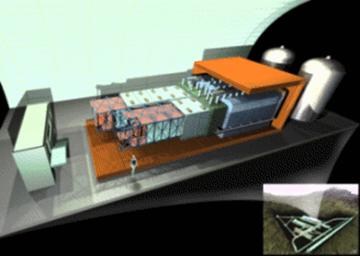 Rubbia had in mind a multi-kiloton detector, but in the end the ICARUS detector is for the time being "only" a 600-ton tank. It is still a large device! It is hosted in the cavern under the Gran Sasso mountain, in the Italian Appennines. The rock above it provide the necessary shielding from cosmic rays. The layout of the detector and its location are shown in the picture on the right.
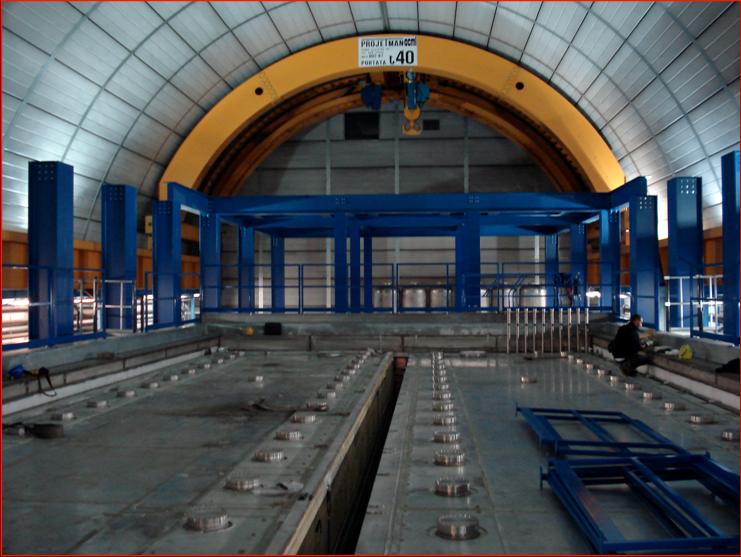
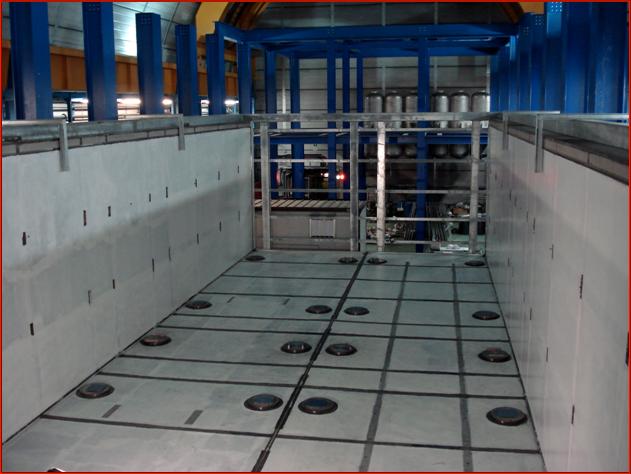
I know I am not doing justice to this exciting experiment with the quite general and short description above. Unfortunately, I am neither an expert of neutrino physics, nor do I have the time to provide a more detailed explanation today. I have twice invited a recently graduated Ph.D. from my University to talk here about her thesis, with poor results... I will try again! In the meantime, I just provide below a couple of pictures of the cavern which lodges the experiment, and the construction of the large vessel.
3 - The Physics
What games can we play with such a huge device ? Many exciting ones! Besides detecting and studying in detail atmospheric and solar neutrinos, supernova neutrinos, and maybe even other possible signals from exotic particles pouring down from the cosmos, the ICARUS experiment may detect proton decays by observing its large mass for a time long enough that one or few of the 10^33 protons in the liquid decide to turn into lighter particles. That would be quite a discovery!
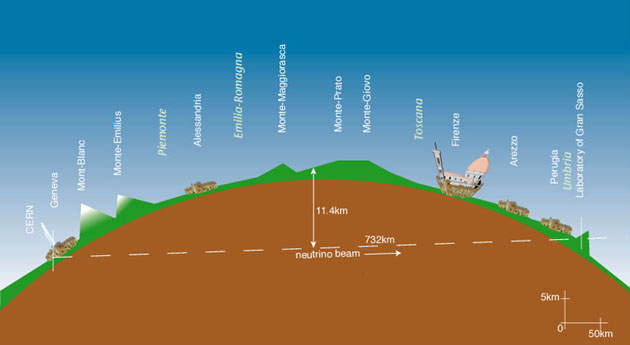 The most interesting project, however, has nothing to do with passively waiting for something to rain down or disintegrate spontaneously. It involves the directing of a beam of muon neutrinos straight at the Gran Sasso cavern from 730 kilometers away: a certain place at the France-Switzerland border, CERN. The relevant project is called "CNGS", and its aim is to study neutrino oscillations, understanding more of the physics of these fascinating particles.
 After the discovery of atmospheric neutrino oscillations by the SuperKamiokande experiment in Japan (but even since much earlier, when a deficit of solar neutrinos was studied by the Gallex and Sage experiments), the attempt at understanding the details of the mixing matrix of these enigmatic bodies has been all the rage. And ICARUS has the potential to break ground in this territory.
So it is a fine day today. We impatiently await the first physics results from ICARUS. Is it too much to ask for a meaningful measurement in time for ICHEP 2010 ? We will know it quite soon!



Comments