

Whenever I try to explain something about particle physics to a layman, I run into the problem of mass/energy units. A Giga-electronVolt is not something you may expect people to be familiar with, and on the other hand it is not appealing to explain directly how it is defined: "if you take an electron and accelerate it by passing it through a potential difference of one billion Volts, that's the energy it has at the end: one GeV": this distracts the listeners by forcing them to focus on electrostatics, with the potential outcome that the conversation may diverge due to additional questions, like "Does the electric field need be uniform ?" or even, "What is a potential difference ?".
To avoid that kind of trouble you may make the choice of avoiding altogether to mention the funny unit, implicitly equating a GeV to a proton mass. This causes you to end up making statements like "The LHC produces collisions at an energy corresponding to 7000 proton masses", or something similar. The escamotage is effective, but imprecise -a proton only weighs 0.938 GeV, which is over six percent less than a full GeV. And six percent may or may not be relevant to the statements you make. If you do not want to live with that you need to make a correction on the fly, or change system.
A nice, although somewhat problem-specific, solution to the above outreach issue has been concocted by Adrian Buzatu. A post-doc for Glasgow University, where he works at a competitor experiment, ATLAS, but collaborates with me by being a colleague in the CDF experiment, Adrian is also a science writer for a Romanian magazine, EVZ. Wanting to explain the progress made by the LHC experiments in constraining the allowed range of masses of the Standard Model Higgs boson from last summer's results to the most recent ones, Adrian compared the tentative Higgs mass values to the masses of heavy atoms. He thus came out with two sets of periodic tables of elements, with elements compatible with Higgs masses not yet excluded by direct searches highlighted in red.
The Summer 2011 situation saw many elements of the table still compatible with experimental searches for the Higgs boson: these correspond to the mass range 114.4 GeV - 149 GeV, the one where the Higgs production hypothesis had not yet been disfavoured at 95% confidence level.
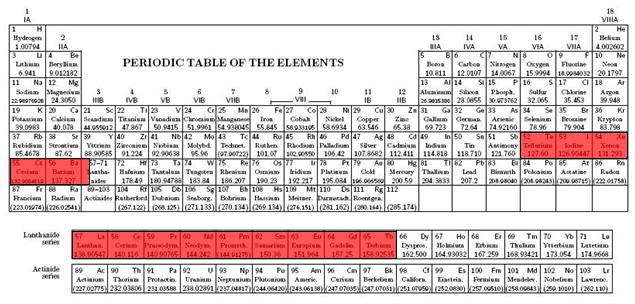
However, the latest results show a dramatic narrowing down of the masses which are not disfavoured at 95% confidence level:
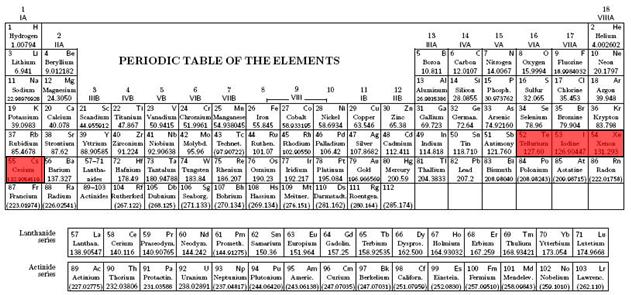
I think this is a quite nice visualization of the progress made by ATLAS and CMS. For the original article by Adrian (in Romanian) see here.

To avoid that kind of trouble you may make the choice of avoiding altogether to mention the funny unit, implicitly equating a GeV to a proton mass. This causes you to end up making statements like "The LHC produces collisions at an energy corresponding to 7000 proton masses", or something similar. The escamotage is effective, but imprecise -a proton only weighs 0.938 GeV, which is over six percent less than a full GeV. And six percent may or may not be relevant to the statements you make. If you do not want to live with that you need to make a correction on the fly, or change system.
A nice, although somewhat problem-specific, solution to the above outreach issue has been concocted by Adrian Buzatu. A post-doc for Glasgow University, where he works at a competitor experiment, ATLAS, but collaborates with me by being a colleague in the CDF experiment, Adrian is also a science writer for a Romanian magazine, EVZ. Wanting to explain the progress made by the LHC experiments in constraining the allowed range of masses of the Standard Model Higgs boson from last summer's results to the most recent ones, Adrian compared the tentative Higgs mass values to the masses of heavy atoms. He thus came out with two sets of periodic tables of elements, with elements compatible with Higgs masses not yet excluded by direct searches highlighted in red.
The Summer 2011 situation saw many elements of the table still compatible with experimental searches for the Higgs boson: these correspond to the mass range 114.4 GeV - 149 GeV, the one where the Higgs production hypothesis had not yet been disfavoured at 95% confidence level.

However, the latest results show a dramatic narrowing down of the masses which are not disfavoured at 95% confidence level:

I think this is a quite nice visualization of the progress made by ATLAS and CMS. For the original article by Adrian (in Romanian) see here.




http://motls.blogspot.com/2012/02/opera-and-italian-comrades.html
All the readers who responded called their mail "Italian comrades" because I used the sentence "Where did the Italian comrades made a mistake?" This was a parody of the Czech film "Cozy Dens" (the plot is placed to the mid 1960s) where an enthusiastic communist professional soldier, proud about the superiority of communist countries, distributes the plastic spoons from East Germany during a big Xmas dinner party.
All the spoons melt in the coffee and the father from the other family, a staunch anti-communist and traditional capitalist citizen (the teenage kids of these two guys date each other, of course, that's the main basis of the movie: the families finally got friendly) says "I would just be interested in where the comrades from GDR made the mistake". :-)
Aside from this fun, all the confusion by the readers was about the units. Of course, the first, most self-confident one, was irritated by the sentence that the Higgs mass was 125 GeV (the last sentences of the article on neutrinos were on the value of the LHC and the Higgs). It is not a unit of mass, I was told. So I explained to him that GeV/c^2 is a unit of mass, according to any units, and physicists also love to set c=1 which means that we may say that even GeV is a unit of mass. Impossible to explain. I think he was an engineer so he may have been trained to be very picky about using the standardized engineering units for everything. But the idea that someone could use completely different units was unexplainable, despite our totally peaceful exchanges.
The proton mass is a way out, a standard one in popular books, too. But the Higgs mass is 133 proton masses. Numerically, it's just way too far from 125 which is why it sucks. I found some isotope that was very close to the Higgs mass, probably cesium of some kind. Of course that people get this point. But the equivalence of mass and energy is something that people don't really see. So they don't really understand that the energy - voltage and charges, the electricity equal to the households of Geneva that the LHC eats etc. - is what is converted to the mass of new particles. Those are great things - understood since 1905 pretty much - but people are almost never told these things. So I would say that even average enthusiastic readers of major newspaper's science/physics sections are still ignorant about E=mc^2 and its content, despite the T-shirt status of the equation. The idea that "c" is an exceptional speed among others is a taboo, too. And of course, one never gets any space in newspapers to explain those things so the ignorance about the fundamental issues is guaranteed to continue.