Banner
    More Thoughts On The New CDF Signal
    By Tommaso Dorigo | April 7th 2011 12:13 PM | 7 comments | Print | E-mail | Track Comments
    About Tommaso

    I am an experimental particle physicist working with the CMS experiment at CERN and the CDF experiment at Fermilab. In my spare time I play chess...

    View Tommaso's Profile
    Given the wide interest (about 20k readers in a day) that the new article by the CDF collaboration has attracted (see my original post here), I think I should collect in a separate post some auxiliary information, concerning past searches which might have been sensitive to such a signal in the past.

    First of all, there is the DZERO search for WW/WZ semileptonic decays, which produced the first evidence for those processes at a hadron collider. I described that analysis in some detail in a post in my QDS blog three years ago. Below you can see the money plot from that analysis: the dijet mass distribution of selected W+jj candidates. There is a clear excess in the 70-100 GeV region due to the W->jj and Z->jj signal (it amounts to about 960 events according to DZERO), but there is no excess at all at 145 GeV or so. The DZERO dataset used amounts to 1.1 inverse femtobarns, so a fourth of the one used by CDF.
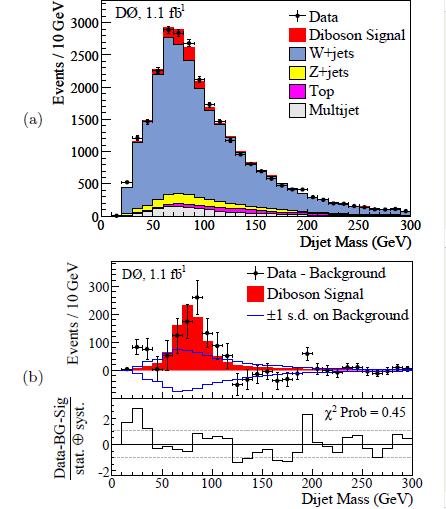


    Please note that the CDF signal, found in the same final state, has a normalization which is of the order of half of the combined WW/WZ signal. However, one must note also that the DZERO analysis uses a very specialized classifier to discriminate WW/WZ-like events from all other backgrounds: one might thus hypothesize that a new particle produced with W bosons as found by CDF would not contribute significantly to the DZERO dataset. I find it hard, however, to believe that it would completely disappear, as it seems the case in the background-subtracted plot above.

    Then there is another search made by CDF two years ago, one I discussed in gory detail here. That search is complementary, to some extent, to the one that produced the 145 GeV bump, since it searches for leptonic W and Z boson decays by applying a 60 GeV cut on the missing transverse energy and not requiring explicitly any charged lepton. That means that, while dibosons do contribute to the sample, the overlap of events with the current CDF analysis seeing the 145 GeV signal is not large. Probably at the level of 40% or so.

    And what did the missing Et plus jets analysis find two years ago, looking at 3.5 inverse femtobarns of data (a similar dataset to the one of the new analysis, coollected in the same time span) ? They find a nice bump from WW/WZ/ZZ decays, but they do not see any enhancement at 145 GeV. See the dijet mass distribution below:
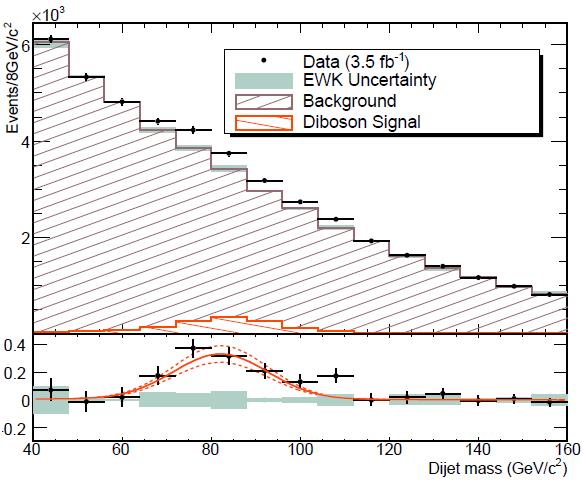


    As you may notice, the background here is larger than in other searches, partly because of the absence of an explicit charged lepton requirement, and partly because the tight missing Et cut reduces the signal. On the other hand, the missing Et requirement does select some signal of diboson decays which the charged lepton search cannot access: these are decays to neutrinos of the Z boson, such that there is added sensitivity: ZZ and ZW events are increased with respect to the standard selection. The total diboson signal in the distribution amounts to about 1500 events.

    So what to conclude from the study of those two distributions ? I think one cannot conclude much, but on the other hand both earlier analyses disfavor the presence of a 145 GeV particle.

    I will add more thoughts here later if I have a chance.

    Comments

    Question: do you know if there exists a similar invariant mass plot for the Z+2 jets channel?

    (I mean with Z leptonic)

    Dear Jester, this question was asked in the questions-and-answers of Cavalieri's seminar and the answer was essentially No.

    Also, the D0 folks said that it would take a few weeks for them to make a verdict.

    A Weizmann Institute reader of my blog has pointed out that the histograms are shifted by one bin so the whole "discovery" could be a pile-up effect.

    dorigo
    Hi Jester,

    not any plot I know. I will try to have a look though.
    Cheers,
    T.
    Is it possible to have "excess" from a low statistics? I come to this question when I look these two plots:

    http://www-d0.fnal.gov/Run2Physics/WWW/results/prelim/HIGGS/H84/H84F01.jpeg

    and

    http://www-d0.fnal.gov/Run2Physics/WWW/results/prelim/HIGGS/H84/H84F02.jpeg

    On the first plot we some "excess", but when we add more data "excess" vanishes on the second plot.

    I don't know whether I read the plots correctly.

    Thanks,

    Nick

    dorigo
    Dear Nick,

    of course statistics can fluctuate. In a part of the data you may have an effect, which goes away when you add five times more data (as in the second version of the figure you post, if I judge by the y axis scale).

    Cheers,
    T.
    Tommaso,

    When you say "Please note that the CDF signal, found in the same final state, has a normalization which is of the order of half of the combined WW/WZ signal." What do you mean by normalization?
    Excuse my stupid question.

    Add a comment

    The content of this field is kept private and will not be shown publicly.
    • Allowed HTML tags: <sup> <sub> <a> <em> <strong> <center> <cite><TH><ul> <ol> <li> <dl> <dt> <dd> <img> <br> <p> <blockquote> <strike> <object> <param> <embed> <del> <pre> <b> <i> <table> <tbody> <div> <tr> <td> <h1> <h2> <h3> <h4> <h5> <h6> <hr> <iframe><u><font>
    • Web page addresses and e-mail addresses turn into links automatically.
    CAPTCHA
    If you register, you will never be bothered to prove you are human again. And you get a real editor toolbar to use instead of this HTML thing that wards off spam bots.