

Banner
    New Tight SUSY Exclusion From ATLAS
    By Tommaso Dorigo | March 3rd 2011 08:54 AM | 47 comments | Print | E-mail | Track Comments
    About Tommaso

    I am an experimental particle physicist working with the CMS experiment at CERN and the CDF experiment at Fermilab. In my spare time I play chess...

    View Tommaso's Profile
    The results of a new Supersymmetry search have been released a few days ago by the ATLAS collaboration. They come from an analysis of events with large missing transverse energy and jets -the most classical signature of SUSY at hadron colliders, as well as the most sensitive one in a wide range of the complicated space of SUSY parameters. Since I discussed two other results on SUSY by ATLAS and CMS just a week ago, and I also hosted a discussion of the theoretical relevance of those results in a subsequent guest post by Ben Allanach, I will only provide a short report on this new paper, accessible to everybody; I am more interested in drawing your attention to some technical details -only for insiders, though- and I will do that toward the end of this article.

    Two introductory words on SUSY

    If you are unfamiliar with what Supersymmetry (SUSY) is, it may help you to know that it is a theory advocating a possible extension of the particle zoo. For each known elementary particle, SUSY predicts the existence of a corresponding "sparticle" with similar characteristics. Three things tell apart a sparticle from its normal counterpart: the spin, the mass, and of course the "s-" in their name (such as in stop, sbottom, selectron, setcetera), which puts them in a different category and earns them a different value of a quantum number called "R-parity". If R-parity is conserved, as in most versions of SUSY, sparticles can only decay yielding other sparticles, such that the lightest of them is perfectly stable, and constitutes a perfect candidate to explain the dark matter in the universe.

    The idea of a supersymmetric world of sparticles, so far hidden from our view but ready to be found by the LHC, is not such an abstruse concoction to many: they will tell you that SUSY brings about enormous advantages from a theoretical standpoint.

    One such advantage is the perfect "balancing" of particle and sparticle contributions to the quantum corrections on the Higgs boson mass, as I have explained in the second of my two recent articles in print on Physics World this month. In two words, the Higgs boson may be as light as we expect it to be (and as light as to make electroweak fits to observed standard model parameters look as good as they do) only if a score of quantum corrections to its mass produced by virtual particles coupling to it exactly cancel their total contribution. SUSY particles do that for free, since for every particle in the SM producing a contribution to the Higgs mass, a SUSY sparticle produces a variation of the opposite sign.

    Another is the fact that with sparticles in the theory, there is a chance that we may one day explain all the forces of nature as the low-energy manifestations of a single interaction. This grand-unification is sort of a Graal for theorists, and they won't stop in front of having to add a hundred or so arbitrary parameters into their theory in order to pave the way to this prize. And Occam be darned.

    The third one is the "dark-matter readyness" of SUSY: as mentioned above, SUSY provides a particle, the lightest neutralino, which might have been produced in large numbers in the Big Bang. These neutralinos would be just as heavy as needed to explain the observed amount of dark matter in the universe.

    The ATLAS search

    The analysis published in 1102.5290 does not present any real novelty with respect to previous searches, so I will not discuss the details here. Suffices to say that ATLAS goes for the production modes expected to yield the largest rate of superparticles: proton-proton collisions materializing pairs of squarks and gluinos. These are the super-partners of quarks and gluons, and they are produced in large numbers because they carry colour charge exactly as quarks and gluons do.

    Some general features of the production and decay of these particles do not depend much on where exactly you sit in the complicated space of model parameters: gluinos and squarks are produced at higher rates if they are lighter; and gluinos decay to squarks or vice-versa depending on which particle is heavier. When these decays occur they produce an ordinary quark or gluon, which in turn may yield an observable jet of hadrons, if its energy is sufficient. The lighter supersymmetric particle may then produce other sparticles and other quarks, and the final decay chain usually includes a neutralino, which escapes leaving missing energy behind. The signature may be quite varied, but the general characteristics are always the same: jets and missing energy. It is always jets and missing energy, as sure as death and taxes.

    ATLAS enforces the absence of electrons or muons in their candidate events. But electrons and muons are precious stones that very seldom get unearthed in the underground mine that a high-energy collision represents: why are they thrown away ? For two reasons.

    One reason is that events with  leptons have been considered already in a different search by the same experiment, and it is a good practice to keep different analyses looking for the same new physics signals "orthogonal" to each other, i.e. to allow no cross-contamination of the relative data samples: this makes it easier to compare the results and maybe combine them without having to worry about correlations.

    The second reason for removing electrons and muons is that these particles are usually produced together with neutrinos in the decay of W bosons. Since neutrinos yield missing energy just as neutralinos do, removing electrons and muons is a way to reduce the annoying background from W boson production. Note that this "electroweak" background is not less troublesome to handle than the one arising from quantum chromodynamical (QCD) processes producing many jets, where missing energy is the result of jet energy mismeasurement (you fail to reconstruct properly the energy of a jet, and this automatically produces an apparent imbalance in the energy observed in the transverse plane, i.e. missing energy); the excellent properties of the ATLAS detector allow to keep the latter rather under control.

    In the end, the main backgrounds are indeed still electroweak ones: W production yielding tau leptons and tau neutrinos, and Z production yielding neutrino pairs. Both W and Z bosons produced in LHC collisions are often accompanied by hadronic jets, and there you have your jets plus missing energy signature.

    Some notes on the result

    ATLAS optimizes the sensitivity to SUSY in different points of the parameter space by considering four slightly different signatures, involving two or three energetic hadronic jets whose kinematical characteristics best resemble those of the SUSY processes. In the end, they add up all the predicted background sources in each region, and compare with the observed data. Here is a summary of the results in the four search regions:

    • Region A: total expected background 118+-35 events, observed 87 events.
    • Region B: total expected background 10+-6 events, observed 11 events.
    • Region C: total expected background 88+-30 events, observed 66 events.
    • Region D: total expected background 2.5+-1.4 events, observed 2 events.
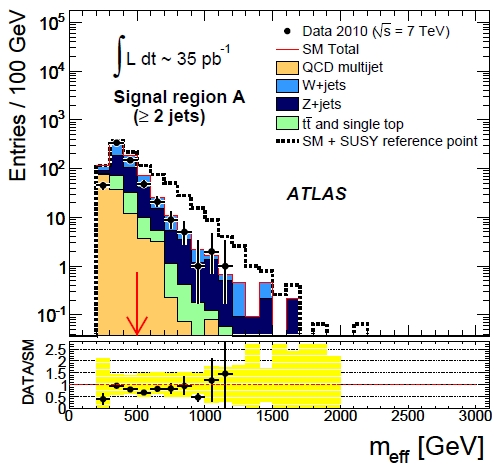
    The "effective mass" (just a sum of transverse energies of jets and missing energy, so nothing more and nothing less than the standard "Ht" variable used in many past searches at the Tevatron) is shown in the figure on the right for region A. The signal region is for effective masses above 500 GeV (the red arrow). Data are points with error bars, backgrounds are stacked, and the SUSY contribution (for a reference point of the parameter space) is shown by the hatched histogram on top of the SM backgrounds.

    Beware, in the list above I have been rough in combining the two main uncertainties in the background predictions produced by ATLAS; my point here is to show just that the order of magnitude of backgrounds agrees with observed data, and yet the latter is usually below expectations. This is good news for ATLAS, which can use this downward fluctuation to place more stringent constraints on the existence of additional processes (SUSY signal events) contributing to the data. The limits are shown as usual in the m_0 versus m_1/2 parameter space, having fixed to standard values some of the other model parameters. Their main result is shown below.


    The point I made above on data fluctuating down acquires meaning if you remember that the same thing happened in the other SUSY search published by ATLAS two weeks ago: there, lepton signatures were considered for SUSY processes, and the search found a total of 2 events when four were expected. Again, a slight downward fluctuation of observed data with respect to backgrounds. Nothing dramatic in fact, but the small deficit allowed a significantly extended reach of the resulting exclusion in the space of SUSY parameters, with respect to what ATLAS predicted it would cover.

    Am I just envious, since I belong to CMS, where we performed the same search described in the latest ATLAS paper but found more events in our dataset than expected,, so that we could produce a rather restricted exclusion region (the black curve) ?

    No, I am not envious -I am actually convinced that SUSY is not there to be found, so I am prepared to see more and more of the parameter space being eaten up by experimental searches at LHC; the game will more or less go as follows: CMS excludes some region, ATLAS then excludes a bit more, then CMS takes revenge and extends the exclusion region with an improved analysis, then ATLAS does it, etcetera. This sort of game has been going on for quite a while at the Tevatron, and now that the players have changed the rules remain the same. Or do they ?

    I only wish to note here that the downward flukes seen by ATLAS get compounded with a new method for limit-setting that ATLAS collaboration has decided to use for their new physics searches.

    Now, this is a rather technical issue and I bet only two of the remaining five readers who reached this down in the article are really interested in knowing more about it. Okay, for you two I will make an effort.

    Limit Setting: Black Magic ?

    When you wish to set a limit on the rate of a new signal potentially sitting in your data by comparing background expectations with observed data, you are asking yourself the following question: just how much signal could, on average, contaminate my search region if I saw x events expecting y+-dy from backgrounds ?

    Alas, the one above appears a quite legitimate and well-defined question, and yet the answer depends on the method you use to compute it. And there are quite a few methods on the market! It however appears that three of them are more "standard" than others, and as such they are discussed by the Review of Particle Properties. They are the Feldman-Cousins method, the CLs method, and the Bayesian integration with a flat prior probability distribution for the signal cross section.

    Now, the method that ATLAS has started to use as of late is one which does not belong to the above list. It is a respectable method, although I do not personally like it much. Regardless of my own preferences, anyway, the chosen method might make comparisons of limits found by ATLAS with those of other experiments more difficult.

    What is possible to say straight away is that in most cases the method used by ATLAS turns out to be slightly less conservative than any of the three "standard" methods. Together with the downward fluctuation, this puts ATLAS in the position of excluding more than competitors do of the SUSY parameter space.

    One last issue I wish to mention this deep down my post is that the ATLAS 1-sigma band in the expected limits (see hatched blue lines in the figure above) is surprisingly wide in this last analysis. It looks strange because one expects that sparticle cross sections decrease quickly as one increases the m_0 or m_1/2 parameters in the plane shown in the figure. I would be happy if a reader provided insight in this matter. To me the width of that band is currently a mystery.


    Comments

    Thanks for the extra effort, I am one of the two guys! Which limit setting method is used in CMS? How it is more conservative?

    Thank you again.

    dorigo
    Hi Anon,

    CMS has been using CLs and Bayesian methods. I would like us to move to Feldman-Cousins, but it is a bit harder to implement, so it is not very popular in the trenches.

    Cheers,
    T.
    Aitch
    I may well be the other........

     Does this take us any further into proving whether we are dealing with 'real reality' or a further set of statistical/mathematical datasets, with adjustments, construed as reality? - [decoherence interpretation?]

    Aitch
    dorigo
    Hi Aitch,

    these searches are for real things, and the results are real, although the particular method one uses to extract them affect the specific answer one gets from the data.

    Cheers,
    T.
    The comment that ATLAS was lucky to see a deficit is bizarrely amusing. ATLAS would have been much luckier if it had seen e.g. a 5-sigma excess already at this stage, wouldn't it? ;-) Note that the subject of the previous sentence is ATLAS rather than a perverse member of CMS with upside-down tastes.

    dorigo
    Hi Lubos,

    indeed this is a point I wanted to make in the post, but then was drawn into a different direction. You know how blogging goes -you sometimes go with the flow of the text. At least I write in bursts, and seldom perform painful re-editing.

    To answer you tongue-in-cheeck, I think ATLAS would have been very, very unlucky to see a 5-sigma excess -because they would publish the observation of new physics, and would then have to retract their article in just a few month's time! SUSY is just a wrong theory... ;-)

    Cheers,
    T.
    On the contrary - in that case, ATLAS would have outpaced the friendly competitors at CMS by several months, proving in a faster way something that will and have to be ultimately be proved by this collider or another experiment, anyway.

    Susy's dead! Can't say I'm mourning her. There are plenty of more urgent issues in the world. Sheesh. How can anyone have ever taken that fairy field, and it's naive implications, so seriously. Nature may be cruel, but she is not ugly.

    My fear is that may no longer be true. Maybe nature abandons beauty at this point. All the ways forward look complex and ugly.

    Well Kea, do you really understand SUSY? I find it difficult to believe that anyone understanding it can seriously think
    it's an ugly idea. I'm afraid your rant tells more about your bad taste. Concerning your "more urgent isues in the world" it really sounds like the usual anti-basic-science propaganda. I wonder what motivates you to read this blog.

    Anonymoys, people who find susy very beautiful as a theory must have very low standards and this is not something to be proud of :p It has a couple of cute points but not what I'd call really, deeply, beautiful, and the main idea sounds nice but rather superficial (hey, what about throwing a remaining symmetry in).
    That said, Kea is very wrong in celebrating, I wonder if she read any of the previous articles. Premature celebrations certainly don't help any case...

    Tulpoeid, I guess you're confusing the obvious beauty of the symmetry with the ugliness associated with its breaking, of which we don't know enough. I don't think your analysis of the motivations for SUSY is very deep ("hey, what about throwing a remaining symmetry in"???). SUSY was not an ad-hoc solution people thought about to solve some problem of the SM. It was found in a different context and then proved to be very successful in doing unexpected things (solving the technical part of the hierarchy problem, sharpening gauge coupling unification, providing a DM candidate, among others). To this impressive list, which beats by far any other idea for Physics beyond the SM, you could also add that it has the potential of allowing us to peek at the physics at very very high energy scales. A totally anthropocentric advantage, obviously, but one gift that you fail to appreciate. Reading some entries in this blog I often think of pearls and swine.

    If I were Lubos I'd start this comment by saying "Dear Swine",
    I mention the "throwing a remaining symmetry in" not as the single motivation, but as the most beautiful part of susy for many people, which I personally find nice but superficial. Looking at your points one on one:

    Solving the hierarchy problem by doubling the particles and taking both signs looks blatant to me, even if it proved to be correct.
    Providing a DM candidate is definitely not a beautiful characteristic, in the sense of mathematical/theoretical beauty, because having a particle that simply doesn't decay is one blatant solution.
    Different context? You mean graded Lie? I'm never sure which one came first but it doesn' matter, I still think this has a cute touch, but it's not extremely beautiful since one suddenly decides to change the rules of the games; it's more like a fed necessity than an aesthetic suggestion.
    Yes, gauge coupling unification is the only thing that makes me take susy a bit seriously.

    I have yet to find the "obvious beauty of the symmetry"; in the beginning I believed I just didn't know yet about some hidden part of susy, but I realized that people simply started calling "beautiful" something that is merely rather well structured. For me, even the Little Higgs models have a more interesting mathematical and conceptual structure with respect to susy.
    And the tremendous gaps in model building that need an army of free parameters certainly take away almost all elegance claimed to exist in susy. In the end, non-falsifiability took away all interest for me.

    Finally, you write
    "To this impressive list, which beats by far any other idea for Physics beyond the SM"
    but this doesn't add to it any plausibility. Reading my horoscope will bring something accurate maybe twice per month, which you might say is better than not reading it at all and not getting anything accurate twice per month.

    " you could also add that it has the potential of allowing us to peek at the physics at very very high energy scales."
    How exactly?

    You just confirmed my suspicions.

    "I mention the "throwing a remaining symmetry in" not as the single motivation, but as the most beautiful part of susy for many people, which I personally find nice but superficial."

    It's certainly nice and pretty far from superficial as it intimately links supersymmetry with spacetime symmetries we hold most sacred. The symmetry foundations for all other BSM options pale in comparison.

    "Solving the hierarchy problem by doubling the particles and taking both signs looks blatant to me, even if it proved to be correct."

    What is blatant is your lack of appreciation of good ideas. Antiparticles (there you have another doubling of the spectrum) perform an exactly similar trick in QED to cancel infinite self-energy corrections to the electron mass.

    "Providing a DM candidate is definitely not a beautiful characteristic, in the sense of mathematical/theoretical beauty, because having a particle that simply doesn't decay is one blatant solution."

    I don't know if DM is beautiful. A (quasi-)stable new particle seems like a pretty good solution to me.

    "Different context? You mean graded Lie? I'm never sure which one came first but it doesn' matter, I still think this has a cute touch, but it's not extremely beautiful since one suddenly decides to change the rules of the games; it's more like a fed necessity than an aesthetic suggestion."

    The context was string theory. My point was simply that SUSY is not a patched-up model cooked-up to half-solve a problem which in the end doesn't even work. And that describes pretty accurately Little Higgs models that you so much appreciate (holy crap, you are a pervert!).

    "Yes, gauge coupling unification is the only thing that makes me take susy a bit seriously."

    What can I say.

    "In the end, non-falsifiability took away all interest for me."

    Well, I thought SUSY has been already ruled out by ATLAS!

    "but this doesn't add to it any plausibility. "

    Theoretical ingenuity and beauty has worked in the past and it's our best bet now.

    "" you could also add that it has the potential of allowing us to peek at the physics at very very high energy scales."
    How exactly?"

    SUSY at the TeV and a desert tilll the GUT scale gives us the power of learning something definite about GUT scale physics, which would be just impossible in other scenarios.

    Ahem. Very seriously, you don't provide any arguments and often misinterpret what I said. We can agree that we disagree in our tastes. Let's attribute these three categories whenever applicable:

    1. "I mention the "throwing a remaining symmetry in" not as the single motivation, but as the most beautiful part of susy for many people, which I personally find nice but superficial."
    "It's certainly nice and pretty far from superficial as it intimately links supersymmetry with spacetime symmetries we hold most sacred."

    You misinterpeted. The symmetry I talked about was fermions-bosons, but you replied about the Lie algebras. See my previous comment about graded Lie algebras. We can agree we have a different taste.

    2. "The symmetry foundations for all other BSM options pale in comparison."

    I don't care. This doesn't provide an argument in favour of susy.

    3. "Antiparticles (there you have another doubling of the spectrum) perform an exactly similar trick in QED to cancel infinite self-energy corrections to the electron mass."

    In my book antiparticles aren't as blatant an idea as superpartners. We can agree we have a different taste.

    4. "I don't know if DM is beautiful. A (quasi-)stable new particle seems like a pretty good solution to me."

    You were off-topic. We were talking about the beauty of the theory.

    5. First you say that susy came up in a different context (than just solving SM issues). Then you clarify it by saying "The context was string theory."

    ARGH! What? Maybe I'm wrong but afaik it was introduced independently by Berezin & Katz, Golfand & Likhtman, and Wess & Zumino in the early 70's, without any context relating to string theory.

    6. "My point was simply that SUSY is not a patched-up model cooked-up to half-solve a problem which in the end doesn't even work."

    I agree. (Although it's not proven to work, but I guess you talk in terms of self-consistency.)

    7. "Well, I thought SUSY has been already ruled out by ATLAS! "

    This is either a joke or it nullifies all your previous comments.

    8. "SUSY at the TeV and a desert tilll the GUT scale gives us the power of learning something definite about GUT scale physics, which would be just impossible in other scenarios."

    Maybe I miss something in my knowledge about susy phenomenology, but how is this done? For the moment I'd classify this under "you gave no arguments".

    All in all, we can agree we have different tastes, but I strongly object to susy fans' right of being the only people with the right to express their aesthetic opinion about susy.

    > "7. "Well, I thought SUSY has been already ruled out by ATLAS! "
    >
    > This is either a joke or it nullifies all your previous comments.

    Ah, ah, I get it now. You are the anonymous-grammar-nazi. Of course you thought that susy is ruled out by atlas, 'cause you can't distinguish between the notion of "susy theories" and "susy", same way as you can't distinguish between definite and indefinite article. Gosh, I wish I'd understood earlier whom I was talking with.

    Yes, well this swine knows a pearl when sees one. And thinks that SUSY is just costume jewelry.

    A swine with an eye condition, that is.

    Do I understand Susy? Well, that's not really for me to say. I have spent a lifetime trying to figure out how to do without it. I believe that much stringy maths is beautiful and highly relevant to quantum gravity. But we were talking about the basic physical idea of throwing in extra symmetries, as if quantum gravity was an ad hoc construction based on classical ideas. Is that beautiful? No. Is it dead? Yes.

    You might say that it was never alive, but saying that it died because of the recent couple of papers sounds like a downright mistake to me...

    I'm confused...if there is more than one method of handling the data, is there a valid reason why all such methods could not be utilised to provide differing perspectives?
    Would this be redundant or of no great benefit?
    Is one method superior over another in specific situations?

    dorigo
    Yes, using more methods and providing their output together is really helpful, and should become a standard.

    Best,
    T.
    Why was this text called "Puzzles in the new SUSY exclusions" before you renamed it? ;-)

    By the way, if the word "puzzles" was related to the question you raise in the last paragraph, the puzzle is almost certainly solved because this assumption of yours is just wrong:

    "It looks strange because one expects that sparticle cross sections decrease quickly as one increases the m_0 or m_1/2 parameters in the plane shown in the figure."

    Note that the m_0 and m_1/2 parameters are not couplings - they're just masses. But they're masses measured at the GUT scale which is, you know, very very high: 10,000,000,000,000,000 GeV (I don't use exponents because there is a risk that you could misunderstand what they mean). To get predictions for the accelerators, which operate at low energies and are occasionally run by low-brow blogging physicists, one must run the RG flows and recover e.g. the gluino masses etc. from m_0 and m_1/2.

    The resulting superpartner masses - and the cross sections - don't depend on m_0 and m_1/2 too strongly and they also depend on A_0, especially in the case of e.g. neutralinos and 3rd generation squarks.

    This wrong idea of yours that the cross sections "strongly diminish" once one changes m_0 or m_1/2 a little bit is linked to the more general misconceptions held by most of the incompetent readers and authors of this blog - which means most of the readers and writers of this blog - that the studies have already (almost or fully) excluded SUSY. This opinion is, of course, a complete crackpottery. The search has just begun.

    Lubos,

    check e.g. the equations in section 7.4 of hep-ph/9709356: how on earth can you write that

    "The resulting [low-energy] superpartner masses don't depend on m_0 and m_1/2 too strongly"?

    The low-energy (squared) soft masses for the sfermions are a linear combination of m_0^2 and m_1/2^2, and in particular those for the squarks are essentially determined by m_1/2 (if the latter is not much smaller than m_0). For what concerns the gluino mass, the solution of the 1-loop RGE is directly proportional to m_1/2, and going to higher loops does not significantly alter the picture. A0 is zero in this plot so it too does not alter the picture. If you actually had had a look at the plot before calling Tommaso an incompetent, you could have seen from the dot-dashed curves how the squark and gluino masses are indeed affected by changes in m_1/2 or m_0.

    Cheers, Ptrslv72

    Dear Ptr, I am not disagreeing with you - the dependence is approximately linear.

    For gluinos, one approximately has the mass phenomenologically given by 2.5 m_1/2 + 25 GeV - which is, because of the constant term, somewhat slower than a proportionality law but not far from it. But this is not a terribly strong dependence, even if one translates it to the cross section, and the result is shown on the picture - the 1-sigma band for m_0 and m_1/2 is simply 25% or so. For other sparticles, the dependence is not that simple and the masses depend on A_0 (and tan-beta for the Higgs sector), too. There are possible cancelations. I just wanted to say that going from the GUT parameters to the cross sections is not straightforward.

    Maybe I should have used a more quantitative language, and so should Tommaso to explain what we mean by a very strong dependence. I used Tommaso's rough definition - a strong dependence would be something that would make the one-sigma bands much narrower than what they are on the picture. And I am saying that the dependence is not that fast.

    The fact that the 1-sigma bands are wide just means that the search has just began so the statistics is not too detailed. As the amount of data increases, the SUSY is either found or the 1-sigma bands will be getting narrower.

    Also, the band is thicker because it was a deficit rather than an excess. That deficit allowed them to make the limit spuriously high, however, the highness is spurious and statistics knows about it because it knows that it could have been - and it probably was - a coincidence that the number of those events was small. Those are effects that have a higher impact on the result than the less important dependence on m_1/2.

    Imagine that by a chance, ATLAS had seen just one SUSY-like event, not even much of the expected background. That would allow them to make the limits on masses very very high. However, one may say that 1 event was "plus minus 50-100 percent" or so, so the band would be controlled primarily by 1/N where N is the number of events they saw - and because N is smaller, 1/N is large. In the limit, that would become arbitrarily more important than the dependence of the predicted cross section on m_1/2.

    dorigo
    Hi Lubos,

    of course m_0 and m_1/2 are not masses we measure, but they are indeed related with the gluino and squark masses, depending on the other model parameters. This is clear even in the ATLAS figure, which indeed shows constant mass values for squark and gluinos (the hatched lines). So sorry if you thought you were disclosing something mysterious which I had overlooked. The cross  section does decrease as one moves up and right in the plane, and I take the lack of quantitativeness of your argument above as meaning that you do not have a clue.

    Cheers,
    T.
    Dear Tommaso, unlike your misguided question, my comments are totally quantitative. I clearly say that the right 1-sigma band are exactly given by the lines on the graphs. Just look what is the precise shape of the band in the m_0-m_1/2 plane and you will get exactly what I am saying about those things.

    The band is thick because very large changes of m_0 and m_1/2 are needed to mimic the uncertainty in the measured cross section that can be extracted from the very limited data available so far. So the comparison is between the "dependence of the cross section on m_0 and m_1/2" and the "error margin with which the non-SM cross section could have been measured so far". Because the dependence of the cross section on m_0 and m_1/2 is not "radical" and the error margin of the observed cross section is very large in comparison, the band ends up being thick.

    Do you understand what I am saying? I am answering your question.

    By the way, the bars will only start to get thinner once the LHC actually sees some non-SM physics.

    As long as it sees everything compatible with the SM, it effectively measures all the non-SM cross sections to be SIGMA plus minus SIGMA: the error margin is of the same order as the measured central value - because zero is in it.

    But if the measured sigma has an error of order 100%, it's clear that this error can only be mimicked by a change of the parameters such as m_0 and m_1/2 that is of order 30% or so - also not far from 100% - because the dependence is just a power law with a low exponent.

    Once the LHC starts to see deviations from the SM, it will be able to draw sharper boundaries and actually distinguish different models - and different points in the parameter space. We're clearly not there yet because the LHC has seen nothing new, so it can't really discriminate points in the parameter spaces, which is why all such bands are inevitably thick.

    God riddance, I won't have to include SUSY in my study plan!
    Still undecided about string theory though; anyway, thats stuff for next year. Who knows, I might understand some of this by then.

    Not so fast, Coward. You'll have to learn SUSY, don't trust Tommaso on this one. But this is good news for you: you'll be offered the great intellectual pleasure of understanding the elegance and appreciating the sheer beauty of this theory.

    Or maybe not. You can see above some quick counter-arguments. Also, afaik strings require susy so you can decide to skip many things altogether ;)

    I might be the third guy who reached the bottom of the article... Thanks Tommaso for this nice post!
    Can you perhaps provide some more detail/insight on the ATLAS method itself? What do they do, in simple terms?
    And, is it possible to describe in simple terms the 'standard' methods? I understand this second point would be a post in itself, but... it's part of your work, since you sit in that committee... ;)

    Hello Tomasso,

    The difference between the ATLAS and CMS results does not only come
    from the what they see in the data (deficit in respect to expectaion or not).

    This is visible in the 'expected limit' curves of both experiments,
    which show the limit of the experiment in the
    case that you see exactly what you expect from the SM (i.e. no underfluctuation).

    Already here the ATLAS result is much better than CMS.

    The main differences is coming from the analysis itself. ATLAS is considering 4 different
    signal regions, combining them by taking the one which gives the best 'expected' limit.
    This means the region changes as a function of the SUSY phase space.
    If ATLAS would have only considered the dijet region e.g., the limit would be similar to CMS.

    The statistical method plays a minor role.
    The main part comes from the analysis method itself.

    Cheers,
    Sascha

    dorigo
    Hi Sascha,

    can you elaborate on why you believe that the statistical method plays a minor role ? I think otherwise... But if you are in ATLAS you might know more.

    Cheers,
    T.
    Hi Tomasso,

    There are some more figures in the supporting material of the paper. You can find
    them on the ATLAS public results webpages.

    The following plot/link shows for signal region D the number of expected SUSY events:
    https://atlas.web.cern.ch/Atlas/GROUPS/PHYSICS/PAPERS/susy-0lepton_01/fi...

    Since the data and backgrounds for this region is given in the paper (and the number of signal
    events in the plot) you can just calulate with the CMS method a new expected limit.

    If you compare this limit with the expected limit from CMS, you will see the difference.
    There is some difference due to the method, but it's not the main reason.

    Cheers,
    Sascha

    dorigo
    Ok, thank you for this information.
    My main question, on why the 1-sigma band is so wide, remains there. Can you answer it ?
    Best,
    T.
    Hello Tommaso,

    Let me reformulate the meaning of the band a bit:
    The 1 sigma band can also be interpreted as the 1 sigma intervall of a 2 sigma limit.
    This means the upper line is rougly the 1 sigma limit and the lower line is the 3 sigma limit.
    So the points below the lower blue line can be interpreted as excluded with 3 sigma already.
    If look at these bands like this, they look reasonable again, right?

    If you show such uncertainty bands in such plots, they always look like this (and are large).
    The same would be true for the CMS limit plots I guess.

    Cheers,
    Sascha

    Yes, you guess... But instead of guessing, just look at the cms plot. The article is linked from the other post I wrote on atlas susy searches a week ago. The 1-sigma band of cms is 15 gev wide.
    Cheers,
    T.

    Sorry Tommaso, are you talking about figure 5 of 1101.1628? I am puzzled because I don't see a "1-sigma band" there. There is one exclusion curve obtained with a NLO computation of the cross sections and another obtained with a LO computation of the cross sections. What makes you think that this is equivalent to the +-1-sigma bands of the ATLAS plot?
    Cheers, Ptrslv72

    Hi,

    the CMS analysis is very conservative, aiming for superb background control rather than the best sensitivity for squarks and gluinos. This may sound like a fallacy at first, until one considers that the energy regime, the detector and the reconstruction algorithms all are new. The ATLAS analysis resembles the CDF one and presumes good control of the background through Monte Carlo simulations. The ATLAS physicists were less conservative and achieved a better a priori exclusion plot, plus they were a little bit lucky and CMS was a little bit unlucky (assuming no signal is present - the opposite is true if signal is present!). I don't believe the statistical methods are so important here - I believe the approaches to the analyses are quite different and that explains the different outcomes.

    regards,
    Michael

    dorigo
    Hi Michael,

    all the points you made are true, except that the difference in statistical methods is important. Not so much in the effect on where the limit sits, but rather in the fact that ATLAS and CMS ought to find a common method of reporting their results.

    Best,
    T.
    Hi,

    A comment from the ATLAS side;) :
    ATLAS has controled each of their backgrounds with 2-4 control measurements. ATLAS found
    a very good description in all control regions from MC. That is the reason why the MC is used as a
    central value. There is no blind reliability on the MC description, it's just that the MC central
    value was the best guess at the end (note that the uncertainty of the control region measurement determines the systematic error).
    The analysis follows the 2008 CSC analysis from ATLAS, the similarity to CDF is not very big.

    Cheers,
    Sascha

    Count me as yet another of the "two readers". Thanks again for an informative and well-written post.

    I figured out something that confused me mildly: you refer to as "hatched lines" what are usually called (in my experience) "dotted lines" or "dashed lines" (depending on whether the length of the small dark sections is comparable to the width, or longer). Usually it is areas, not lines, that are called "hatched", when they are shaded by filling them in with a series of parallel lines. If the parallel lines run in more than one direction, the area is crosshatched.

    dorigo
    Hi Tracy,

    you are right, dashed is the word. I mixed it up... Remember I'm not an English native speaker.

    Cheers,
    T.
    Folks -- as a retired Physician who almost did not get into Medical School because of P-Chem, I now spend all my time reading and trying to learn all the subject matter of which all of you seem to be experts!!!

    Keep up the debates and analysis of the data that is so fascinating to me now.

    Carl,

    dorigo
    Thank you captain, keep visiting!
    Cheers,
    T.

    Add a comment

    The content of this field is kept private and will not be shown publicly.
    • Allowed HTML tags: <sup> <sub> <a> <em> <strong> <center> <cite><TH><ul> <ol> <li> <dl> <dt> <dd> <img> <br> <p> <blockquote> <strike> <object> <param> <embed> <del> <pre> <b> <i> <table> <tbody> <div> <tr> <td> <h1> <h2> <h3> <h4> <h5> <h6> <hr> <iframe><u><font>
    • Web page addresses and e-mail addresses turn into links automatically.
    CAPTCHA
    If you register, you will never be bothered to prove you are human again. And you get a real editor toolbar to use instead of this HTML thing that wards off spam bots.
