

Banner
    The Quote Of The Week - Detecting Cosmic Rays With Pee
    By Tommaso Dorigo | March 7th 2013 08:24 AM | 5 comments | Print | E-mail | Track Comments
    About Tommaso

    I am an experimental particle physicist working with the CMS experiment at CERN. In my spare time I play chess, abuse the piano, and aim my dobson...

    View Tommaso's Profile
    Nel 1929 Bruno Rossi, ricercatore presso l’istituto di fisica sperimentale
    dell’Università di Firenze [...] intuì quella che sarebbe stata la sua ragione di vita: indagare sulla natura di questi corpuscoli ionizzanti provenienti dall’alto. Doveva realizzare un circuito che permettesse di rivelare e contare le coincidenze che si verificavano in una certa unità di tempo e realizzò uno strumento molto semplice, il circuito a coincidenze.
    L’involucro dei tubi Geiger è collegato al polo negativo di una batteria da 1200 volt (non
    disegnata). La scarica nei tubi genera un impulso di tensione negativa sulle resistenze da
    circa 5 gigaohm (5000 megaohm) tra il filo del Geiger e massa. Tale impulso viene accoppiato capacitivamente (10000 pF) alle griglie dei primi tre tubi, collegate a massa tramite resistenze di 8 megaohm. Questi tubi normalmente sono in conduzione e mantengono la griglia del quarto tubo a potenziale negativo tramite una batteria di 30 volt. Quando si verifica una coincidenza i primi tre tubi vengono interdetti, la griglia del quarto tubo, grazie alla resistenza di 8 megaohm tra griglia e positivo, assume potenziale positivo e nella cuffia connessa all’anodo si ascolta un “tic”. [...] Le resistenze di elevato valore non esistevano, venivano costruite riempiendo dei tubicini di vetro con una miscela di liquidi organici.
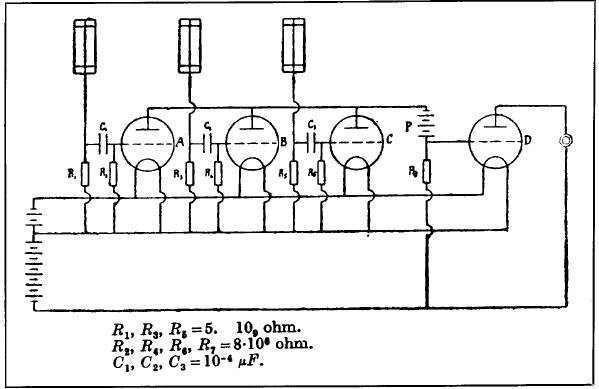

    English translation:
    "In 1928 Bruno Rossi, researcher at the experimental physics institute of Florence University, [...]understood what would be his goal in life: investigating the nature of these ionizing corpuscles raining from the above. He had to build a circuit which allowed the detection and counting of the coincidences that occurred within a given time interval, and he constructed a very simple instrument, the coincidence circuit.
    The Geiger tubes are connected to the negative pole of a 1200 volt battery (not shown). The discharge in the tubes generates a negative voltage pulse on the 5-gigaohm resistences between the Geiger and ground. Such impulse is connected by capacitive coupling (10000 pF) to the grids of the first three tubes, connected to ground by 8 MOhm resistances. Such tubes normally conduct, and they maintain the grid of the fourth tube to negative potential by a 30 volt battery. When a coincidence is created, the first three tubes are inhibited, the grid of the fourth tube, thanks to the 8-MOhm resistance between grid and positive, acquires positive potential, and in the earphone connected to the anode one hears a "tic". [...] Resistances of such large value did not exist, and they were built by filling glass tubes with a organic liquid mix."

    Claudio Pozzi

    One may well wonder what organic liquid was used in the tubes...

    Comments

    Try it out!

    (just don't fill the tubes when the "1200 V battery" is connected! :)

    I think it is impossible it is urine. Urine is mostly water and has very low resistance. There are documentations of electrocution by urinating on live wires http://www.nbcnews.com/id/35650429/ns/us_news-life/ .

    Must have been some types of oil.

    dorigo
    Water has a resistivity of 18 megaohms centimeter. It is exactly in the right ballpark.

    Cheers,
    T.
    rholley
    from Electrical conductivity and total dissolved solids in urine.  http://www.ncbi.nlm.nih.gov/pubmed/19921168

    The values of EC ranged from 1.1 to 33.9 mS, the mean value being 21.5 mS.

    from http://en.wikipedia.org/wiki/Conductivity_%28electrolytic%29

    High quality deionized water has a conductivity of about 5.5 μS/m, typical drinking water in the range of 5-50 mS/m, while sea water about 5 S/m

    Which seems to put urine near the geometric mean of deionized water and sea water, but close to drinking water.

    Robert H. Olley Quondam Physics Department University of Reading England
    rholley
    Reminds me of this:

    Science 2 June 1967:
    Vol. 156 no. 3779 pp. 1231-1234
    DOI: 10.1126/science.156.3779.1231

    Living Relative of the Microfossil Kakabekia

    S. M. Siegel, Karen Roberts, Henry Nathan, Olive Daly

    A living, ammonia-obligate, umbellate form, similar to the Precambrian microfossil* Kakabekia umbellata Barghoorn, has been isolated from two soil specimens collected at Harlech, Wales. This organism is amenable to culture on agar and in broth. The two soil specimens are similar in that they differ from a typical clay loam in high content of carbon, hydrogen, and organic nitrogen and low levels of sodium, potassium, and titanium. In all other constituents, such as calcium, magnesium, and iron, they are quite dissimilar. Kakabekia-like forms can be grown in glucose-ammonia media with the latter as the sole source of nitrogen, but they can also be grown on peptone and silicate in glucose-free media. Ammonia is necessary, and growth is always slow without glucose. The fission process was not observed, but the enlargement and differentiation of a preumbellate structure into its “mature” form, followed by disintegration (senescence) of this stage, was seen. An ontogeny is proposed in which the stalk and basal bulb of the complete umbellate structure are assumed to be part of the reproductive apparatus.

    The fossils are from the Gunflint Chert, about 2 Gigayears old.

    Widely circulated at the time was the story that one of the ‘soil specimens’ was from the urinal at Harlech Castle.  Researching the literature of the time, it seems that the location was at the base of the castle wall, used for that purpose in medieval times.  But considering that the soil was “ammonia rich”, one wonders how long it had be disused.  Hundreds of years seems unlikely.

    Robert H. Olley Quondam Physics Department University of Reading England

