

Are blogs valuable? They must be to science readers. A Pew Research Center study shows that Old Media doesn't cover science very well, leaving a gap to be filled by bloggers, with 10X the science content. And leadership.
They cite the "ClimateGate" East Anglia coverage, which was basically ignored by cheerleaders in science journalism until it took off in the blogosphere. A week later, it gained traction in traditional media.
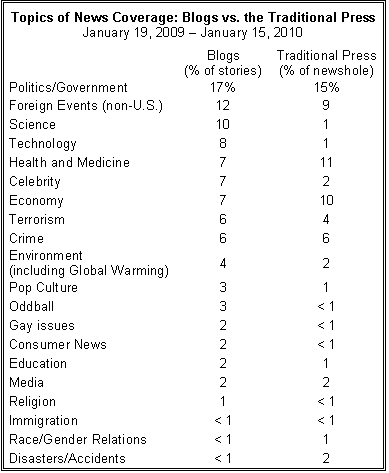
In opposition to non evidence-based claims of Science's crazy old uncle, Donald Kennedy, who clearly misses the glory days of 1980s journalism when it meant progressive good works and claims blogging is just 'journals of announcement', blogs and journalism shared the same lead story with traditional media in just 13 of the 49 weeks studied. 10X the science content and original stuff that journalism doesn't cover until a week later. I'd say blogging is here to stay.

They cite the "ClimateGate" East Anglia coverage, which was basically ignored by cheerleaders in science journalism until it took off in the blogosphere. A week later, it gained traction in traditional media.
In opposition to non evidence-based claims of Science's crazy old uncle, Donald Kennedy, who clearly misses the glory days of 1980s journalism when it meant progressive good works and claims blogging is just 'journals of announcement', blogs and journalism shared the same lead story with traditional media in just 13 of the 49 weeks studied. 10X the science content and original stuff that journalism doesn't cover until a week later. I'd say blogging is here to stay.





Hank’s comments spurred me to think a little more deeply into what science blogging is all about. It brought to mind another quote, this one from a book review by Michiko Kakutani and related comments by Jaron Lanier (The New York Times, March 17, 2010):
“...the dynamics of the Web are encouraging authors, journalists, musicians and artists to treat the fruits of their intellects and imaginations as fragments to be given without pay to the hive mind.”
So, are the readers of Science 2.0 a hive mind? Are the authors giving stuff away without pay? I would answer the first question with a maybe (not sure what a hive mind is), and the second with “Of course!”
These questions and answers help clarify how scientific blogging fits into the larger Web, and why we make the effort to contribute blogs or to read what others have written. It comes down to the value we assign to the “fruits of our intellects and imaginations,” what we mean by “work” and what we are willing to do without pay.
Here’s the deal, at least for me. When I used to work for a living, I got paid and I understood that the pay was for doings things that I would not ordinarily choose to do. A short list of those things would be reading and evaluating exams, assigning grades, sitting hour after hour in committee and faculty meetings, writing grant proposals, and so on. Of course, if that was all I did as a biology faculty member, I would never have chosen to go into academics. The two primary pleasures of academic life outweigh all the chores that we get paid for: the endless joys of trying to figure out how living things work, and passing along my accumulated knowledge to the students in my classes and laboratory. If play is the opposite of work, then those activities are playful for me. As a contributor to Science 2.0 I enjoy giving something away without pay, and I enjoy reading the efforts of other contributors. It follows that blogging must be a playful activity. However, the larger society does not give much value to play activities. Do I expect to be rewarded for anything I publish here? Certainly not, because the playful activity of blogging has intrinsic pleasures that don’t translate into extrinsic value.
Now I want to ask a more serious question: quite a few denizens of this particular reef are working scientists. Would any of us publish a significant new scientific discovery here? Probably not, because blogging is a play activity, and significant new discoveries are serious business, requiring peer review and publication in a scientific journal.
I suppose Science 2.0 might be a hive in the most general sense, in that we congregate at a central location and perform little verbal dances to communicate where the nectar is out in the larger world. But the analogy is not exact because the individual bees in a hive are anonymous. Maybe a better metaphor is a tropical coral reef, populated by a few colorful denizens but with schools of other fish constantly moving through to see if there’s anything good to eat.