

Banner
    Is That A Dragon In Your Berth Or Are You Just Happy To See Me?
    By Hank Campbell | May 25th 2012 03:44 PM | 8 comments | Print | E-mail | Track Comments
    About Hank

    I'm the founder of Science 2.0® and co-author of "Science Left Behind".

    A wise man once said Darwin had the greatest idea anyone...

    View Hank's Profile
    Is it cheaper to privatize deliveries?  Sure is, that is why UPS and FedEx are doing well and the US Post Office is now advertising that companies should send more junk mail and waste natural resources.(1)

    Likewise, as long as Space Exploration Technologies (SpaceX) costs under $450 million per launch and doesn't explode 2 out of 135 times, it beats the government-run Space Shuttle program, which became basically a UPS truck for the International Space Station.  One launch is done, the Falcon 9 rocket lifted off nicely and the Dragon capsule docked with the ISS.  Because this is a commercial project it can't dock automatically, like ESA’s Automated Transfer Vehicle or Russia's Soyuz, so it stopped 10 yards from the berth and a robotic arm guided it in.

    Look for Dragon to leave its orbital home next Wednesday. It will take about 30 minutes to return to terra firma after it deorbits and it will splash into the Pacific Ocean rather than land on a runway.  Old school.
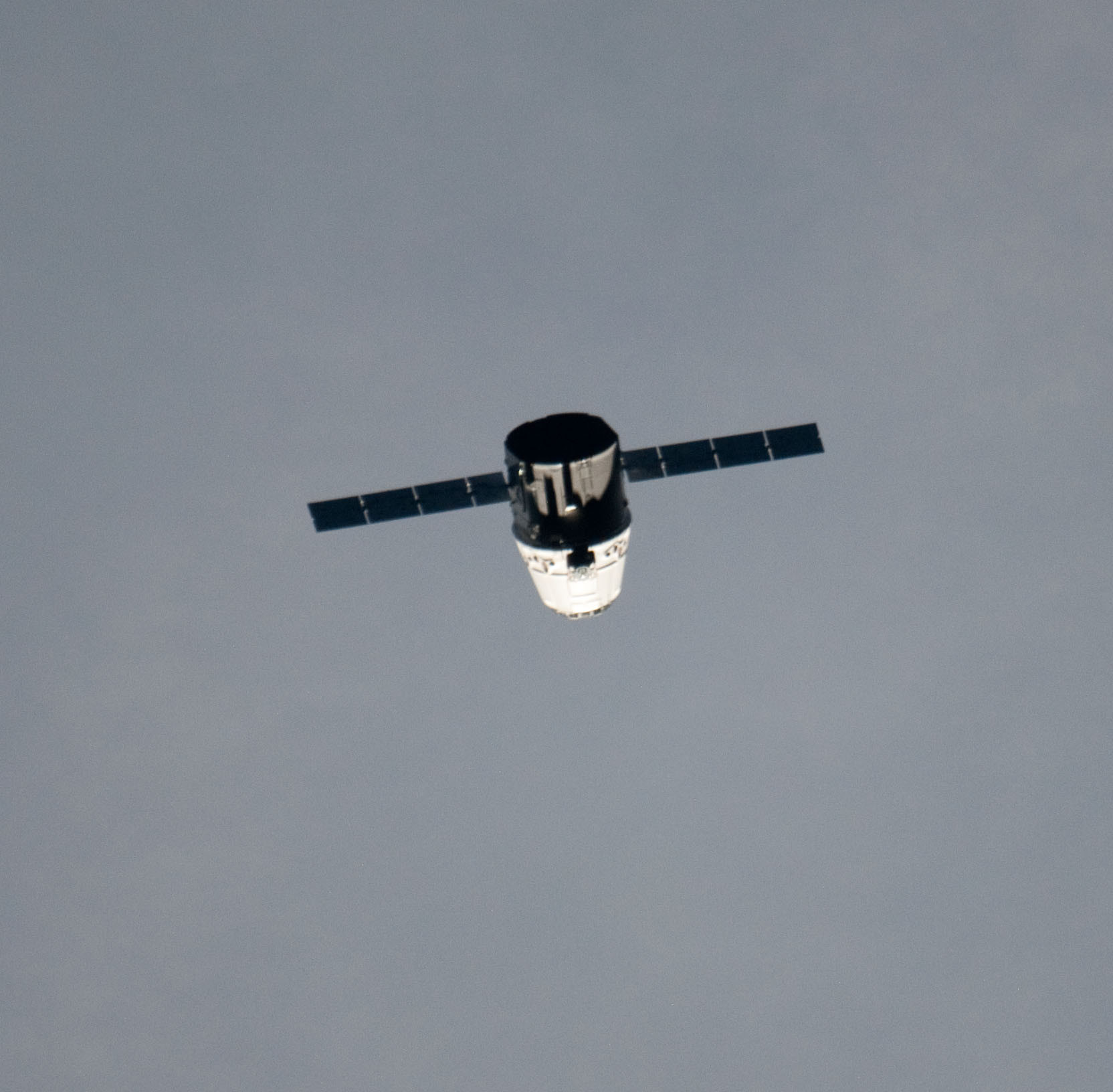

    Dragon as seen from the International Space Station during maneuvering May 24th, 2012. Credits: NASA/ESA

    Columnist Dr. David Brin got to see the Dragon module last month and reports that is not the only commercial space venture worth getting excited about.

    But it's worth getting excited about right this moment.

    "By handing off space station transportation to the private sector, NASA is freed up to carry out the really hard work of sending astronauts farther into the solar system than ever before. The Obama Administration has set us on an ambitious path forward and the NASA and SpaceX teams are proving they are up to the task," said NASA Administrator Charles Bolden.

    Well, maybe.  The only reason President Obama seems to have canceled the Constellation Program was to replace it with something that did not have his predecessor's name on it, a move no president had ever done before (imagine if Richard Nixon had called the Moon landing off because it was the work of Jack Kennedy - the man who basically stole the election from Nixon) and it may be that whoever succeeds him, in 7 months or 55, will do the same thing.  We'll never get anywhere if billions of dollars are going to be thrown out over vanity but precedents are precedents.

    SpaceX kept the costs low and even made some money on the deal.  They have an agreement with Celestis (part of Space Services, Inc. - who did the first-ever private launch in 1982), to launch  human ashes into space, and 310 lucky urns were on this voyage.   

    Want to go?  You have to be dead, so the price is a little steep, but at least you get a 10 percent discount if you are a veteran.  That's good to know for some Memorial Day Weekend in the (hopefully) distant future.

    NOTES:

    (1)

    It's not junk mail, it's jobs mail, if you are a government union employee. 



    Comments

    rholley
    I’m sorry, Mr Postmaster-General, Sir, but in this case it IS rocket science!
     
     
    Robert H. Olley Quondam Physics Department University of Reading England
    JohnK.
    This is very exciting news.  Free markets in this area will lead to more rapid decreases in lift cost than a government only program could ever achieve.  More than anything, this is what will really trigger the space age.  
    Hank
    Now, if only NASA would turn over that plasma drive they said they would test. NASA should be like the Dept of Education - suck up some money but hide in DC so they can't get in the way of things being done.
    Want more no-nonsense, independent science? Buy Science Left Behind
    Hi Sir, I am not a creationist but I have a question that I wonder if you can help me with. According to DNA analysis, chimp and bonobo diverged some 2 million years ago. Yet, they still look very much similar.
    On the other hand, human and chimp diverged some 6 million years ago. Yet, the differences we developed are enormous. Considering the rate of reproductive isolation between the chimp and bonobo, do you think that 6 million years of reproductive isolation is enough to generate such two different species like human and chimpanzee?

    Hank
    That's the best proof of evolution - well, that and hair and milk anyway.  And our messed up reproductive system.  Benny Hill could not design a reproductive system as messed up as the human male, it is too funny. 

    Chimps only look similar to us in the way all Americans look similar to Asians; to chimps the chimps of 2 million years ago are not similar at all, as dissimilar as Neandertal is to us and certainly Lucy, etc. 1 million years of reproductive isolation is a long time, in evolution.  6 can do quite a bit, as we see by the evidence.

    But what does it have to do with aerospace?
    Want more no-nonsense, independent science? Buy Science Left Behind
    Gerhard Adam
    That's one of the common misunderstandings regarding genetics, because people have been told that it's like a "blueprint".  In truth, animals that have exactly the same genes [i.e. EXACT DNA sequence] can still produce vastly different physical characteristics, because it isn't the gene that creates the trait.  The gene only codes for a protein, which is responsible for the trait, but that is also dependent on when and how long it is expressed, etc.

    You can easily see something like that when you observe a human going through puberty.  The changes are driven by genes signalling the onset of puberty and controlling the expression of various traits that change that individual in rather significant ways.  Just consider how physically different a young adult is from a pre-pubescent child.  That can show you just how striking the genetic controls are with respect to how physical traits are represented.  Remember, the individual's genes have never changed throughout that transition, but the expression of them produces vastly different outcomes.
    Thanks all of you for your fast reply. Indeed, we evolved from an ape like ancestor. The evidence from the fossil record and the comparative DNA analysis is undeniable. But my question precisely is, beside reproductive isolation, what was the major evolutionary driver in the human lineage? was it the habitat ??? Diseases??? Bottlenecks??? It seems that humans had undergone many selective pressures that made us look very different from the rest of the primates such as bipedalism, hairlessess, 46 chromosomes, intelligence, etc …..

    Hank
    It's the big biology question; genetic drift, mutation, natural selection, etc. all played a part but determining what caused exactly what and when would get you the biggest Nobel prize ever.
    Want more no-nonsense, independent science? Buy Science Left Behind


