

Banner
    Garra Rufa Fish Pedicures - Complementary Medicine Quackery For Your Toes
    By Hank Campbell | May 16th 2012 05:24 PM | 5 comments | Print | E-mail | Track Comments
    About Hank

    I'm the founder of Science 2.0® and co-author of "Science Left Behind".

    A wise man once said Darwin had the greatest idea anyone...

    View Hank's Profile
    Garra rufa - "doctor fish' - are now trendy in some fish pedicure places.  The pedicuree dips their feet (see? I don't specify a gender or make any judgments, I am not Manny Pacquiao) into water containing the fish and the little critters exfoliate you by basically eating the dead skin from your toes.

    But that may not be the grossest thing about it. The grossest thing may be what the fish give back.  Writing in My Health News Daily, they note some reason for concern from an upcoming Emerging Infectious Diseases article about these fish and 'zoonotic disease pathogens of clinical relevance' - namely the presence of bacteria like Vibrio vulnificus, which can cause wound infections and septicemia, and Streptococcus agalactiaea common cause of infections in older adults and those with chronic diseases such as diabetes.
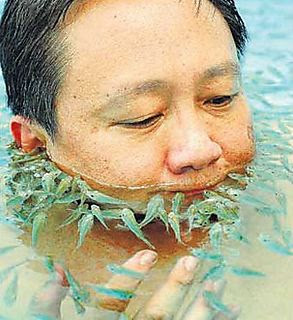

    Convincing us that fish pedicures are a good idea may be proof that Asia has not forgiven us for Hiroshima. Link: The Burmese Ruby Diary

    Yikes. That's not to say anyone should panic, the CDC does not have record of any illnesses due to foot pedicures, but regular nail salon foot baths have led to outbreaks of nontuberculous mycobacterial infections that left customers with boils and scars, along with really clean toes.(1)


    Still creepy, even with an Asian woman instead of a man.  Link: Octoviana.com

    It's not all bad. One study, albeit in Evidence-based Complementary and Alternative Medicine(2), found that Garra rufa does help with psoriasis.

    10 states have already banned the use of fish pedicures, for various reasons:

    1) It is not legally a pedicure unless an Asian woman is talking to her friends about you in a foreign language while she touches your feet.  Asian fish do not count, so it is false advertising in some states to call fish nibbling your feet a pedicure.

    2) Hygiene. My hair stylist is not even allowed to use the same comb she used on someone else without cleaning it first - some skepticism that salon owners are cleaning these fish, or even the water the fish is kept in, between each pedicure is warranted.  Actually, if the water is ever cleaned I would be surprised.

    3) These fish lack documentation. Since Garra Rufa is not native to the United States, there is concern by the US Fish&Wildlife Commission that if these fish are released into nature, they will get better test scores than American fish and then take all the good jobs.

    4) Nibbling on your feet is cruel.  Why isn't PETA outside these salons with half-naked mermaids protesting fish pedicures?  They objectify naked human women over dead fish all of the time so you'd think starved fish forced to eat foot skin for sustenance would get some attention.

    If it will help prevent cruelty to fish and also prevent disease, I will endorse PETA activists Lauren Quillow, below left, and Virginia Fort:


    Link: Metropulse.com

    REFERENCES:

    (1) Vugia DJ, Jang Y, Zizek C, Ely J, Winthrop KL, Desmond E. Mycobacteria in nail salon whirlpool footbaths, California. Emerg Infect Dis. 2005;11(4):616-618.

    (2) Grassberger M, Hoch W. Ichthyotherapy as alternative treatment for patients with psoriasis: a pilot study. Evid Based Complement Alternat Med. 2006;3(4):483-488.


    Comments

    I hate to break it you, Hank, but the -ee ending of pedicuree derives from the specifically feminine form of the French past participle of -er verbs. (See http://fr.wiktionary.org/wiki/pédicurée)

    Hank
    Wow!  I had no idea that was even a real word, I thought I invented it, along with a rationalization for putting up a picture of starved vegetarian chicks. This thing had 4,000 readers and you are the first to note my participe passé faux pas.
    Want more no-nonsense, independent science? Buy Science Left Behind
    BTW, pics of chicks rarely require rationalization. And here are some links which may be useful when reading my post below:
    http://en.wikipedia.org/wiki/Animacy
    http://en.wikipedia.org/wiki/Grammatical_gender
    http://en.wikipedia.org/wiki/Indo-European_languages
    http://en.wikipedia.org/wiki/Proto-Indo-European_language

    Even if it weren't a French word, (and my guess is the word was actually borrowed back into French) the -ee suffix is what is called productive in linguistics. (http://en.wikipedia.org/wiki/Productivity_(linguistics)) Like -able it can be added to pretty much any transitive verb to make a new word anyone will understand. Other suffixes like -wise 'in regard to, or -th "zeroth" "gazillionth" are also productive. But other suffixes like -en "plural" are no longer productive. You would not be understood if you said iPoden unless perhaps if you were making an obvious joke. The irony here was your using the third person plural "their" with a form which was feminine in its original French, if no longer in meaning in English.

    You may also be interested to know that the pronoun he is not truly masculine, but actually animate in form. The original distinction in Indo-European was between he and it, just as between who and what, with the ending which is now -t in English signaling inanimacy. That is why "What did it want" is so unacceptable as a question about the person who just called. The -a feminine ending arose later by analogy, when the ending for the Indo-European word *gwena "queen" became generalized to other terms. Hittite evolved away from I-E so early it has no feminine pronoun, only the animate/inanimate distinction. Greek and Latin retain a large number of adjectives where there is no masculine/feminie distinction. It may be out there, but I am not aware of any modern I-E language that makes a distinction between a masculine and a feminine who. And, believe it or not, the English word she actually developed in a phonetically complex manner from he with the -a ending appended. So, the "problem" with the he pronoun has never been that it is masculine only. It is not, it is merely animate. The problem is the special treatment of females. Do away with she, or at least proudly say "each child should bring his lunch" and the problem is solved.

    The Fish actually only do what they do since hundrets of years. The only thing that changed is that they do not do in Kangal and find food much more easy.
