

Banner
    Square Kilometre Array Telescope Makes A Decision, Sort Of
    By Hank Campbell | May 28th 2012 10:55 AM | 7 comments | Print | E-mail | Track Comments
    The Square Kilometre Array telescope will be the world’s largest and most sensitive radio telescope, but it had a bit of a problem most big science projects do not have; multiple countries wanted to host it.

    At an impasse, it fell to Members of the SKA Organisation who were not interested in hosting it (U.K., Canada, China, Holland and Italy) to find an uncomfortable solution and decide who should be the host, Australia or South Africa. In true United Nations fashion, they punted and basically agreed on both.  Instead of making a decision that would make one happy and one not but be best for the project, they 'split the difference'. The existing ASKAP and MeerKAT sites in those countries will be used for Phase I of the SKA.

    Like all modern Big Science projects, the justification is big, namely that the SKA will allow astronomers to learn more about the evolution of the first stars and galaxies after the Big Bang, investigate the "was Einstein wrong?" nature of gravity, and...wait for it...possibly even discover life on other planets. Also like many modern Big Science projects, no one really seems to want to make a decision.  Most of the members agreed not to do anything and host SKA in both locations, for example. How bold!  They tentatively stated that South Africa was probably better, given projections of radio frequency interference, the longer-term projections on how long it could be a radio quiet zone - basically, how long before people want to be able to get cell service there.  But they also had to consider the working and political environment, which has nothing to do with the science; basically, in which place would astronomers he happiest in 2024, when this goes online.

    Obviously either country would be thrilled to have them so the clear answer would have been to pick the country that did the most; do you want to have educated people with good-paying jobs bringing their culture to yours and have a science reason to keep the environment clean? Pay more money.  Politicians simply have to consider how much money one project is worth for that nebulous 'leadership' claim. Every time a big project comes up, the argument is America will lose leadership if we don't fund it.  Has America lost anything because we did not fund the LHC here?  Not that anyone can see, unless spending $5 million per job is good politics. We have the James Webb Space Telescope as a bottomless pit for money starving out other projects so we don't need more than one.

    But now the project moves ahead (on schedule so far, since the only requirement on the timeline for 2012 was picking a location) and while most of the SKA dishes for Phase 1 will be built in South Africa and combined with MeerKAT, some SKA dishes will also be added to the ASKAP array in Australia. All the dishes and the mid frequency aperture arrays for Phase II of the SKA will be built in South Africa while the low frequency aperture array antennas for Phase I and II will be built in Australia (and New Zealand).


    So how will that work again?  SKA is supposed to look like this:
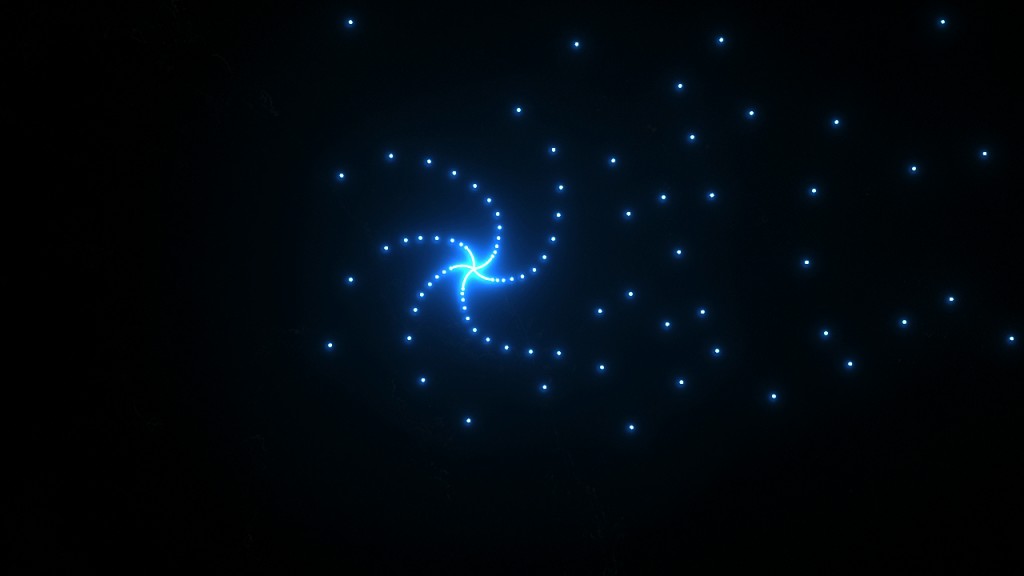

    Credit: SKA

    They picked that spiral arm shape for a reason. 3,000 antennas are bunched in that core and logarithmically placed along those five spiral arms up to 3,000 kilometers away. The three antenna types, high frequency dishes and then mid- and low-frequency aperture arrays, will monitor from 70 MHz up to 10 GHz and because of the design it will create a 'collecting area' equivalent to a dish with an area of about 1,000,000 square meters.  Big, right?  You can't do that on two separate continents, though, doing it in two locations is the same as positioning the antennas randomly and post-processing the data to account for that.  It will still work, but it isn't efficient.


    Artistic view of what the arrays will look like. Credit:SKA

    So once this is cooking, what is it really going to do?  They want to monitor pulsars, those lighthouse-like spinning cores of dead stars, for gravitational waves. Since a pulsar emits in radio frequency along its magnetic axis and rotates precisely, astronomers can use them as natural clocks and conduct strong-field tests of gravity.  The SKA will also map the cosmic distribution of hydrogen and maybe help identify the nature of dark energy, because hydrogen atoms produce radio emissions at a wavelength of 1.420 GHz. 

    But don't get too excited.  SKA has been in development since 1991 and even starting construction of the Phase I antennas won't begin for 4 years.  At least they have a location now.  Well, two of them. 

    Comments

    Umm you might want to read what the actual decision was and rewrite this blog entirely. The split is doing different frequencies. The two parts of the array do not need to be looking at the same objects. UV coverage is *not* an issue with the split site decision.

    Hank
     most of the SKA dishes for Phase 1 will be built in South Africa and combined with MeerKAT, some SKA dishes will also be added to the ASKAP array in Australia. All the dishes and the mid frequency aperture arrays for Phase II of the SKA will be built in South Africa while the low frequency aperture array antennas for Phase I and II will be built in Australia (and New Zealand).
    What's the confusion?  And how do you know the motivations of the committee? If you're on it, say so.
    Want more no-nonsense, independent science? Buy Science Left Behind
    The blog says:

    They picked that spiral arm shape for a reason. 3,000 antennas are bunched in that core and logarithmically placed along those five spiral arms up to 3,000 kilometers away. The three antenna types, high frequency dishes and then mid- and low-frequency aperture arrays, will monitor from 70 MHz up to 10 GHz and because of the design it will create a 'collecting area' equivalent to a dish with an area of about 1,000,000 square meters. Big, right? You can't do that on two separate continents, though, doing it in two locations is the same as positioning the antennas randomly and post-processing the data to account for that. It will still work, but it isn't efficient.

    The 3000 antennas will not be split between sites at any given frequency. All 3000 Phase II dishes will be in Southern Africa, and all of the aperture arrays will be in Australia and New Zealand. The only part that will be split at the same frequency is the ≈90 dishes of the Phase I survey array will be in Australia (including the 36 that are already being built for ASKAP), while the Phase I pointed array will be in Africa. According to the committee reports, this is to take advantage of the existing ASKAP and MeerKAT infrastructure in the respective sites, given that which pieces of Phase I will make it into Phase II depend upon the results of Phase I (particularly with respect to the Australian phased array feeds). Because both sites already have Phase I-capable infrastructure in place or close to in place, this is very cost-effective. This piece of the site decision very closely follows the recommendation of the site selection working group report, as far as I can tell from a relatively quick read.

    Hank
     the recommendation of the site selection working group report, as far as I can tell from a relatively quick read.
    Yes, a split site is exactly what they recommended but that is part of the problem - the decision was made in advance, rather than really being debated, so the committee didn't want to hurt anyone's feelings and did something that is now going to be more expensive and less efficient.  Granted, it's only the money of the taxpayers in those countries but it's reasonable to be critical of silliness. 
    Want more no-nonsense, independent science? Buy Science Left Behind
    I'm not quite at the centre of this process but I am reasonably close. If you think that people's feelings are a consideration in discussions like this, you couldn't be more naive or more wrong. And your statements about the dual site solution being "less efficient" are simply wrong. There is no loss in efficiency since the different components were going to be used independently anyway.

    The big win here is the reuse of infrastructure already developed at the ANZ site and in progress at the RSA site.

    Overall, I think this is a very good solution.

    Hank
     If you think that people's feelings are a consideration in discussions like this, you couldn't be more naive or more wrong.
    ha ha Yes, I would be the naive one in that statement.
    Want more no-nonsense, independent science? Buy Science Left Behind
    The decision has very little to do with "in which place would astronomers he happiest in 2024" - but rather aims to maximize the huge investment in precursors which has taken place at both sites. Most in the radio astronomy community think that the decision will result in the highest scientific returns, rather than being some sort of botched compromise as you seem to think.


