

Banner
By Hank Campbell | September 6th 2008 03:59 PM | 6 comments | Print | E-mail | Track Comments
About Hank

You've probably heard of Science 2.0 but never heard of me. And that's okay.

A wise man once said Darwin had the greatest idea anyone...

View Hank's Profile
When scientific terms become part of the cultural fabric they often lose their meaning. Biology has had its share of modern misunderstandings with 'evolution' becoming colloquial rather than scientific, along with the general term 'theory', which today is used by anyone with a crackpot notion about particle physics, math or the end of the world due to a tunnel in Switzerland.

So it goes. That's why today we have advertising claims like 'the next evolution in cars' and then press releases about the 'missing link' in comets.

Hey, we don't shape the culture, we just try to cut through it. So this time we will talk about the 'missing link' between an Oort cloud and Halley's comet and discuss the 'evolution' of these mysterious space bodies, which will make biologists here irritated. Later on we can use terms like 'genesis' and 'creation' in their place so religious folks can feel slighted also.

Why mention all that? Well, we run out of science terms to use when there is no previous explanation for an object, so we have to fall back on cultural ones in order to convey why something is important. In this instance, a team of scientists has found an unusual object whose backward and tilted orbit around the Sun is just baffling enough that it may tell us about the origins of some comets.

You heard me. Researchers from the Canada-France Ecliptic Plane Survey project have discovered an object that orbits around the Sun -- backwards. And it is tilted at an angle of 104 degrees, almost perpendicular to the orbits of the planets. Take a look:
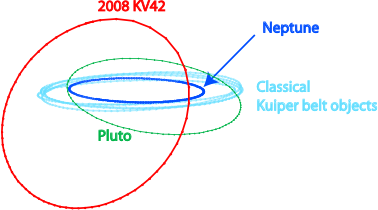


Trans-Neptunian objects (TNOs) with large orbital inclinations, for which 2008 KV42 is the poster child, may be indicating that an orbital pathway exists between the inner Oort cloud and the Halley-type comets. Here are the orbit paths (looking along the plane of the solar system) of the retrograding 2008 KV42 and some other outer solar system objects


I call that 'fascinating.' They just call it 2008 KV42.

2008 KV42 is not just any rock. It also gets called a "trans-Neptunian" object, because its orbital path is greater than Neptune's. It's about 50 kilometers in diameter and 35 times further from than the Sun than our friendly Earth.


Just as an FYI, this trans-Neptune region of the solar system usually gets called the Kuiper Belt, a term you are likely more familiar with than this Trans-Neptunian business - so now you know.

First, some things about comets. The known comets can be divided into three groups, based on the shape of their orbit:

- ‘nearly isotropic’ comets (meaning they are come from all directions). These comets plunge in from the outer Oort cloud from ten-thousand times (or more) the distance from Sun to Earth. They have very large orbits, and cross inside of Jupiter’s orbit.

- ‘Jupiter-Family comets’ which orbit with small tilts.  These comets are believed to come from the Kuiper Belt.

- ‘Halley-type comets’ have retrograde and/or highly-inclined orbits, their origin is currently a puzzle.  Models trying to produce these from either a Kuiper Belt source or an Oort cloud source have been largely unsuccessful.


Animations produced using Xephem from the Clear Sky Institute.

"Certain types of comets are not naturally produced after planet formation, especially those with highly tilted orbits," says University of British Columbia astronomer Brett Gladman, who also holds the Canada Research Chair in Planetary Astronomy. "This discovery may finally show how they transition from the Oort Cloud to become objects like Halley's Comet."

Except we don't know anything of the kind from this research, though Gladman says studying these objects can someday give us a peek into the early history of our solar system, so they have been carrying out a targeted search for objects with these highly tilted orbits. It won't matter to Digg readers, 30,000 of whom will run off a cliff over a press release with the term 'missing link' in its title. The initial discovery was made using the Canada-France-Hawaii Telescope in Hawaii, with follow-up observations provided by the MMT telescope in Arizona, the Cerro Tololo Inter-American Observatory (CTIO) four-metre telescope in Chile, and the Gemini South telescope, also in Chile.
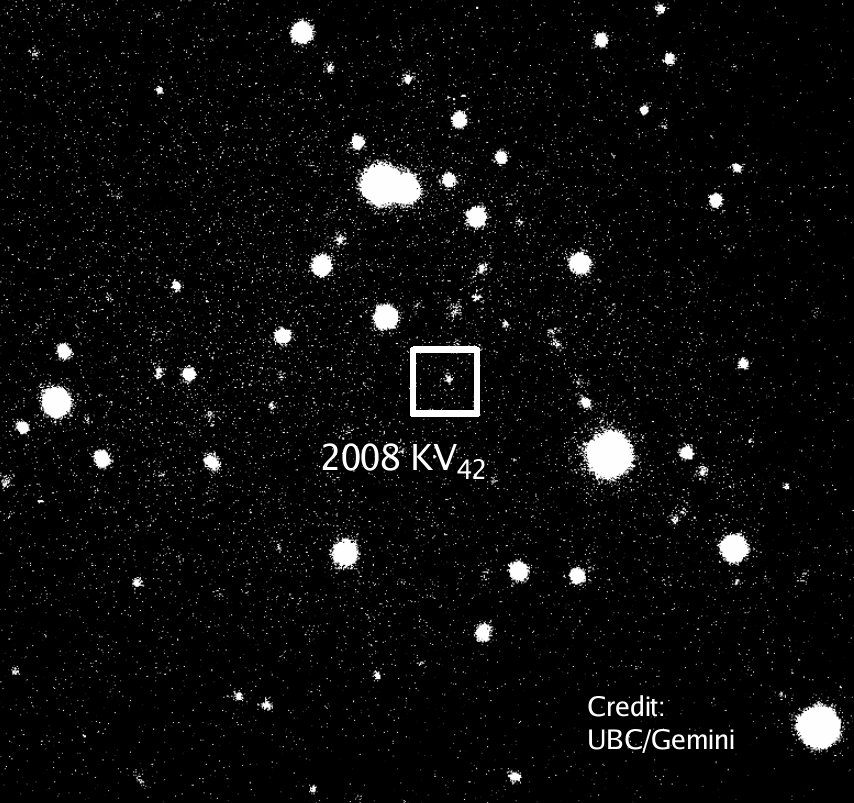


A visible light image, acquired by the GEMINI South telescope, showing the location of 2008 KV42. This image shows the object as a `point source’ of light. 2008 KV42 is currently nearly 4.5 Billion kilometers from Earth and only a few 100 km in diameter: from this distance, all we see is a point of light shining back at us.


The discovery team is currently performing follow-up observations of 2008 KV42 to pin down its orbit with greater precision. They will then begin unravelling the archaeological information trapped in the orbit of this highly exceptional member of the trans-Neptunian population.

Does that mean we will really get answers about the origin of something like Halley's Comet? Unlikely. Heck, we can't even really observe 2008 KV42 but, like anything in science, baby steps lead to big leaps over time.

Computer simulations say 2008 KV42 may be just such a 'transition object' but it will take real discovery of the Oort Cloud to find out. And maybe we'll find a whole lot of "Halley's Comets."

Learn more about the Canada-France Ecliptic Plane Survey project here.

Comments

ricochet17
anything that makes people, and scientists, think outside of the box can only benefit our species! If you think about it, most truly revolutionary ideas occurred when someone has to explain something that did not fit a traditional prevailing idea!
rholley
The word "quantum" is one that has really been turned on its head in popular use. As I wrote in an online article:

In the years close to 1980, a number of primitive first-generation personal computers came on the market. Following the success of the Apple II, the British inventor Clive Sinclair produced the Spectrum, based on the ZX80 chip, and followed this with the QL, a Motorola-based machine, whose name stood for QUANTUM LEAP.

This name was intended to suggest that his new computer was a "Great Leap Forward" in personal computing, and is based on a very popular but totally wrong idea of what a quantum is. The only grain of truth in the popular idea arises from the fact that the amount of energy in an atom does not change along a smooth road, but jumps from one quantum state to another. So what exactly is a quantum?

As for theological words, most of these are taken from general usage. I have heard it said that the only new word in the New Testament is "Christian".

Regarding Wilbur R. Knorr's book "The Evolution of the Euclidean Elements" (which I recommend) the title does make one think of a chimpanzee holding a diagram of Euclid's proof of the Pythagorean theorem (Proposition I:47).

Robert H. Olley
Physics Department
University of Reading
England

Robert H. Olley
Physics Department
University of Reading
England

The classic theories and assumptions have so many problems and when a Scientist who's specialty is grid science tells you folks that comets are simple,simple,simple,you folks always discharge us as some sort of quack science because "Your"man has insisted his theory is where you will be welded.
But anyway,comets are core material,a crystal,ammonia based,and are the resultant from a system explosion here in this galaxy sector 28 thousand ago,and return on the feed lines to revv our grid or be depleted into the suns feed lines.
Its realy simple. But methinks you will stay in your comfort loop.

The recent approach of comet Lulin reminds the collision of comet Shoemaker-Levy with the Jupiter in July 1994. As Jupiter has several moons, a comet can collide with a moon. But some of them are forward orbiting and some in the opposite, so predicting the collision is bit difficult. The said difficulty takes us to a global n chronic problem in the teaching / learning of Circular Motion. Interested readers can see my Letter in Physics Education, a bimonthly from UK, November 1995, p. 327 or contact me on +91-020-65100495 or my cellphone: 9922467861or write me on "Prerana Apts / A-40 / Kasturba Society / Dighi Post / Pune / MH / 411015 / INDIA

Dileep Sathe
Photo of my poster, showing Jupiter with one prograde (green arrow) and one retrograde moon (red arrow). It was presented in a conference in honor of Prof C N Yang, in SINGAPORE, Nov. 2007.  I had a good discussion with Prof Martin Perl (Nobel, Physics, 1995) because we both love mechanics.  In photo, the poster is between him and myself.
http://mail.google.com/mail/?ui=2&ik=9d3771e8c0&view=att&th=12027ca98b2a4686&attid=0.1&disp=inline&realattid=f_fsjxvduc0&zw

logicman
Robert: I seem to recall that Alan Sugar described the Sinclair QL as 'a boffin's ego trip'.

I call that 'fascinating.' They just call it 2008 KV42.

Hank:  I like it!
What happened to science?  Time was, every scientist would invent a new Latin or Greek name for something.  Let's see:  is this comet an antilignatory object?  It is 'going the wrong way', going 'against the grain' (a term from carpentry).  :)

baby steps lead to big leaps over time.

I can't find the reference at the moment, but I'm fairly sure the idea comes from Steven Pinker.
Some scientists are like mattresses - when you jump on them they just absorb the impact.  Others are like trampolines - when you jump on them, you just keep bouncing higher.

I wish I'd said that.

Add a comment

The content of this field is kept private and will not be shown publicly.
  • Allowed HTML tags: <sup> <sub> <a> <em> <strong> <center> <cite><TH><ul> <ol> <li> <dl> <dt> <dd> <img> <br> <p> <blockquote> <strike> <object> <param> <embed> <del> <pre> <b> <i> <table> <tbody> <div> <tr> <td> <h1> <h2> <h3> <h4> <h5> <h6> <hr> <iframe><u><span>
  • Lines and paragraphs break automatically.
  • Web page addresses and e-mail addresses turn into links automatically.
CAPTCHA
If you register, you will never be bothered to prove you are human again. And you get a real editor toolbar to use instead of this HTML thing that wards off spam bots.