Banner
An Open Letter To Squid

Dear Squid of the World,Excuse me. What is this? I have been your friend and advocate for years...

With This Devoted Squid Mama, I Bid Farewell

Squid typically die after spawning. Their orphaned eggs are left alone in the cold brine to develop...

ICAD 2012: Top Ten Cephalopod Stories From The Last Year

To celebrate International Cephalopod Awareness Days, I decided to comb through all the cephalopod...

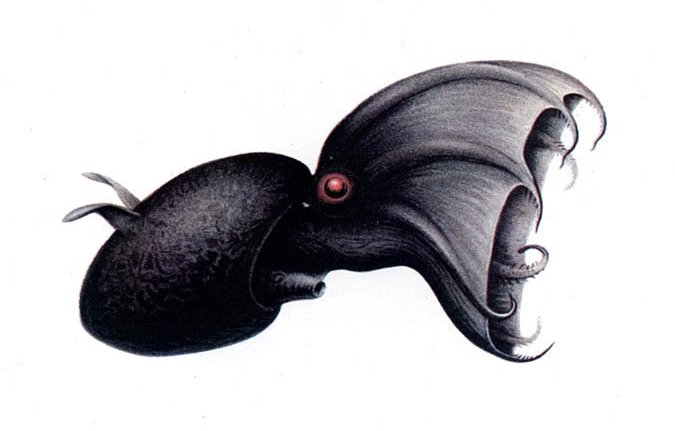
Scavenging Cephalopods: Mild-Mannered Vampire Squid Just Want To Eat Waste

A couple of weeks ago ago, a debate about the existence of scavenging cephalopods broke out on...

User picture.
picture for Hank Campbellpicture for Helen Barrattpicture for Josh Wittenpicture for Holly Moellerpicture for Alex picture for Becky Jungbauer
Danna StaafRSS Feed of this column.

Cephalopods have been rocking my world since I was in grade school. I pursued them through a BA in marine biology at the University of California, Santa Barbara, followed by a PhD dissertation at... Read More »

Blogroll
If you haven't heard the kerfuffle about flying squid by now, you've been under a rock. A cephalopod-free rock. 
I'm stoked to be joining the blogging team at KQED QUEST--a Northern California science multimedia extravaganza! My first post went up yesterday. As you can see, it required extremely rigorous and extensive consumption of chocolate.
Probably not. No one's ever heard a squid make any kind of noise, really, other than "splash" at the sea surface.
But if you read io9's fantastic piece on the deep sea's mysterious sounds, you'll learn about The Bloop, an unexplained deep-sea noise from 1997. What could have made it?
Gary Griggs, director of the Institute of Marine Sciences and Long Marine Laboratory at UC Santa Cruz, wrote a nice piece for the Santa Cruz Sentinel on the history and current status of California's commercial fisheries. Squid, of course, play a starring role:
In 2010, California's biggest catch by far was market squid, coming in at over 144,000 tons, or 66 percent of the state's entire commercial catch. This is eight pounds of squid for every person in California. . . . 
The Freeport News--"Grand Bahama's First Newspaper"--ran an article today that was a mix of highly detailed biology and complete bone-headed confusion.

Could there be a healthy squid population living in local waters? has a fantastic opening:
Is it a possibility that there is a healthy squid population in waters around Grand Bahama?
Although, at this point, there is no official answer to the question from the proper authority, this daily will continue to search and keep our readers updated.
Mystery! Intrigue! The authorities may be ignoring the situation, but never fear, the journalists will poke and prod until it all comes out.
Peru is at the cutting edge, the forefront--nay, Peru is a veritable trendsetter, trailblazer, and spearheader--because Peru, alone in the world, has decided to set a quota for Humboldt squid.

Before you go off in a huff about how ridiculous I'm being*, let me explain why this is kind of a big deal. First, the Humboldt squid fishery is the biggest squid--the biggest invertebrate--fishery in the world. Second, no single country (or group of countries, for that matter) has ever set a quota for Humboldt squid before. That means fishermen have, by and large, been free to catch as many as they can.