Banner
    Diving into Euler-Lagrange: 1D (1 of 2)
    By Doug Sweetser | February 21st 2012 11:25 AM | 15 comments | Print | E-mail | Track Comments
    About Doug

    Trying to be a semi-pro amateur physicist (yes I accept special relativity is right!). I _had_ my own effort to unify gravity with other forces in...

    View Doug's Profile
    Sophisticated physicists appreciate the dance of abstract symbols. I need to build something. The abstract is more real when made out of clay and pipe cleaners. In this blog on the 1D Euler Lagrange equations, beads (not clay) and pipe cleaners will be used to appreciate this important tool, followed by the same story told with symbols.

    [note: I missed my usual self-imposed deadline because I was not able to get the icon bar to appear in Google Chrome on a Mac. The browser Opera worked, so long as I cut and plasted URLs for images and HTML code from codecogs.]

    Calculus is the study of change. I will look into three variants. The first is differential calculus, the first one taught to students. The visualization is well known:
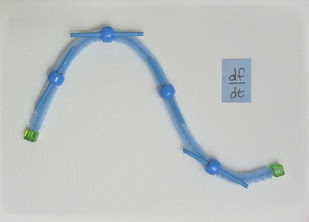

    Notice the straight lines. This is a key to all forms of calculus - the linear approximation when changes are tiny enough.

    Integral calculus involves summing. Its visualization should be familiar too:
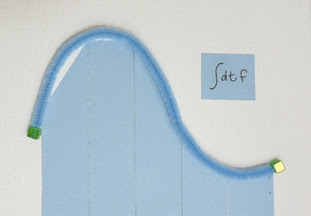
    There are straight lines where the area bar meets the curve. The areas will become an excellent approximation when the changes become tiny enough.

    The fundamental theorem of calculus can be viewed as the intersection of differential and integral calculus:
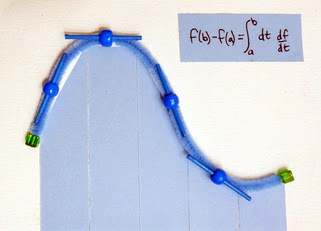
    Take the integral of a derivative and the result is the function evaluated at the endpoints.

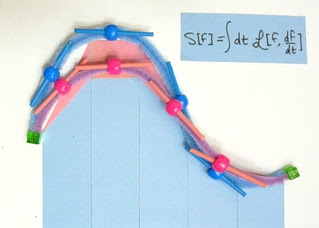
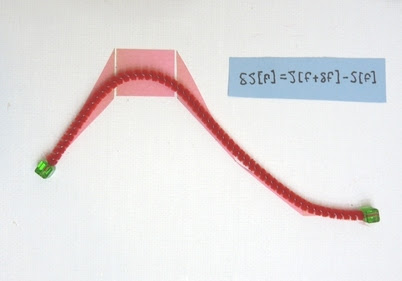
    The calculus of variations is often not taught in a year long calculus class. One reason to avoid the subject is the focus shifts from one function to many possible functions and how they vary. This is quite the abstraction. The action to physicists, or functional [...] to math folks, can be visualized like so:

    [Jargon correction sidebar]
    I originally call the above a "functional integral" instead of a "functional". Turns out there is a BIG difference between the two. A functional is a function of functions. You may have seen something like this:

    This is true if f is an additive function. But the equation itself is called a functional equation. The calculus of variations is about minimizing functionals.Functional integration underlies the path integral approach to quantum mechanics. The math is much more difficult than is done in this blog. Often only perturbation theory can be used to get an approximate solution.
    [End jargon correction sidebar] 

    Start with the function depicted by the line in blue. In both differential and integral calculus, that function, once set, stays the same. In [the action or functional], the function itself is allowed to change. One variation is the function shown in peach. It too has slopes, and those slopes are different from the ones in blue. The area under the curve can be larger or smaller depending on where one happens to be. The action S will be varying the function f which is why I wrote S[f]. What is "linear" is that one works with first order derivatives of the the function f, not higher order derivatives. I believe one can work with higher order derivatives, but that will be beyond the scope of this blog.

    One comforting idea is that the tools of standard differential and integral calculus still work, with good old variables like position x substituted with alien functions like f. It can look like a global search and replace. For example:


    Likewise:


    The first derivative I ever learned still works even if I use a function f.

    Another relevant tool is the method for looking for extremes, where the limit of a change is zero because a local maximum, minimum, or inflection point has been found. Here is a visualization of the process:

    Compare three flavors of calculus: differential calculus, integral calculus, and the calculus of variations:
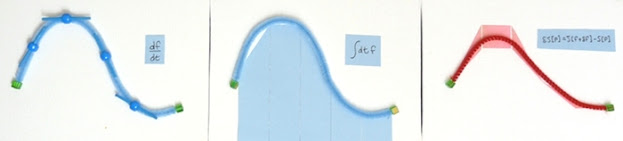
    Differential calculus uses ratios. Integral calculus uses sums. The calculus of variations exploits both differentials and integrals when looking at [a small] difference [as the function is varied].

    Enough with the pictures, on to the real mathematical physics.

    Define the action S:


    Original: Vary the function f by a factor of delta, looking at the limit of the difference like so:
    Better I hope: The entire function f is allowed to vary by a small amount, δf. Over the entire range of the function f, the function changes. Look at the difference between the functional that is changing to first order in the derivative and the original functional:


    [Two corrections were made to the original equation. First, I had put in a limit. What is really needed is the variation of the function must be small like the graphic suggests. This is so the variation depends on the first order derivatives of f, not higher order derivatives. Second, the delta needs to be snuggled against the function f because it is the function that is being varied. For a number of subsequent functionals, the limit process and location of the delta were altered.]

    [note on notation: why not use f dot for the time derivative of f like everyone else? This is part of "owning" a derivation, writing it slightly different. This is forcing me to notice where the total and partial derivatives live throughout the process.]

    What is the difference of these two in the integrand? Since the goal is to look at the [...] variation [for small changes in the function], one can take the Taylor series of the term on the left:


    The partial derivatives of the Lagrangian are used because the Lagrangian in this functional [...] depends both on f and changes in f (recall the picture). A derivative of the Lagrangian with respect to the function f must hold the time derivatives of f constant.

    Plug the Taylor series expansion back into the variation, noticing the first term cancels, leaving:


    I call this phase: apple (δf) meets orange ( d(δf)/dt). Pros can say integration by parts and boundary conditions and be done with it. Those who have to stay after school is out need to work through the details. I just don't use integration by parts on a regular or even irregular basis. I have an easier time with the product rule:


    or


    For that second term in the integrand, if a=f, and b is everything else - it is a bunch of stuff - then we can plug the two terms on the left for the one on the right.


    This doesn't initially look like progress. There are now three terms instead of two. The middle term however is the fundamental theorem of calculus in action. It doesn't have to equal zero. However, physicists often pick boundary conditions such that this term is zero. If the boundary conditions are periodic, then the value will be the same at a and b, so the term contributes nothing.

    [More detail on the "middle term" of the variation of the functional…]

    Say the endpoints are fixed (there is a wall there, that kind of thing). Then the function f cannot vary at the endpoint b, nor at a, so this will evaluate to zero. In the graphic, the endpoints were green cubes that were epoxied to the canvas. 

    The endpoint could vary, but if they varied together, then again the middle term would evaluate to zero. This is what is meant by "harmonic boundary conditions": what happens at endpoint a is what happens at endpoint b, so these two are the same and cancel each other. 

    A third option is to say one is going out to infinity, and there is no there there (the Lagrangian is zero that far away).

    [end detail]


    Proceed assuming the periodic boundary conditions or things go to zero at infinity and beyond (I watch a lot of "Toy Story" these days). Apples are now together with apples:


    The variation of the action can equal...just about anything. What is of most interest to Nature is apparently extremums. That happens when the variation equals zero. And that happens if those two terms inside are always just as big as each other:


    Is this extremum a maximum, a minimum, or an inflection point? That all depends on exactly what the Lagrangian happens to be. I have never seen that calculation done, a second derivative of this mess to see if it is positive, negative, or zero. There is always more to try out.

    The odds are good that I have tripped over a detail or two since I have demonstrated low fidelity at these tests of symbol manipulations. I will keep the pipe cleaner canvases on the book shelf. The eye can appreciate the logic of the calculus of variations quickly.

    Doug

    Snarky Puzzle:

    A few blogs ago in the comments section, a little finite group theory happened, leading to the calculation that the quotient group of the quaternion group Q8 modulo the multiplication group {1, -1} Z2 was the Klein 4-group:


    Don't feel bad if that doesn't mean much to you. Instead reread the comments so that it will make some sense - I know I tripped over any detail I could before stumbling to the answer. Now calculate:


    What is Z4? It is a finite group with - you guessed it - 4 elements. There are a bunch of ways to represent the group. One applies to the complex numbers: e(i n pi/2) for n between 0 and 3. The result should be a non-Abelian because a quaternion divided by a particular complex number will be non-Abelian. Which group? Don't ask me, I have not done the calculation yet, but it may be interesting.

    Next Monday/Tuesday: Diving into Euler Lagrange: 2D, 3D, 4D (2 of 2)

    Comments

    Halliday

    Doug:

    You don't want to be using the term "functional integral", since that implies something well beyond what you are doing, let alone what you are prepared to deal with!  ;)

    What you are working with are simply functionals (the action).

    Second, you should not be "[v]ary[ing] the function f by a factor of delta" (or even one plus delta, as you have within your article).  We are varying the action (δS[f]) by varying the function f (δf).  Just as the variation of the action with respect to the function (δS[f]) is the difference between the action with the new function and the action with the old function (S[f + δf] - S[f]), the variation of the function itself (δf) is the difference between the new function (f + δf) and the old function (f).  We could make this more explicit, like calling the new function g, or f', or some such, and letting the variation of the function be called δf.  However, such is seldom done, since it is so trivial.  ;)

    Unfortunately, this leads to your greater error:  The 'δ' cannot, properly, be separated from the 'f'.  Luckily, you were fortunate enough not to trip on this error, as far as I can see, and proceeded (mostly) correctly.

    The only other thing I have to quible over is your boundary condition argument.  While it is technically correct, there is the addition of other boundary condition candidates that also result in the middle term yielding zero, or no contribution.  I suggest you explicitly apply the fundamental theorem of calculus to that term, and take a closer look at what you have.  (Hint:  You will still have variations of the function [δf] in what is being evaluated at the boundary points.)

    David

    Halliday

    Doug:

    On your "Snarky Puzzle":  The first thing to check is whether Z4  is actually a normal subgroup of Q8.  If it is (so each and every left coset equals the corresponding right coset), then all should proceed OK.  If not, then it is quite possible that the set of cosets of Q8 modulo Z4  do not form a group.

    Have fun.  :)

    David

    Halliday

    Doug:

    I just finished checking, to make sure I didn't do this mistake:  You really shouldn't be expressing any of the variations in terms of limits—whether as δ approaches zero (as if 'δ' can be separated from 'f'), or even of δf and d(δf)/dt approaching zero.

    After all, it is quite apparent that, barring "strangeness", these limits will go to zero.  However, what we want to see is whether they are zero even for non-zero (though small) variations.

    Yes, it is very reminiscent of a derivative.  However, we have not divided by the "small" thing (the variation, in this case).  (The reasons we haven't are first, it's really not necessary, and second, there is no straightforward way to do so without developing a whole new area of mathematics.)

    Anyway, just trying to stave off misunderstandings, whether on your part or on the part of other readers.

    David

    The Stand-Up Physicist
    David:

    Before I correct the blog, removing the \lim's from the equations and adjusting the text accordingly, is there any way to signal that the variation in the function is in fact "small"? I was hoping the limit was a way to say in the functional: "this variation of the function is small." I recognize now I should have at least used \delta f in the limits even if I will be dropping the limits. Multiply anything by something going to zero ends up at zero. 

    Perhaps the thing to drop is the idea that the variation in the function needs to be small at all. Translate a system a small distance or a huge one, and if the action remains the same, then the system conserves linear momentum.
    Halliday

    Doug:

    The only purpose for the variation of the function (and the derivative of this variation) being "small" is the applicability of the Taylor series, and the reasonableness in neglecting higher order terms.

    David

    P.S.  As for the question of whether the "extremum [is] a maximum, a minimum, or an inflection point?"  This is contained within the second order term of the Taylor series.  The difficulty, however, is that we have terms that depend upon both the variation of the function and the derivative of that variation.  Since this all takes place within an integral, this is very difficult (if not downright impossible) to separate this out into something of the form A*(δf)2, in order to answer this question.  (In general, it should look something like A(f(t),(df/dt)(t);f(t'),(df/dt)(t'))*δf(t)*δf(t'), where t and t' are both time, but evaluated at potentially different times.  This takes into account the potential for cross terms.)

    The Stand-Up Physicist
    Nice. I now see the source of the constraint.
    Halliday

    Doug:

    While you're changing things, please change all cases where the 'δ' is separated from the 'f' (namely terms like δ df/dt) to terms that keep the intimate relationship between these two elements intact:  The important thing is that δf is a single entity, not some product, or even an operator acting on some function, f.  (The latter is less of an issue, and can work for many function spaces.  However, there are function spaces where some "operator" definition of the variation, δ, would not hold d(δf)/dt = δ df/dt.)

    David

    The Stand-Up Physicist
    Changes have been made. I feel like the graphics were more accurate than the work with symbols. Of course the limitation of the graphics are that they provides no roadmap to actual calculations. The visuals did give me confidence that I was wrong and you were right :-)
    Halliday

    Doug:

    You say:

    [Note: some ideas still missing on the boundary term, more thought required...]

    Well, don't forget my suggestion, above:

    ... I suggest you explicitly apply the fundamental theorem of calculus to that [middle] term [(in the equation just before the "boundary term" discussion)], and take a closer look at what you have.  (Hint:  You will still have variations of the function [δf] in what is being evaluated at the boundary points.)

    David

    The Stand-Up Physicist
    Is it that obvious I am stalling :-) (actually, doing some work on the next blog). Here is my stall point. The integral is over dt, the derivative is with respect to dt, so by the fundamental theorem of calculus, whatever is in the function gets evaluated at the two endpoints, a and b:


    I know I should be having an epiphany right now. All I can come up with is the idea that a and be are endpoints, and there is no variation out at fixed endpoints. I literally epoxied the endpoints in place, so I am not sure if math follows art.
    Halliday

    Doug:

    Very good.  :)

    Probably your greatest source of difficulty, at least at this time, is your own lack of confidence in yourself, your abilities, and/or knowledge.

    If the endpoints of the function are fixed (like the way you "literally epoxied the endpoints in place"), then what values do δf(a) and δf(b) have, or, equivalently, what values are they allowed to have (or even forced to have)?

    If the system is periodic, so we can take periodic boundary conditions, what does that do to the right-hand side of the equation?

    Is it possible for the Lagrangian to have some form that will allow this equation to be zero, while allowing the endpoints (or, at least one of the endpoints) to take on arbitrary values (so, the corresponding variation is arbitrary)?  After all, we have two terms, each one being the product of the variation of the function (at the endpoint) with something having to do with the form of the Lagrangian (at the same endpoint).

    Just think about, and play with this for a little.

    David

    The Stand-Up Physicist
    I added some detail to the blog along these lines.
    Halliday

    Doug:

    I cannot be certain you have a full understanding of even what you have added to the article, and I know there is more to understand than what you have expressed.  However, I think what you have, there, is probably good, for now.  ;)

    David

    The Stand-Up Physicist
    Agreed. Among the big things missing would be symmetries of the action and how those lead to the conservation of charges. There is always more to learn and relearn from new angles. 
    Halliday

    Doug:

    I meant to say something about this near the end of last week, but simply didn't get to it 'till now.

    There are a few illustrations of the variational principle (what the calculus of variations tries to put into mathematical rigor) that may be helpful (especially in the 1D context of this article).

    One has a nice analogous problem in differential calculus:  Given a fixed length, closed boundary (like a fence), what shape boundary will maximize the enclosed area?  The analogous differential calculus problem is to find the rectangular boundary, with fixed length, that encloses the largest area.  (Both can be illustrated with pipe-cleaners, I expect.  In fact, the variational calculus version has periodic/harmonic boundary conditions.)

    Another, with fixed boundary conditions—that should also be illustratable using pipe-cleaners—is the question of what shape path is a minimum length path between two fixed endpoints?

    Anyway, I hope these suggestions help.

    David

    Add a comment

    The content of this field is kept private and will not be shown publicly.
    • Allowed HTML tags: <sup> <sub> <a> <em> <strong> <center> <cite><TH><ul> <ol> <li> <dl> <dt> <dd> <img> <br> <p> <blockquote> <strike> <object> <param> <embed> <del> <pre> <b> <i> <table> <tbody> <div> <tr> <td> <h1> <h2> <h3> <h4> <h5> <h6> <hr> <iframe><u><font>
    • Web page addresses and e-mail addresses turn into links automatically.
    CAPTCHA
    If you register, you will never be bothered to prove you are human again. And you get a real editor toolbar to use instead of this HTML thing that wards off spam bots.