

Banner
    Earthquakes At Uturuncu Volcano
    By Gareth Fabbro | November 28th 2011 04:04 PM | 11 comments | Print | E-mail | Track Comments
    About Gareth

    For those of you who are not geologists, a tuff is a volcanic rock, made up of solidified ash. Hence the pun as my blog title. Actually, my research...

    View Gareth's Profile
    Given that there has been some recent interest in Uturuncu in the media, when this paper from the Bulletin of Volcanology came up among my RSS feeds it instantly piqued my interest.  Titled "Shallow seismicity, triggered seismicity, and ambient noise tomography at the long-dormant Uturuncu Volcano, Bolivia", it reports the findings from a seismic survey of the volcano between April 2009 and April 2010.

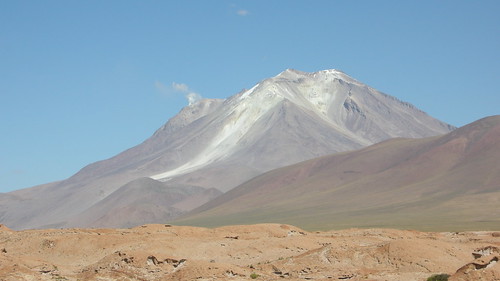
    <del>Uturuncu volcano</del> A volcano near Uturuncu, in Bolivia.
    Uturuncu volcano A volcano near Uturuncu, in Bolivia.  Photo CC BY-SA by einalem.

    Uturuncu is in a remote part of the Bolivian Andes, and hasn't erupted for the last 271,000 years.  However, InSAR (satellite) measurements have shown it to be inflating by 1-1.5 cm/year, which is quite fast.  Modelling this deformation shows it is most likely in response to some increase in volume 15-17 km bellow sea level (21-23 km below the summit).  There is a zone of material at this depth where the velocity of seismic waves is found to be low compared to solid rock, and this implies it is partially molten (at least 14-27% melt, likely in some sort of crystal mush).  This suggests that the inflation is due to the injection of fresh magma.

    This recent study placed a temporary network of seismometers around Uturuncu in order to map out the locations of any earthquakes that might be there.  They then did three things with it: attempted to determine the cause of the seismicity; used the low-level seismic noise to calculate some the structures found beneath the volcano; and looked at the effect of the 27 February magnitude 8.8 Maule earthquake.  With respect to the Maule earthquake, the team recorded the seismic waves as they arrived.  They found that these waves triggered a swarm of small earthquakes.  This has been observed before, and doesn't tell us much about the volcano itself, so I shall leave the discussion at that and move on to the cause of the earthquakes.

    They recorded on average three earthquakes a day, although several times a month there would be a swarm of 5-60 within a few hours.  The largest was a magnitude 3.7.  The earthquakes clustered around the summit, at depths of around sea-level (The summit of Uturuncu is 6,008 m above sea level).  This is much shallower than the source of the inflation, so are the two related?

    The first question is why do the earthquakes not descend deeper?  Globally, earthquakes are almost always found in the shallow crust.  In order to get earthquakes, the rocks must deform brittlely, that is by cracking or snapping.  Deeper in the crust, rocks deform ductilely, by flowing.  Different rock types will behave slightly differently, but the biggest controls on whether a rock flows or breaks are the temperature and the rate at which they are strained.  At Uturuncu we know the stain rate, so if we can calculate the temperature profile with depth then we can work out at what depth this brittle-ductile transition should be.

    Fortunately, the temperature profile of the crust is easy to estimate (especially for shallow depths) as long as we know the amount of heat flowing out of the surface of the ground, the heat flux.  This is not that well known for Uturuncu, but it has been estimated to be between 100-200 milli-Watts/m2 which is quite high for continental crust but not so surprising if there is a large magma chamber 20 km below the surface.  Using these values, the measured strain rate two different rock types that are likely to be found beneath Uturuncu, the team came up with a depth of 8.5-0.8 km below sea level.  The reason there are no earthquakes below sea level is that rocks at that depth behave ductilely, and flow rather than break.  You can also see that further away from the summit the earthquakes go to greater depths; further away from the summit there is less heat transmitted up from the magma chamber 17 km below.  This made them reject their other possible explanation as unlikely.  You often see a sharp cut-off in earthquakes with depth directly above a magma chamber, as the solid rock above can break brittlely but the magma, as a liquid or mush, flows.  Because the shallow depths of the earthquakes can be explained by the brittle-ductile transition, there is no reason to believe there is a shallow magma chamber as well as the deep one.

    So what is causing these earthquakes?  They resemble tectonic earthquakes, caused by faults slipping under stress rather than the earthquakes caused by fluid moving (the other major cause of earthquakes on volcanoes).  The team provided three lines of evidence to support this.  Firstly the frequency of the seismic waves produced by the earthquakes was closer to those from tectonic earthquakes.  Secondly, looking at the number of earthquakes of each magnitude, they found that the distribution more closely resembled that of tectonic earthquakes than those caused by fluids.  Finally, the earthquakes were aligned NW-SE.  Most of the regional faults are also aligned NW-SE, suggesting that regional faults are the ones that are active at Uturuncu.

    The other option, rather than regional faults, is that it could be the hydrothermal system that was causing the earthquakes.  This happens at other volcanoes, notably the Campi Flegrei caldera outside Naples.  There is also an active hydrothermal system at Uturuncu, as shown by fumaroles.  Using the seismic waves arriving at their seismometers the team imaged an area of low seismic velocity under the volcano that likely corresponds to the system at depth.  However, for the reasons discussed above it is likely that the hydrothermal system at Uturuncu only plays a small part in the earthquake activity there.  The most likely explanation for the seismicity is that the inflation is activating pre-existing regional faults.

    Should we be worried by the seismicity?  To answer that question we need to first know if the seismicity is unusual, for either Uturuncu or other similar volcanoes.  It is difficult to say what is normal for Uturuncu.  There have only been two previous seismic surveys, one in 1996-1997 and one in 2003.  As none of these used the same methods or stations, comparisons are also difficult, however it appears there has been little change in the seismicity for the last 14 years.  Looking further afield, this style seismicity doesn't seem that unusual at large volcanoes, and doesn't necessarily precede an eruption.

    It is becoming clear that magma injection, like what is currently happening at Uturuncu, often occurs before an eruption.  Indeed, it is likely that it triggers some eruption.  However, the injection of magma doesn't always lead to eruption at the surface.  We don't have enough experience of eruptions of this sort to really tell what is going to happen.  While an eruption of Uturuncu is not going to lead to the end of the world, especially as it is so remote, it could still cause us problems.  I wouldn't loose too much sleep over it, but it is definitely a volcano to watch closely.

    Reference:

    Jay, J.A. et al., 2011. Shallow seismicity, triggered seismicity, and ambient noise tomography at the long-dormant Uturuncu Volcano, Bolivia. Bulletin of Volcanology, in press. DOI:10.1007/s00445-011-0568-7


    Comments

    Fitzgabbro
    Hi Gareth,

    That's a great explanation of the tools and the science behind the current efforts to understand what is going on at Uturuncu. Your explanation of ductility versus brittle rock earthquakes at depth gave me a great visual depiction of what a volcano's plumbing system might look like as one looks deeper. The below sea-level matter is very interesting, as well. You have an excellent way to make the science more accessible. Thank you for that.

    I have a couple of questions:

    First, if I understand the geology correctly, the Andes, including the area where Uturuncu is located, is part of an uplift caused by the subduction of one plate under another. Somehow in that region, magma is forced upward toward the surface forming the arc of volcanoes in the Andes. Is the 40-mile-wide area of uplift and magmatic activity beneath Uturuncu directly related to the subduction forces?

    Second, many websites have chosen to imbue apocalyptic proportions to the global effects of a major, caldera-forming eruption of Uturuncu. They have a much more fertile imagination than I have. Either that, or they have watched way too many horror movies... Would you help to set the record straight and describe what kinds of problems it could "cause us" if such an eruption took place?

    Best again,
    Moishe
    Fitzgabbro
    This comment got stuck in moderation, I couldn't work out how to get it to post apart from posting it myself.

    To answer your questions:

    The height of the Andes is due to uplift caused by subduction forces, like you say.  I don't know whether the part of the Andes around Uturuncu is still being uplifted like this, but the 40 mile wide area of deformation around the volcano itself is on top of any regional movement.  The fact that the deformation is concentrated and dome shaped suggests it isn't directly subduction related, but rather due to the expansion of something at depth (probably magma injection).

    The possible problems that the eruption of Uturuncu could cause really deserves its own post (I might write one on that next).  Of course, Uturuncu may not even erupt, which would make this discussion rather academic.  However, there does appear to be a large amount of magma down there, and it is surrounded by volcanoes that had large eruptions in the past, so there is the potential for something spectacular to happen.  Much of what I am going to say is speculation on my part, so don't take it as scientific fact

    Large eruptions di lead to short-term global cooling.  My guess would be, in a worse-case scenario, maybe 1-2ºC cooling for 1-2 years after the eruption.  This would lead to greater rates of famine around the world, which may well kill large numbers.  Bear in mind, though, that we have seen this sort of thing before.  Think of Krakatoa and Tambora, or the "year without a summer".  The world didn't end then, I doubt it will this time, even if Uturuncu is somewhat larger.  In my opinion, we would be better off worrying about the poverty that makes countries vulnerable to famine rather than worrying about the apocalypse.

    Of course, speculation over, the larger the eruptions the rarer they are in the geological record and so the less likely they are to happen in the future.
    Hi Gareth,

    Thanks for providing a more "sane and informed" answer to the question about the problems an eruption of Uturuncu might cause. I am grateful.

    I'm not so worried over a major eruption of Uturuncu, because there really is very little that any of us could do about it if it did, so it seems to me that carrying on with life is better than worrying about what that eventuality might bring to our doorstep. Living life squeamishly and in fear is not very appealing.

    I lived near, camped in and traveled through Long Valley caldera when I was a kid, hence my interest in what happens in these large systems. To make sense of Uturuncu, I'm trying to understand it in terms of what I know about LV.

    In terms of size, Uturuncu's area of uplift appears to be between the size of Yellowstone caldera and Long Valley caldera. It appears, as well, that the type of magma (high in SiO2) is roughly consistent between them. On the western rim of LV, Mammoth mountain is emitting certain gasses that indicate that magma is present and on the move. Are gasses also being measured at Uturuncu? If so, are the gasses measured at a caldera different than, say, on a stratovolcano like Mt. St. Helens, or a shield volcano like Mauna Loa?

    Thanks again,
    Yak

    Fitzgabbro
    Long Valley gives a reasonable approximation to the sort of eruption that Uturuncu may have, although its unlikely that Uturuncu will be that big.  The area that deforms doesn't simply correspond to the size/shape of the magma chamber below, the rocks above bend and inflate outwards as well as up (think of your chest as you breath in).

    As far as I am aware the gasses at Uturuncu are not being measured, it is too remote and in too poor a country.  Jay et al. reported active fumaroles there, so there is some degassing.  However, that could just be from a shallow hydrothermal system, recycling and heating up rainwater.

    The composition of the gasses emitted during quite periods doesn't tell us much about what the next eruption will be like.  The gas content of the magma is very important in controlling the eruption style, but it is the gas that remains in the magma that matters, not that which is released.  What changes the composition the most is the depth the magma is sitting at, some gasses get released at depth, others stay in the magma until it gets shallower.  From what I've read about Mammoth Mountain it is mainly CO2 that is being released.  This shows there is magma down there, but I don't think there has been any signs of it moving any closer to the surface.  For Uturuncu I don't think anyone has checked.
    Gareth,

    While reading your article on seismicity, I was intrigued by your description of various physical states of magma and surrounding rock, and wondering about the seismic profile of an active caldera versus say, a stratovolcano.

    I understand that there are several kinds of tremors that correspond to magma movements or changes at various depths under a volcano. Out of the short-period, long-period and harmonic tremors, the long-period seismic waves appear to be a kind of broad indicator of an impending eruption of a stratovolcano.

    Given their larger size construction, do calderas operate in the same way seismically?

    Thanks!
    Yak

    When I look at pictures of Uturuncu volcano, like the one you have here, it doesn't appear to be very tall.
    It's prominence looks to be maybe a thousand or so feet. Is that the case?

    thanks, Yak

    Fitzgabbro
    I've never been to Uturuncu.  It is 6,008 m tall (19,700 feet), but much of the Andes, especially the Altiplano, are at 4,000 to 5,000 m (13,000-16,500 feet), so it probably isn't much higher than the surrounding area.
    As always a very interesting article from you! Thanks for a great read at breakfast here!

    I just now found your blog, by google-search on Uturuncu. Great article and well written! Thanks.

    After seeing the topics of posts you have written, I'm now looking forward to reading everything you have here!

    Magma Chambers I and II, here I come! :)

    Hi
    the photograph from the article (by einalem) shows the volcano "Ollagüe", not the Uturuncu!
    Uturuncu coordinates: 22° 16′ 12″ S, 67° 10′ 48″ W
    Regards
    Rolf

    Fitzgabbro
    I thought it didn't quite match up with the photo in the paper, but I couldn't find any other photos that were free to use.  The picture is just for illustration, but I've changed the caption now.  Thanks for spotting it!

