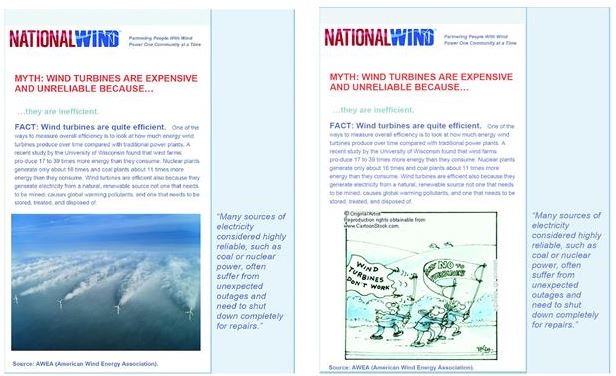
Though photos are considered more credible, if you are evangelizing a controversial energy type like wind, a cartoon may appear more persuasive.
In a recent study, participants were shown one of two versions of the same set of brochures. Each set was designed to debunk a myth about wind energy, the intent being to give readers desired information about wind energy and assuage their concerns. Each pair of brochures was identical in design, text, color, size, etc.
The only difference was that the originally designed brochures featured a beautiful, professional photograph of wind turbines, while the look-alike brochures created for the study swapped out the photograph with a cartoon.
Solar power is all the rage, at least for government officials who don't understand physics but do spend a lot of time with environmental (and solar panel) lobbyists.
Even in a small country like Belgium, solar can't even meet half of energy needs. In order for it to meet energy needs would require batteries, and that means doubling the cost for the public. If it were implemented in a large country like America, the cost would be astronomical, and that's without adding new transmission lines equivalent to every paved road in the U.S.
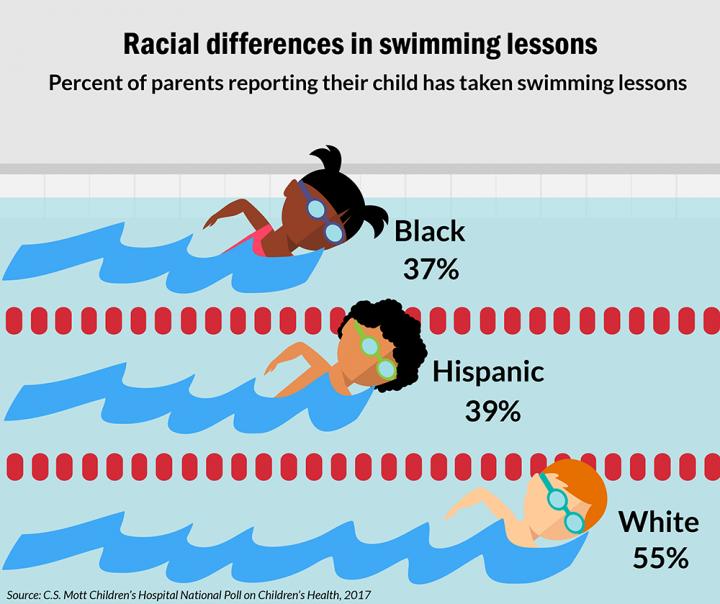
A new national poll says that parents are in a panic about things like swimming pools.
Least likely to think their kids can swim; black parents. A slight majority of white parents are fine with kids swimming sans parental hovering. Almost all parents think a natural lake (84 percent) or ocean (87 percent) , lacking concrete and a diving board, is too dangerous to be allowed. Only 63 percent would even allow kids to swim in their backyard.
Granted, pools can be dangerous, with some 5,000 child and teen injuries a year and around 1,000 drowning deaths occurring, but it shows we are bad at evaluating risk. Sharks attack fewer people than cows do, but who do you think parents worry more about after Shark Week?
We are at the top of the food chain, but some of our senses got short shrift when it came to other animals. Dogs can hear at frequencies we can't, mantis shrimp got 16 visual pigments and we are stuck with just 3.5, and don't even get other animals started on our pathetic sense of smell.
But a weak nose in humans is really just a 19th century myth that won't go away, like homeopathy and organic food, according to a new analysis. Instead of being limited to a paltry 10,000 odors, humans can discriminate maybe one trillion different ones, the same as dogs and rodents.
The faulty persistent claim is thanks to Paul Broca, a 19th century brain surgeon and anthropologist as the culprit for the falsehood that humans have an impoverished olfactory system.
Yesterday I visited the Liceo “Benedetti” of Venice, where 40 students are preparing their artwork for a project of communicating science with art that will culminate in an exhibit at the Palazzo del Casinò of the Lido of Venice, during the week of the EPS conference in July.
The National Commission on Forensic Science was dissolved by Attorney General Jeff Sessions in a decisive action that brought an end to a highly decorated body of professionals, but one that was frequently stymied by legal gamesmanship and discord. The commission, a precipitant of the Obama administration's criminal justice reform efforts, was curiously loaded with trial attorneys, law professors, and other academicians but relatively few forensic scientists.
There has been some ongoing concern about bee colonies, even fears of an impending "colony collapse disorder", but both the fears and the causes have been misplaced, recent studies have shown.
Rather than being a mysterious effect due to pesticides (like neonicotinoids) slight variations in bee populations remain the fault of parasites. Yet that brings its own mystery. Varroa mites, the biggest culprit, are not very mobile.
A little while ago I encountered an interesting problem, which I had fun solving by myself. I think my solution is not original (it must have occurred to others a gazillion times in the past) but I do believe the implementation is nice, so I want to share it with you here.
The general problem
Imagine you are given a set of counts distributed in bins of a histogram. This could be, for instance, the age distribution of a set of people. You are asked to assign uncertainty bars to the counts: in other words, estimate a "one-sigma" interval for the relative rate of counts in each bin.
When "Guardians of the Galaxy" was in development, I was skeptical. When I was a kid, they were simply different Avengers, in space. Seriously, they had a Major from America, an archer, a strong guy, etc. And everyone knows Marvel had sold off the movie rights to the popular characters to prevent bankruptcy so they had only B level characters left.
But one of those B-level characters was Iron Man, and Jon Favreau, Robert Downey, Jr. and a whole team of four writers (usually a bad sign) turned in arguably the best superhero movie of all (1). And it just so happened other B-level characters made up The Avengers, and a boom was born.
Atrial fibrillation and flutter (also known as AFF) is associated with serious health problems and is a significant contributor to death rates. Knowing that, why would there be different death rates for male and female patients who presented with AFF to emergency departments and then discharged? Even 30 and 90 days after discharge.
AFF is an irregular heartbeat (arrhythmia) that is associated with blood clots to the brain (e.g., stroke) and other organs, heart failure, and sometimes death. It affects approximately 2.66 million Americans.