Yesterday's event at TEDx in Antwerp, in the gorgeous Flemish Opera, was followed by an enthusiastic audience of 1000. I spoke in the afternoon and tried to explain what it is that we do at CERN with these protons and the complicated machines we use. I must say I had never spoken in front of such a large audience (although I had played the fourth Brandemburg concerto by Bach a few times in front of similar numbers, but that was 30 years ago), and my heart rate went to about 160 for the whole duration of my speech. I went blank a couple of times (forgot the succession of things I wanted to say from my script, that is), but nobody noticed, and it was a great performance according to the listeners and the organizers.
So, as I had announced a bit prematurely three days ago, the
Opera experiment is about to release the results of a measurement that is bound to stir endless discussions.
"Excluding wrong Higgs boson mass hypotheses is starting to feel like explaining how to make the chocolate mousse by compiling a list of all the wrong ingredients."
T. D., TEDx Flanders, Sept. 24th 2011
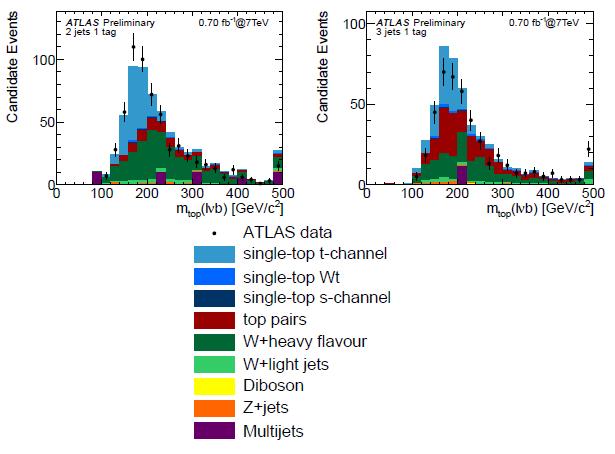
A well-known HEP rule says that yesterday's searched new processes will be tomorrow's annoying irreducible backgrounds; but since I am an optimist, I always see the glass half-full and feel compelled to add that today they are pleasing high-statistics signals. Take single top quark production: the Tevatron experimentalists (you can include me in the lot) banged their head for a decade trying to measure it; they finally succeeded, but the signal always remained a small excess of events in the tail of a highly-refined multi-variable discriminator.
[Introduction: I published the text below last Monday, when the news of this controversial new measurement had spread in the corridors of physics departments, as well as in the threads of popular HEP blogs. I felt I was not doing anything wrong, since all I was reporting were facts, with a cautious opinion on my part. I was however forced to take it down only a few hours afterwards, due to a kind of pressure I could not ignore, my own job being at stake. I understand that the experiment who did this measurement was not too happy to see the news in print before they wanted to, but then again the fault is theirs. And in retrospect, what damage did I cause with the post below ?
The Collider Detector at Fermilab, CDF for insiders, is the longest lasting physics experiment ever (yes, I know about the pitch drop and no, I do not consider that a physics experiment). Designed in 1979, it was assembled in the early eighties, and operated since 1985 to 2011. Now, in two weeks it will stop data taking, and soon will be decommissioned.


 A Great Year For Experiment Design
 Living At The Polar Circle
 Conferences Good And Bad, In A Profit-Driven Society
 USERN: 10 Years Of Non-Profit Action Supporting Science Education And Research