
Fake Banner
Conferences Good And Bad, In A Profit-Driven Society

Nowadays researchers and scholars of all ages and specialization find themselves struggling with...
USERN: 10 Years Of Non-Profit Action Supporting Science Education And Research

The 10th congress of the USERN organization was held on November 8-10 in Campinas, Brazil. Some...
Baby Steps In The Reinforcement Learning World

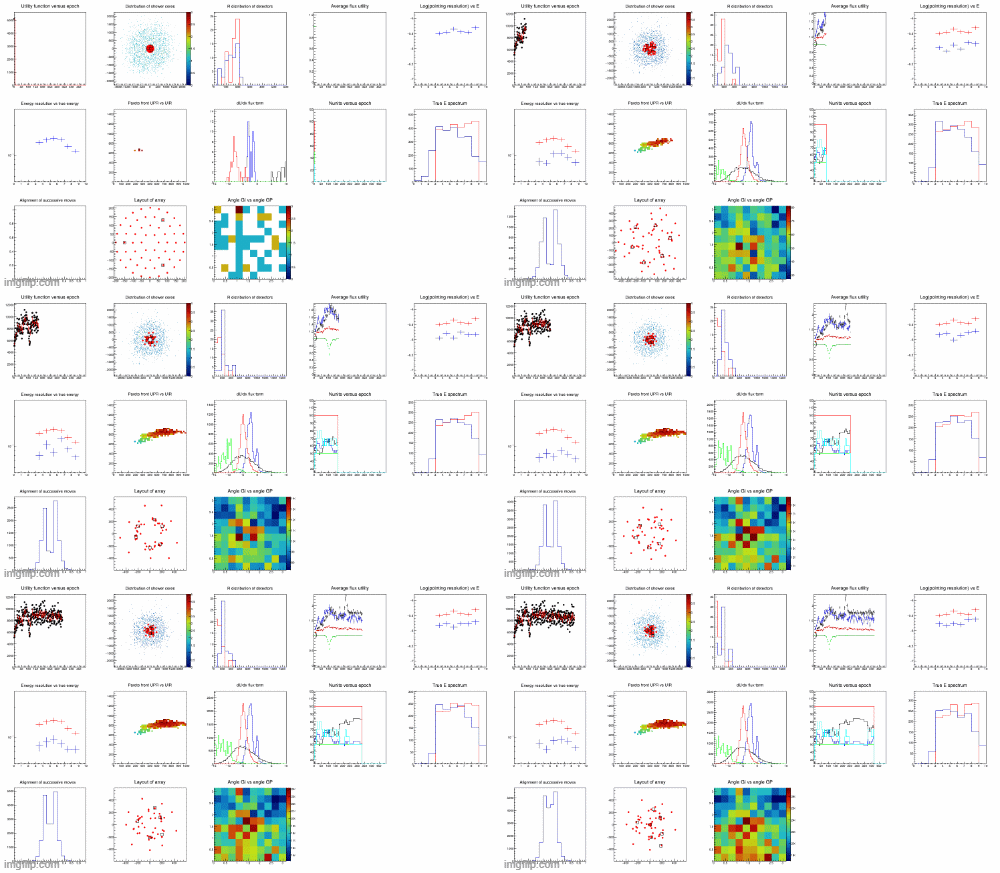
I am moving some baby steps in the direction of Reinforcement Learning (RL) these days. In machine...

Restoring The Value Of Truth

Truth is under attack. It has always been, of course, because truth has always been a mortal enemy...

User picture.
picture for Hank Campbellpicture for Patrick Lockerbypicture for Heidi Hendersonpicture for Bente Lilja Byepicture for Sascha Vongehrpicture for Johannes Koelman
Tommaso DorigoRSS Feed of this column.

Tommaso Dorigo is an experimental particle physicist, who works for the INFN at the University of Padova, and collaborates with the CMS and the SWGO experiments. He is the president of the Read More »

Blogroll
Americans, but in general scientists, and science-lovers of any country, should be proud of the achievements of the Tevatron collider, the 2-TeV proton-antiproton collider build over a quarter of a century ago under the prairie of Batavia (IL), and which is still the world's most powerful, and may I say successful, particle accelerator ever built by humans.
"Brezhnev, Andropov, Chernencko: these three premiers of Soviet Union unexpectedly died around 1984, such that Gorbachev could lead the process that ended with the fall of Soviet Union, such that the US congress stopped funding the SSC, such that the Higgs was not discovered.

According to the new theory of backwards causation, you should be proud of having destroyed communism
."
Many thanks to Dennis for linking, from the NYT site, an article I wrote one year ago to comment a crackpotty paper by an otherwise esteemed scientist.
The essay just appeared on the New York Times site is excellent, as always with Overbye, but it is also way more balanced than my rather vitriolic attack on the theory of backward causation and, in particular, the idea that one should use the Large Hadron Collider to test it by deciding to run or not to run based on the turn of a card.
The web site of the Cornell preprint archive, arxiv.org, says it best: successful submissions to the preprint archive are a source of considerable pride (darn it, the page with the exact statement is only available just after you submit a paper, so I cannot quote it literally here since my browser has by now forgotten it!).
Ah, the pleasure of study! I had forgotten the immense intellectual pleasure one may derive by reading a stimulating, informative book. And if half a lifetime has passed from the last time you studied something, and what is left in your brain of it is just Culture, then reading it back again combines the pleasure of the discovery (a rediscovery, in this case) with the one of putting things in perspective, combining the bits of information you recollect with all the knowledge you have acquired since the last time you put the book down.
"It turns out that any optimal classical decision rule is also some Bayesian rule. In other words, even if the decision maker is not a Bayesian, he will behave as if he were!"

Frederick James, Statistical Methods in Experimental Physics




