Fake Banner
Conferences Good And Bad, In A Profit-Driven Society

Nowadays researchers and scholars of all ages and specialization find themselves struggling with...
USERN: 10 Years Of Non-Profit Action Supporting Science Education And Research

The 10th congress of the USERN organization was held on November 8-10 in Campinas, Brazil. Some...
Baby Steps In The Reinforcement Learning World

I am moving some baby steps in the direction of Reinforcement Learning (RL) these days. In machine...

Restoring The Value Of Truth

Truth is under attack. It has always been, of course, because truth has always been a mortal enemy...

User picture.
picture for Hank Campbellpicture for Patrick Lockerbypicture for Heidi Hendersonpicture for Bente Lilja Byepicture for Sascha Vongehrpicture for Johannes Koelman
Tommaso DorigoRSS Feed of this column.

Tommaso Dorigo is an experimental particle physicist, who works for the INFN at the University of Padova, and collaborates with the CMS and the SWGO experiments. He is the president of the Read More »

Blogroll
After over one year of forced confinement, due to the still ongoing Covid-19 pandemic, academics around the world seem to have settled down on the idea that after all, we can still do our job via videoconferencing. We had to adapt to the situation as everybody else, of course, and in a general sense we are a privileged minority - other human occupations which are only possible in person suffered way more.
One of the reasons why I love my job as a researcher in experimental physics is that every day brings along a new problem to solve, and through decades of practice I have become quick at solving them, so I typically enjoy doing it. And it does not matter whether the problem at hand is an entirely new, challenging one or a textbook thing that has been solved a million times before. It is your problem, and it deserves your attention and dedication.
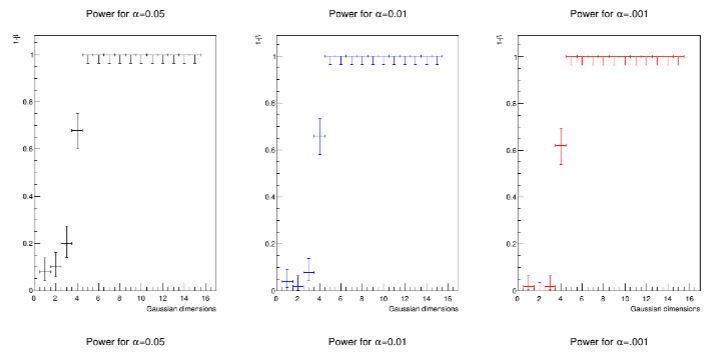
In the previous post I mentioned a research project that I was about to conclude, centered on the detection of anomalies in multidimensional data. Here I would like to give some more detail of that research, as the article I wrote on the subject is now publically accessible in the Cornell preprint arXiv (and is being sent to a refereed journal).
Usually, when we talk about our research we discuss things we have recently published, highlighting the importance or novelty of their contribution to the advancement of human understanding or knowledge of the specific field of Science we work on. 


So it is only normal for me to try and go against that particular cliché here, and talk about things I will publish in the future. Admittedly, it is a bit of a mine field (it is never easy to be an anticonformist), but I will try to avoid stepping on the most obvious triggers (violations of confidentiality, scooping risks, impossible promises).


1. A new tool for anomaly detection
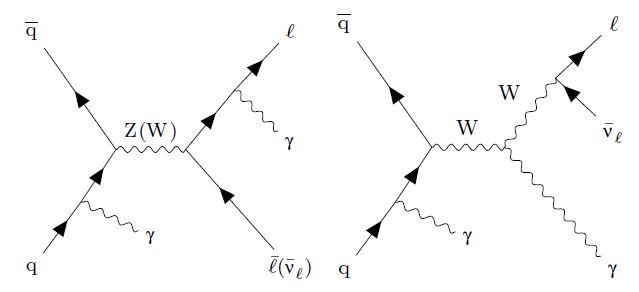
The CMS Collaboration submitted for publication last week a nice new result, where proton-proton collisions data collected by the experiment during the past run of the Large Hadron Collider were scanned in search of very peculiar events featuring a weak boson (W or Z) along with two energetic photons. The rate of these rare processes was measured and found in good agreement with predictions of the Standard Model of particle physics.

The title of this post coincides with the one of a scientific report which was submitted for publication in Reviews in Physics last Sunday; and it is also the meaning of the acronym "AMVA4NewPhysics", the name of an European Union-funded Innovative Training Network I directed as scientific coordinator from 2015 to 2019.