Fake Banner
Conferences Good And Bad, In A Profit-Driven Society

Nowadays researchers and scholars of all ages and specialization find themselves struggling with...
USERN: 10 Years Of Non-Profit Action Supporting Science Education And Research

The 10th congress of the USERN organization was held on November 8-10 in Campinas, Brazil. Some...
Baby Steps In The Reinforcement Learning World

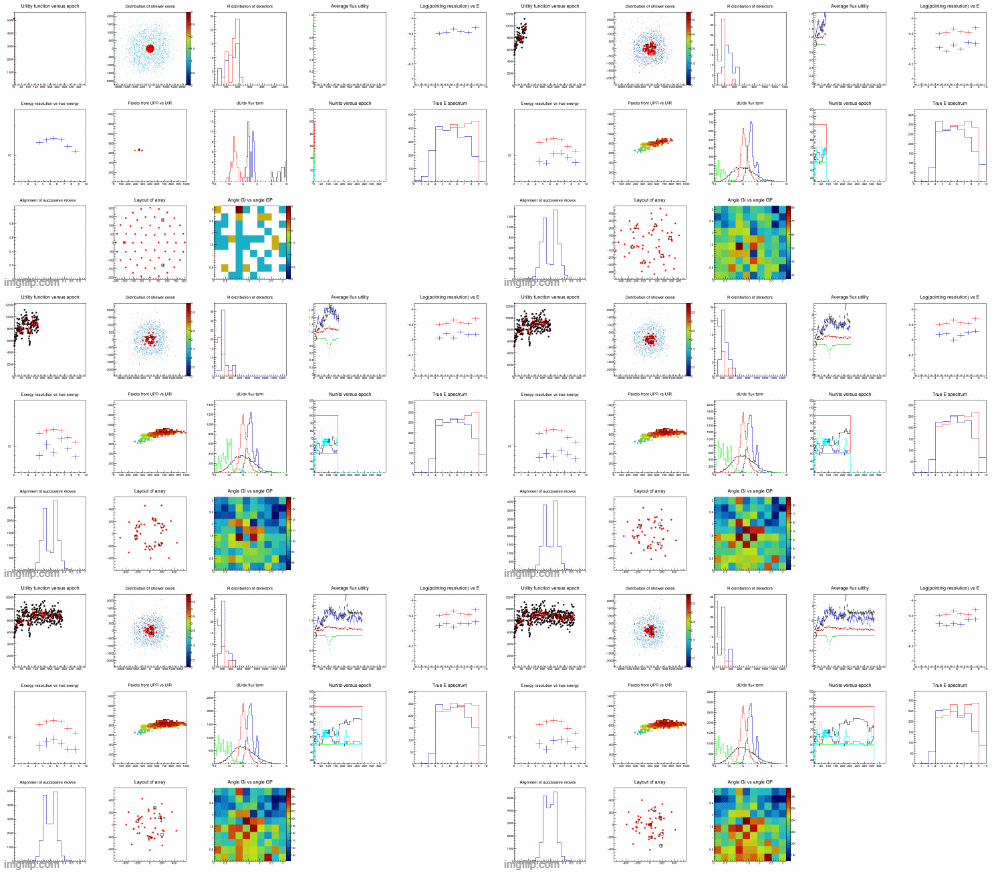
I am moving some baby steps in the direction of Reinforcement Learning (RL) these days. In machine...

Restoring The Value Of Truth

Truth is under attack. It has always been, of course, because truth has always been a mortal enemy...

User picture.
picture for Hank Campbellpicture for Patrick Lockerbypicture for Heidi Hendersonpicture for Bente Lilja Byepicture for Sascha Vongehrpicture for Johannes Koelman
Tommaso DorigoRSS Feed of this column.

Tommaso Dorigo is an experimental particle physicist, who works for the INFN at the University of Padova, and collaborates with the CMS and the SWGO experiments. He is the president of the Read More »

Blogroll
Quantum Mechanics (QM), the theory that describes the behaviour of matter at microscopic distance scales apparently unfathomable by our senses, is very hard to understand and make sense of. And indeed to this day, 100 years after its first formulation, there are thick debates among theorists on the very meaning and interpretation of the wave function, which is the mathematical description of a quantum system. Yet we deeply rely on QM to figure out the organization of matter at molecular, atomic, and subatomic level. It works, despite the open questions. And today we deeply rely on QM for our technology.
While exchanging ideas with a dear colleague of mine on possible applications of differentiable programming to the optimization of the design of detection instruments, I came about an interesting, crazy idea which, since I do not have enough time to investigate at the moment, is only suitable for this blog. 

The rationale is that if it is a viable, patentable idea worth something, once it is published here it becomes of public knowledge and hence non-patentable anymore... Which in turn means nobody owns it, and it can be exploited without problem, like the Salk vaccine.
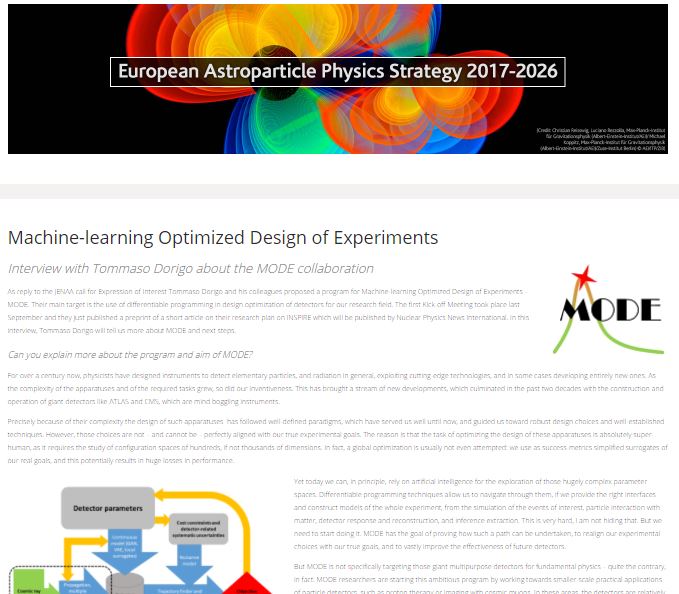
A few weeks ago I was interviewed by Katrin Link for APPEC, the Astro-Particle Physics European Consortium. APPEC is a consortium of 19 funding agencies, national government institutions, and institutes from 17 European countries, which is responsible for coordinating and funding national research efforts in astroparticle physics. 

The interview stems from the help that the JENAA group (a joint effort of APPEC, NuPECC and ECFA) is trying to offer to the research plan of the MODE collaboration, a group of physicists and computer scientists for which I am serving as the scientific coordinator.


Design and purpose are definitely not two things that scientists consider as their guiding ideas in trying to decypher the fabric of our Universe, or of natural phenomena in general. So teleology should not belong to this blog, I agree.
Today the University of Padova has issued a call for Ph. D. positions to start in October 2021, and the Department of Physics and Astronomy has 23 new openings. The English version of the call page is here.
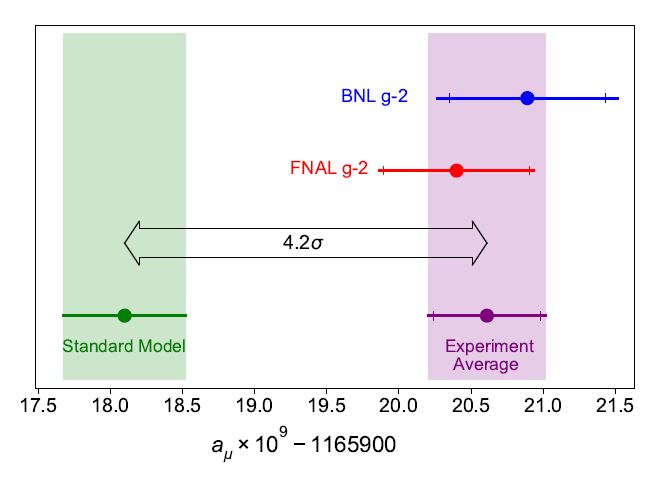
Note: this is an updated version of the article. For the original discussion of the muon anomaly, published before the release of results, please scroll down.