Fake Banner
Living At The Polar Circle

Since 2022, when I got invited for a keynote talk at a Deep Learning school, I have been visiting...

Conferences Good And Bad, In A Profit-Driven Society

Nowadays researchers and scholars of all ages and specialization find themselves struggling with...
USERN: 10 Years Of Non-Profit Action Supporting Science Education And Research

The 10th congress of the USERN organization was held on November 8-10 in Campinas, Brazil. Some...
Baby Steps In The Reinforcement Learning World

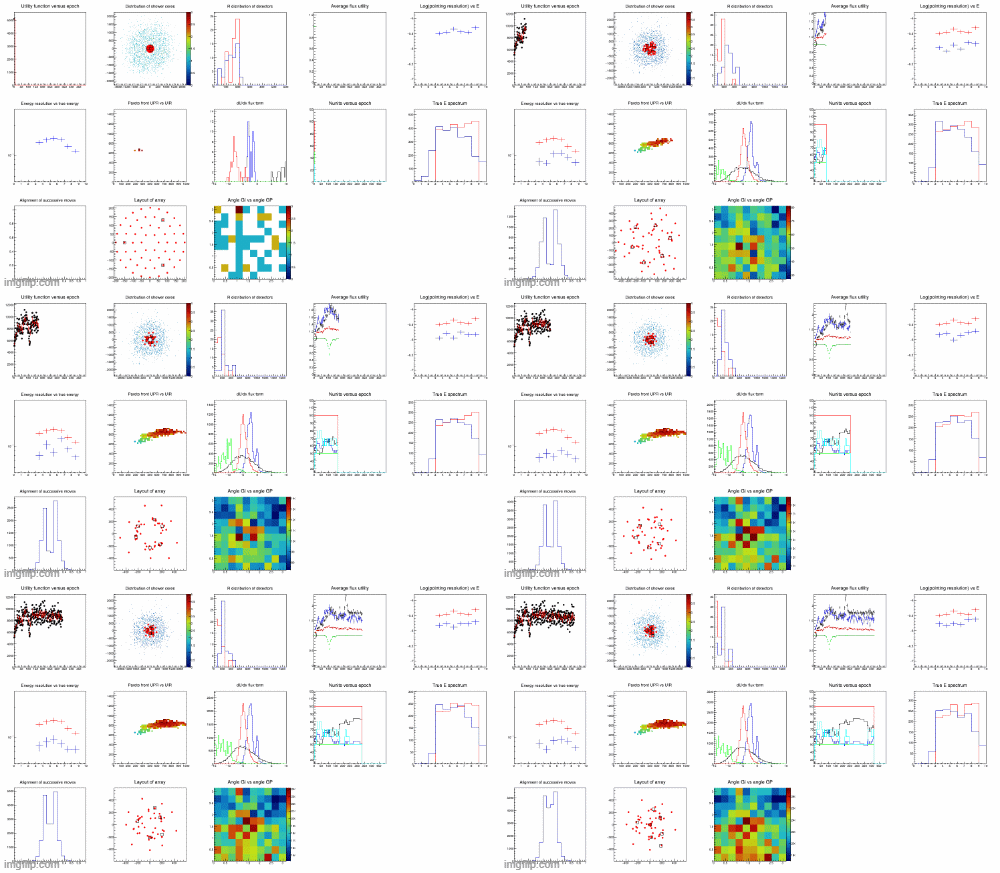
I am moving some baby steps in the direction of Reinforcement Learning (RL) these days. In machine...

User picture.
picture for Hank Campbellpicture for Patrick Lockerbypicture for Heidi Hendersonpicture for Bente Lilja Byepicture for Sascha Vongehrpicture for Johannes Koelman
Tommaso DorigoRSS Feed of this column.

Tommaso Dorigo is an experimental particle physicist, who works for the INFN at the University of Padova, and collaborates with the CMS and the SWGO experiments. He is the president of the Read More »

Blogroll

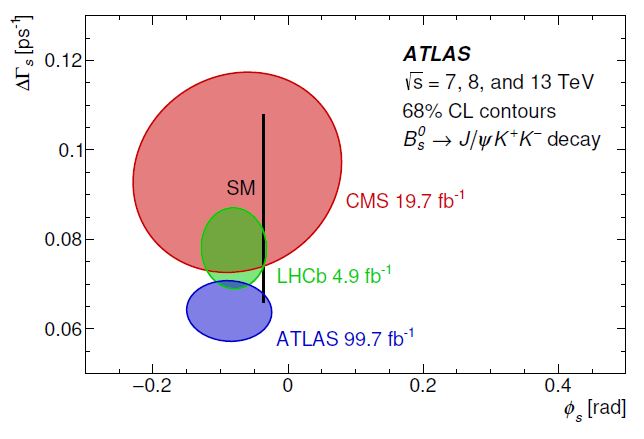
The ATLAS Collaboration has released last week the results of a careful analysis of a large dataset of proton-proton collisions acquired during Run 2 of the Large Hadron Collider. This is a measurement of CP violation effects in the system of B hadrons.

Although LHC and ATLAS are things that readers of Science20 may be acquainted with, I realize that the previous 14-word sentence contains already a mention of at least four unknown entities to 99.99% of non specialists, so I suspect I have to open a parenthesis already now.

One of the most suprising results of the "Machine Learning for Jets" (but really, for particle physics in general) workshop I attended in New York City two weeks ago was the outcome of a challenge that the organizers had proposed to the participants: find a hidden signal of some new physics process in a dataset otherwise made up of some physics background, when no information on the new physics was given, nor on the model of the background.<\p>

The third "Machine Learning for Jets" workshop is ongoing these days at the Kimmel centre of New York University, a nice venue overlooking Washington Square park in downtown Manhattan. I came to attend it and remain up-to-date with the most advanced new algorithms that are been used for research in collider physics, as I have done last year. The workshop is really well organized and all talks are quite interesting, so this is definitely a good time investment for me.

What hurts you is not what you don't know, but those mistaken assumptions which "everyone knows to be true".
[The following text is courtesy Andras Kovacs - T.D.]
Although you probably did not notice, this blog has been inactive during the past three weeks. The reason is simple: I took a break, treating myself to a 24-day trip to Thailand and the Philippines. Anticipating that many of the places I would visit would offer non-existent or very bad internet connection, I decided that it was going to be frustrating to pretend I could blog during the trip, and just left my laptop at home (or rather, in the Bangkok hotel which I first visited for a conference, before leaving for the tour).
I am currently in Bangkok, where the final 2019 meeting of the CMS collaboration started today. The meeting was inaugurated this morning with an official visit of Her Royal Highness Princess Maha Chakri Sirindhorn, giving me the rare opportunity to miss an appointment with a princess, something that was still missing from my repertoire. Checked now.