





China’s growing participation in international trade has been one of the most prominent features of its economic reform. It is the world’s third-largest exporter, and the fastest growing exporter among members of the World Trade Organisation (WTO), which it joined in December 2001.

The secret of China’s exporting success may lie in unfair production subsidies, according to new research presented at the Royal Economics Society annual conference by a team from The University of Nottingham’s Globalisation and Economic Policy Centre (GEP).

The economists behind the research say it raises serious questions about whether China is being fair with its trading partners.

Sleep apnea is a condition characterized by temporary breathing interruptions during sleep, in which disruptions can occur dozens or even hundreds of times a night. According to the National Institutes of Health, it affects more than twelve million Americans.

Researchers at the University of Pennsylvania School of Medicine have provided a detailed look at the molecular pathways underlying sleep apnea and found that, in an animal model of sleep apnea, poorly folded proteins accumulate in one compartment of a muscle nerve cell, which, under certain conditions, tells a cell to heal itself or destroy itself.

The vision system used to process color is separate from that used to detect motion, according to a new study by researchers at New York University’s Center for Developmental Genetics and in the Department of Genetics and Neurobiology at Germany’s University of Würzburg.

The findings run counter to previous scholarship that suggested motion detection and color contrast may work in tandem.

Whether motion vision uses color contrast is a controversial issue that has been investigated in several species--from insects to humans. In human vision, it had been widely believed that color and motion were processed by parallel pathways. More recently, however, the complete segregation of motion detection and color vision came into question.

BIRMINGHAM, England, March 19 /PRNewswire/ --

ATTN: England Editors

Community groups across England are all set to spring clean their neighbourhoods with the launch of a GBP50 million lottery-funded grants programme today, Wednesday 19 March.

The Community Spaces programme will provide grants and support to community groups wanting to make their neighbourhoods cleaner and greener. Community Spaces will help local people improve and create play areas, community gardens, parks, wildlife areas, ponds, courts and village greens.

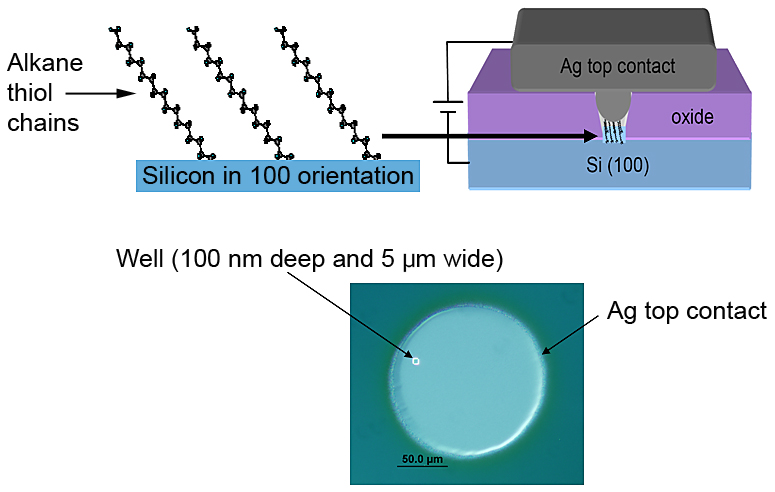
Researchers at the National Institute of Standards and Technology (NIST) have set the stage for building the “evolutionary link” between the microelectronics of today built from semiconductor compounds and future generations of devices made largely from complex organic molecules. In an upcoming paper in the Journal of the American Chemical Society, a NIST team demonstrates that a single layer of organic molecules can be assembled on the same sort of substrate used in conventional microchips.

The ability to use a silicon crystal substrate that is compatible with the industry-standard CMOS (complementary metal oxide semiconductor) manufacturing technology paves the way for hybrid CMOS-molecular device circuitry—the necessary precursor to a “beyond CMOS” totally molecular technology—to be fabricated in the near future.


Side and top views of the NIST molecular resistor. Above are schematics showing a cross-section of the full device and a close-up view of the molecular monolayer attached to the CMOS-compatible silicon substrate. Below is a photomicrograph looking down on an assembled resistor indicating the location of the well. Credit: NIST

Researchers at NIST and the Joint Quantum Institute (NIST/University of Maryland) have developed a new method for creating pairs of entangled photons, particles of light whose properties are interlinked in a very unusual way dictated by the rules of quantum physics. The researchers used the photons to test one of the fundamental concepts in quantum theory.

In the experiment, the researchers sent a pulse of light into both ends of a twisted loop of optical fiber. Pairs of photons of the same color traveling in either direction will, every so often, interact in a process known as “four-wave mixing,” converting into two new, entangled photons, one that is redder and the other that is bluer than the originals.


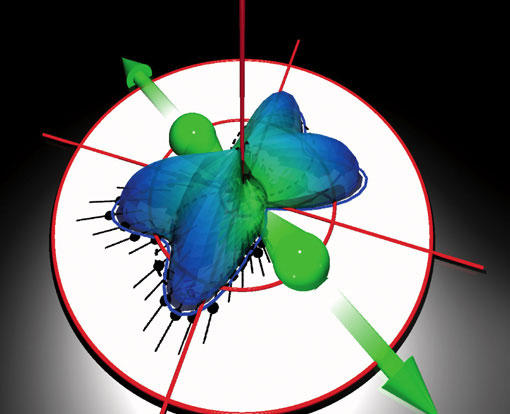
Three-dimensional view of photon-induced fragmentation of a deuterium molecule, showing the angular distribution of one ejected electron in the plane containing the molecular and light polarization axes. Another escaping electron of the same energy is emitted upwards out of the plane. The direction of the molecular axis is given by the exploding nuclei (in green). Credit: Lawrence Berkeley National Lab

If you had one hundred unlabeled DNA samples, taken from people all around the world, could you use that DNA to determine where the original donors came from?

With major improvements in genotyping technology, geneticists are now getting better and better at this game, and a recent paper in Science reports the largest study to date of human genetic diversity: 650,000 genetic differences scrutinized in nearly 1000 different individuals from 51 different populations.

Studies like this one lay important groundwork to help us understand how human genomes differ around the world, how differences in our genes and environments together make us healthy or sick, and how very ancient migrations led to the structure of today's human populations around the globe.

DES MOINES, Iowa, March 18 /PRNewswire/ --

- Bunge, DuPont Alliance on Track to Deliver First Biotech Product with Direct Consumer Benefits

New oil testing results confirm a new, improved soybean oil trait from DuPont will deliver increased nutritional benefits with broader applications than other soybean oil products currently on the market. The high oleic soybean oil trait is the next generation of improved oil products developed by DuPont business Pioneer Hi-Bred as part of the Bunge DuPont Biotech Alliance.

SCOTTSDALE, Arizona, March 18 /PRNewswire/ --

- CMD Paper on New Re-Passivation Technology to be Presented as Part of WLCSP Forum Program Track

California Micro Devices announced it would deliver a technical paper on a new CSP repassivation technology designed to minimize parasitic elements in ASIP(TM) (Application Specific Integrated Passive(TM)) products at the IMAPS 4th Annual International Conference and Exhibition on Device Packaging, March 17th through March 20th, 2008, at the Radisson Fort McDowell Resort and Casino in Scottsdale, Arizona. The presentation will be part of a technical track of papers sponsored by the Wafer Level Chip Scale (WLCSP) Forum on wafer level chip scale package board reliability.


