





What is the ultimate fate of the universe? The big crunch and the big freeze aside, what is the fate of intelligent beings in the universe? It is reasonable to assume that even if it is the case that humanity and its spawn become destroyed, then other intelligent species across the universe will nonetheless go on existing. If not all intelligent life is destroyed by the time the big freeze would render the cosmos uninhabitable, or the big crunch would obliviate all life as we know it in the universe, then hopefully at least one species in the cosmos would advance to a high enough profile of intellgience to make these occurrences avoidable.

It is the most common thing to hear people to refer to philosophy as uesless. There is even a joke about it. What's the difference between a pizza and a philosopher? A pizza can feed a family of four. Apparently the joke would suggest that society seems to have no need for philsophy, and perhaps you might hear this answer for why: most of the questions philosophy asks can't be proven one way or the other anyway, so why even bother?  But we are quickly approaching an age where we are acquring the technological means to answer that biggest question of all, which we have been putting off for so many years of human history. What is consciousness?

I base my beliefs and any predictions of off two assumptions:

Frog skin and human lungs hold secrets to developing new antibiotics, and a technique called solid-state NMR spectroscopy is a key to unlocking those secrets.

That's the view of University of Michigan researcher Ayyalusamy Ramamoorthy, who will discuss his group's progress toward that goal March 3 at the annual meeting of the Biophysical Society in Baltimore, Md.

Ramamoorthy's research group is using solid-state NMR to explore the germ-killing properties of natural antibiotics called antimicrobial peptides (AMPs), which are produced by virtually all animals, from insects to frogs to humans. AMPs are the immune system's early line of defense, battling microbes at the first places they try to penetrate: skin, mucous membranes and other surfaces.

TOKYO 02/03/2007

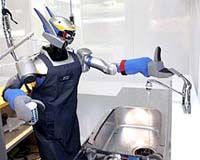
Japan's advanced humanoids can now serve tea and wash the cup afterwards, but they still need to learn from their mistakes if they are to become real household helpers.

A Tokyo University team this week showed their latest robots which can perform more complicated daily tasks, but the machines still have a learning curve.


Japan's advanced humanoids can now serve tea and wash the cup afterwards, but they still need to learn from their mistakes if they are to become real household helpers. © AFP,Ken Shimizu

The European Molecular Biology Laboratory [EMBL] has developed a new computational tool that makes images obtained with cutting-edge microscopes even sharper. The technological advance and its applications are published in this week's online issue of the journal Nature Methods.

Since the Single Plane Illumination Microscope [SPIM] was developed at EMBL in the early 2000s it turned into one of the most powerful tools in cell biology. SPIM allows scientists to study large, living specimen along many different angles, under real conditions and with minimal harm to the specimen.

Brain damage that was thought to be caused by hypoglycemic coma actually occurs when glucose is administered to treat the coma, according to a study in rodents led by researchers at the San Francisco VA Medical Center.

The results are surprising, say the authors, and may be of clinical significance for the treatment of diabetics in hypoglycemic coma, though they caution that the results cannot be immediately extrapolated to humans.

Lunar Eclipse

Lunar Eclipse

Mar 03 2007 | comment(s)

Tonight there will be a total lunar eclipse. The partial eclipse will begin at 21:30:04 UT and end  3½ hours later at 01:11:46 UT. The total eclipse lasts for about one hour; it begins at 22:43:49 UT and ends at 23:58:01 UT. The moment of greatest eclipse is at 23:20:56 UT on March 3. The eclipse will be visible over Europe, Africa, and the western part of Asia. Unfortunately, we over here in America will see only a part of it and only on the East coast.  For a more detailed schedule, click here.

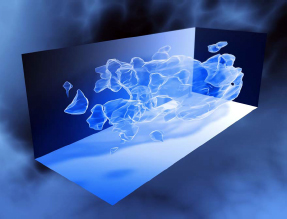
By analyzing the COSMOS field, the largest field of galaxies ever observed with the Hubble space telescope, an international team of scientists led by researchers from the California Institute of Technology (United States) and researchers from the associated laboratories of the CNRS and the CEA , made the first three-dimensional map of dark matter in the Universe using gravitational lensing effects. This historic first seems to confirm the standard theories on the formation of the large structures of the Universe. This study was presented in the January 7, 2007 issue of the journal "Nature."


Three-dimensional map of black matter in the COSMOS field. © ESA/NASA

We don't normally like to highlight people funnier than we are but we have to make an exception here - we mean Lee Silver, of course, not Stephen Colbert, though he might be pretty funny also.

Taped last summer, now you can get the six-minute lesson on stem cell research, how science is threatened by the left and the right, and why sometimes "mother nature is a real nasty bitch."

Lee Silver on Vimeo

I discovered the Scientific Blogging site while preparing the next episode of my Books and Ideas Podcast , which is going to be a discussion of Dr. Lee M. Silver 's excellent book Challenging Nature . Therefore, I must admit that I am more of a podcaster than blogger.

